Wayback Whensday: Ink Slingers – Georges Lichty and McManus
Skip to comments
In the world of comic art, artists are often dubbed ink-slingers based upon not only the volume of ink used, but the activity in which that ink is slung.
Grin and Bear It!

“Lichty works fast. His style is apparently slapdash; he pencils in outlines and features, and then brushes on tones or color. (He once said that he could finish a week’s work in two days.) But the antic drawing—the fiendish expressions, the fierce glares of disapproval, the bland arrogance of the governmental face—is the perfect medium for his antic humor.”
[Stephen] Becker had the benefit of writing about Lichty and his work during what I consider Lichty’s heyday; the 1950s. While I adore Lichty’s work during all periods, things seemed to coalesce for him artistically from the mid-to-late 1940s and into the 50s. To witness that comic strip genius on a daily basis must have been truly wonderful.

This is a perfect example of what Stephen Becker was referring to when he wrote, “…Soviet logic to a lunatic extreme…” Similar to the previous panel, Lichty has placed two figures smack in the middle of the composition, with the woman holding the wrench acting as the focal point in the cartoon. The use of her black dress adds both contrast and weight, while the rest of this slap-dash line work brings the movement. Slap-dash is often meant to convey something negative, as in something being done in a careless or haphazard way. But in Lichty’s hand, slap-dash brings the effervescence to the drawing…
Rob Stolzer has an eye and appreciation of great comic art and he considers cartoonist George Lichty is one of the best. George Lichty: The Slingiest Ink-Slinger of ‘em All! is Rob’s appreciation of Lichty. Aftr a brief biography Stolzer dives into nearly a score of Lichty’s marvelous linework panels and gags.
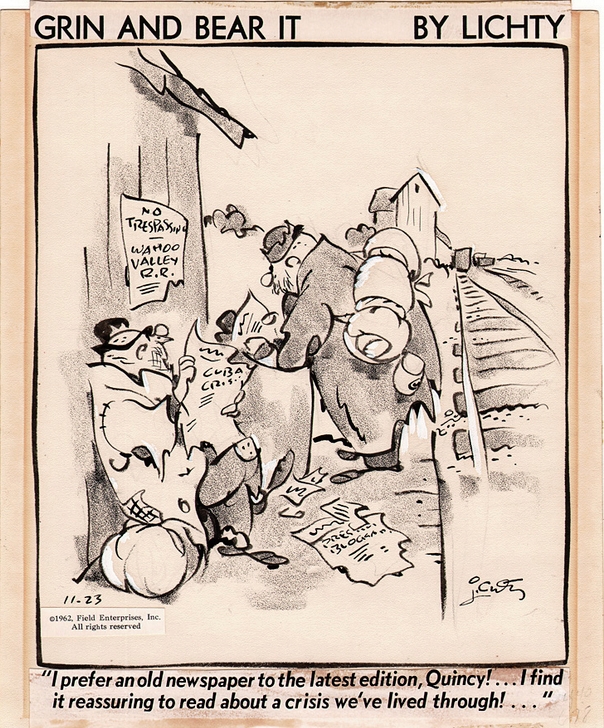
There is so much to love about this panel, from the beautifully wonky train tracks to the wonderfully delineated figures. Check out how Lichty plays with the line weight of the railroad ties as they go back in space to that also wonky rectangle that represents a boxcar. Getting back to the hoboes, Lichty always gave those figures a roundness, as if they’ve managed to lead a well-fed life. The body language is perfect, as the character sits on his bed roll, leaning back against the wall. This weird, misshapen hat sits beautifully atop his head, legs crossed; all done with a beautiful variation in thick and thin line work. And those feet! They look more like footprints than shoes, and not complete footprints at that. Yes, there is bigfoot cartooning, but in Lichty’s case, he’s both a Bigfoot cartoonist and an Abstract Foot cartoonist…
Let George Do It!
… In the eyes of the voracious publishers (benign godfathers they were, when all is said and done; or wet-nurses) there was no bigger star in their constellations than George McManus. He had attracted the attention of Pulitzer in their original working environs of St Louis; then McManus drew for Pulitzer’s New York World.
McManus the cartoonist had a short gestation as a struggling stylist; soon his artwork was polished, handsome, mannered… and funny. As a creator, he created multiple strips starring in multiple titles. His premises were funny, and his narratives flowed like stage-plays…

Rick Marschall continues his profiles of the early Hearst cartoonist bullpen with part three and a look at George McManus with “Let George Do It!” And McManus Did, Many Times Over.

…McManus created another strip for Hearst, a Sunday page called The Whole Bloomin’ Family. It is curious to note that Bringing Up Father, which commenced full-term as a Hearst feature in 1913, never was a Sunday page until six years later. After that it became the major strip among Hearst and King Features’ properties for years. It owned the front pages of the Hearst chain’s Sunday comic sections until supplanted by Blondie in the early 1950s.


Comments 4
Comments are closed.