Comic History Comic Strips

When Comic Strip Facts Go Wrong or, Dubious Internet Truths

The Washington Examiner (I know, I know) published an article this morning by Mark Judge titled “Celebrating Superman’s Jewishness.” The writer begins with people doubting Superman’s Jewishness:

Yet, in his origins, different names, and even his costume, Superman is a deeply Jewish creation. With a new Superman movie about to be released and American Jews suffering a terrible new wave of antisemitism, it’s a good time to celebrate Superman’s Jewishness — and the truth, justice, and American way he represents.

I recently spoke with Valerie Estelle Frankel, author of the book Jewish Science Fiction and Fantasy through 1945: Immigrants in the Golden Age. In her book, Frankel explores the Jewish origins of the comic book. Comic strips appeared in newspapers in the early 29th [sic] century, but in 1933, Charlie [sic] Gaines (born Max Ginsberg) had the idea to reprint the most popular newspaper comics in a booklet. It was a huge hit, and by 1939, comic books were selling 400,000 copies a month. Gaines and his assistant, Sheldon Mayer, were the original publishers [sic] of Superman.

That last paragraph took a few liberties with the facts, but it was the next sentence where I stopped reading:

Superman was created by two Jewish children from New York, Jerry Siegel and Joe Shuster.

above: Superman origin comic strip from Superman: Sunday Classics 1939 to 1943

Everyone knows Superman was created by two kids from Cleveland, Ohio. It is one of those “common knowledge” things. The character was created in the first half of the early 1930s and first published in 1938. Wikipedia says Jerry Siegel landed in New York after World War II:

After the war, Siegel moved to New York.[18]

That [18] reference is The New York Times.

Joe Shuster, on the other hand, had his Joe Shuster Studio in Cleveland until 1943.

So I decided not to link to that Washington Examiner article – though I guess I did after all.

Anyway, that brings us to…

15 Comic Strips That Disappeared from Newspapers
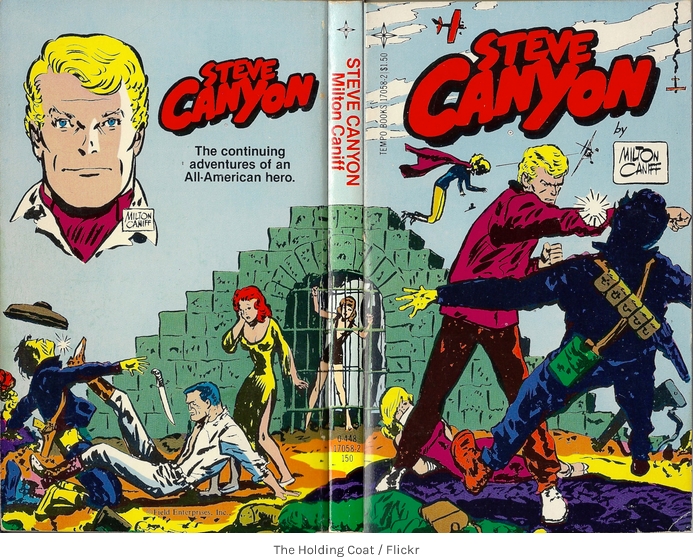
Steve Canyon, Tempo mass market paperback – 1979

Ace Vincent, at Go2Tutors (“Go2Tutors is the internet’s top destination for learning about anything and everything under the sun”), provides us with “a list of 15 comic strips that once graced newspaper pages but have since disappeared from daily circulation.”

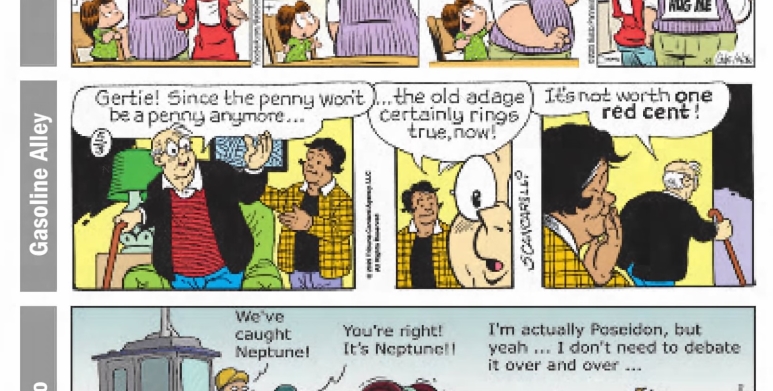
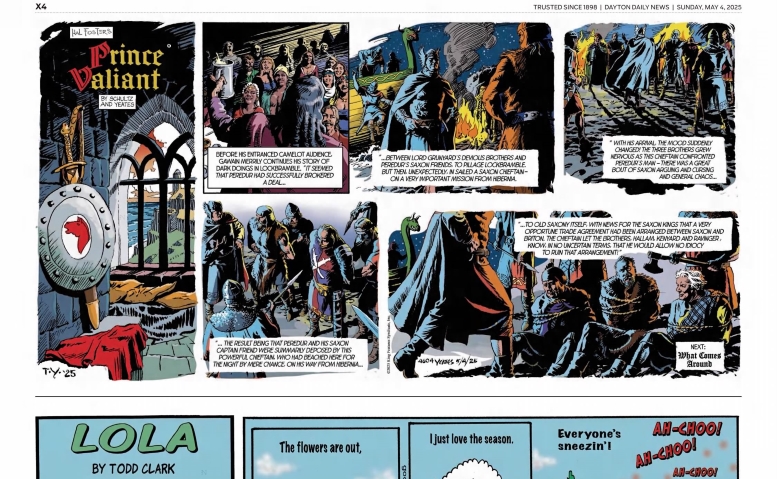
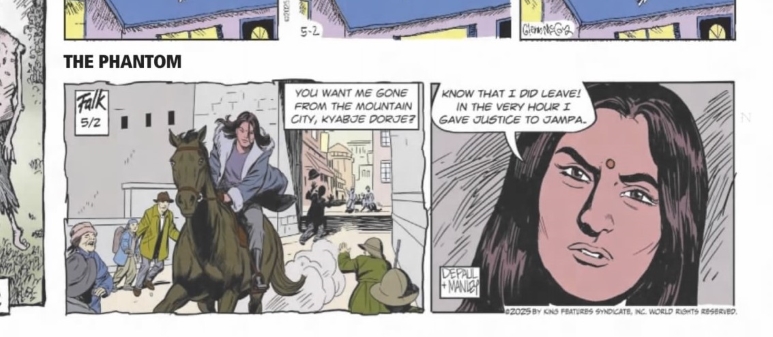
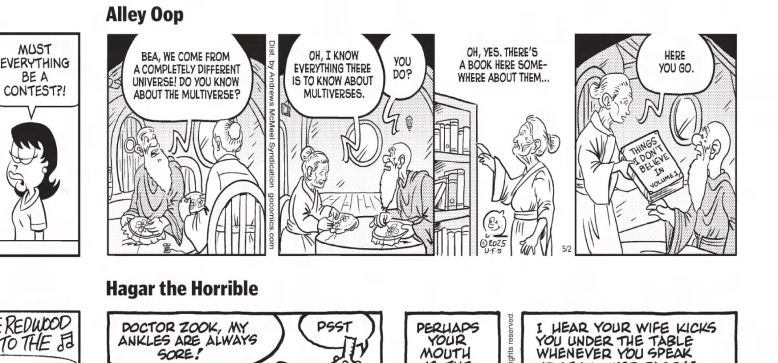
It starts off reasonable enough listing Calvin and Hobbes, The Far Side, Bloom County, Little Orphan Annie, and Pogo. But then it goes off the rails when Ace decides that Dick Tracy, Gasoline Alley, Prince Valiant, The Phantom, Alley Oop, and Flash Gordon no longer appear in newspapers.

Samples via newspapers.com (mostly).
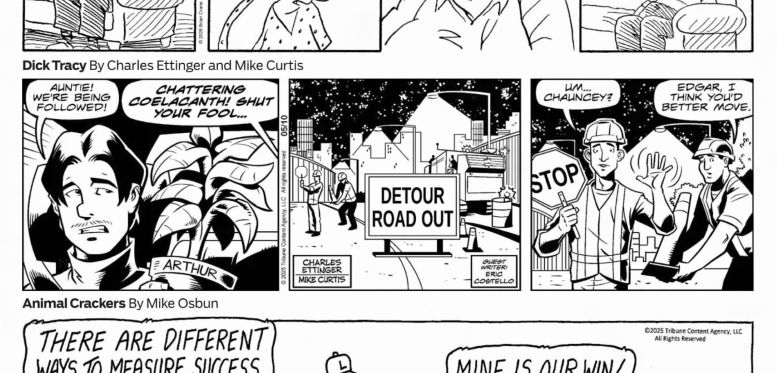
Dick Tracy, The Chicago Tribune – May 10, 2025

Gasoline Alley, The New York Daily News – May 3, 2025

Prince Valiant, Dayton Daily News – May 4, 2025

The Phantom, Press Enterprise – May 2, 2025

Alley Oop, The Daily Chronicle – May 2, 2025

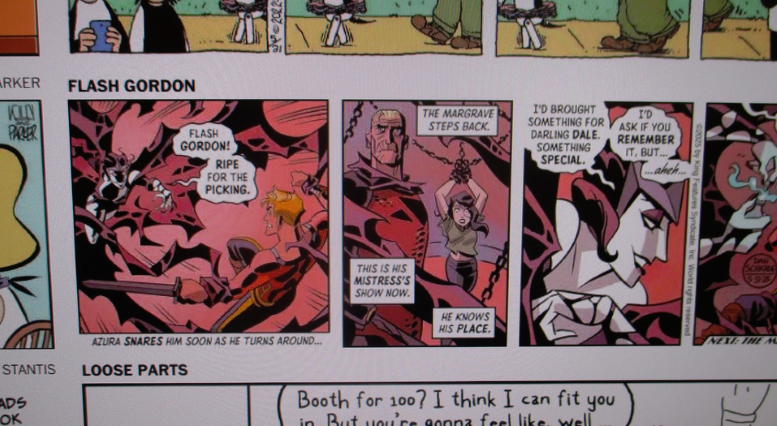
Flash Gordon, The Washington Post – May 31, 2025

Flash Gordon, as far as I know, continues to run in The Washington Post. And the Jim Keefe reruns run in papers that carry it via the King Features Weekly Service.

Most egregiously is the inclusion of Peanuts on the list!

Schulz’s decision that no one else should continue the strip meant its end coincided with his passing, creating a poignant finale to comics’ most successful franchise.

As if you needed proof that Peanuts still runs in hundreds of newspapers:
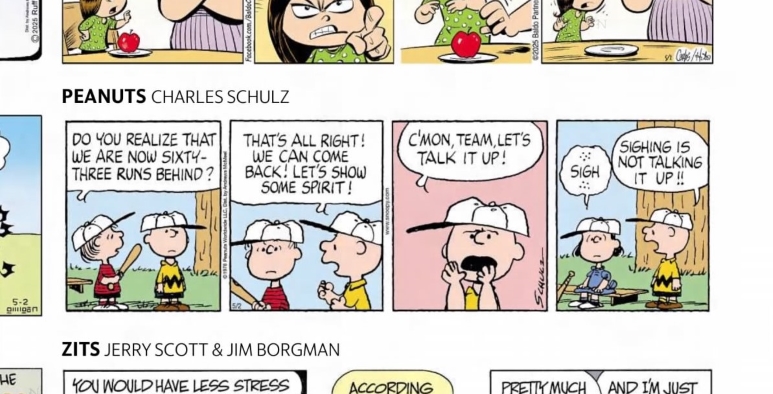
Peanuts, The Wichita Eagle – May 2, 2025

I do give them a thumbs up for running that Steve Canyon comicback®™ cover! I loved seeing it.

Previous Post
It’s Beetle Bailey’s 75th Too
Next Post
CSotD: To Live and Die in LA

Comments 9

  1. Is there a way to find out how many newspapers a particular comic strip appears in? My somewhat faulty memory is that back in the 1970s, somebody used to publish the number of papers that carried a particular strip. I think it was “The Comic Buyers’ Guide” using data that they got from “Editors and Publishers Weekly”. I could be wrong on both counts but it seems like in this data-driven age, that data should be readily available. Is it?

    1. I remember the Comics Buyer’s Guide (I forget who or for how long) transferring the annual syndicate directory information from E&P to CBG so we knew what comics were being syndicated. I don’t remember seeing complete comic strip circulation lists anywhere.

  2. It feels just like the “where are they now?” moment in Spinal Tap.

  3. There is absolutely nothing Jewish about Superman.
    Seigel and Shuster’s parents may have been Jewish immigrants from Lithuania, Ukraine, and the Netherlands, but they were not religious. They grew up as much a part of general Canadian and American culture as they could.
    Kal-el is not a Hebrew name, it’s a science fiction name. It was originally Kal-L, a name starting with the letter after Jor-L (originally a character in a different comic, which became Kal-L’s father’s name). Numbers or letters for names is a standard sci-fi trope.
    Clark Kent doesn’t “hide” anything about his identity; for the first ten years of his publication, he didn’t even know he was from another planet. Krypton was nothing more than the reason he had super-powers. “Family Crest”? For crying out loud, that came from the costuming department of the 1978 movie!
    Neither Seigel nor Shuster would have known what a tallit was if it hit them in the face.
    Sure, when I read silver age Superman comics, I imagine that Superman represents the American Jew who has discovered the Jewish people in the wake of the Holocaust, The Bottle City of Kandor is the State of Israel, and Supergirl is the refugee who embraces American culture. But that isn’t even subtext, that’s just me projecting.

  4. EDITOR & PUBLISHER never provided lists of feature clients. If THE BUYER’S GUIDE ran such a list (under Alan Light or Don & Maggie Thompson’s editorship) it was independent data gathered by the authors, who I believe are still present online with their survey, though I can’t find it among my bookmarks.

    D.D., I’m sure you saw that HOLLYWOOD REPORTER ran an article in the past several days about the McClusky JAMES BOND “1958” originals, again crediting the artist with somehow drawing Bond in the exact likeness of Sean Connery several years prior to his casting, this despite the original version being easily found in any search-engine investigation to prove that it isn’t true. The heads on those revised originals look pretty suspicious, even only being able to examine them online.

    1. At one time I was sure that it was in the “Menomonee Falls Gazette” but I went back and read all of my papers (starting with #42) but it wasn’t in any of them. I should have kept my old CBGs but I started with #6 and they were taking up a LOT of space. Maybe I’ve imagined the whole thing but it seems like this data should be more available than “at it’s peak the strip appeared in ‘x’ number of papers”.

  5. If Prince Valiant and Peanuts aren’t still running in newspapers, than what have I been reading this whole time?

  6. Jeffrey Lindenblatt did some articles for E&P back in the day about strip circulations. The figures were based on surveys of newspapers, because syndicates generally do not publish this information, except when the numbers are spectacularly good. When they do publish figures they tend to be of the ‘take it with a grain of salt’ variety.

    Now Lindenblatt is doing the same sort of surveys for the Stripper’s Guide website. He has so far published annual surveys of feature circulation for the years 1977 – 2003, and the series continues.

  7. Joe Shuster was from Toronto! They even have a street named after him there. He has said that the Daily Star (the name of the newspaper Clark worked at in the early years of the strip) was named after the Toronto Star. His family moved to Cleveland, where he met Jerry Siegel, later on.

    Siegal and Shuster may not have been religious, but they were culturally and ethnically Jewish immigrant kids. It is hard to miss the subtext of the alien who becomes more American than the Americans (who never seem to notice his blue hair!), or later on that sense of being a survivor of a civilisation that endured horrible catastrophe.

Comments are closed.

Search

Subscribe to our newsletter

Get a daily recap of the news posted each day.