CSotD: Random Funny Stuff
Skip to comments
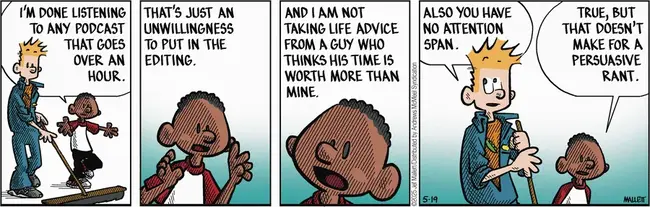
An hour? Holy catfish! Caulfield’s got a way longer attention span than I do. My limit for sitting listening to anything on my computer is about four minutes. As for selfie-podcasts, my limit for looking at a close-up of somebody’s big fat face delivering a rant is zero minutes.
The counter-benefit of ADD is that I can hit the chair cold and have a thousand words written, linked and formatted in less than six hours. Hyperfocus is a lovely tool.
Otherwise, I can’t just sit there. When I watch TV, I’ve got to also be doing something else, like folding laundry or popping in and out of the kitchen making dinner.
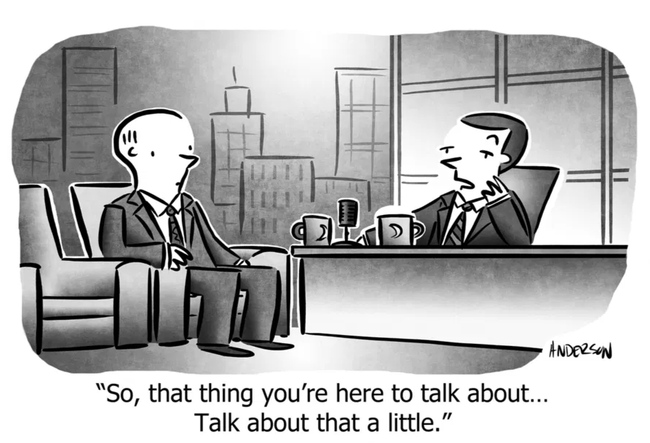
It’s interesting to see how talk show guests work their goal into the interview, particularly on light, personality-driven shows. That is, it’s not surprising that an author on Fresh Air talks about their book, because we all know that’s why they’re there. But when they’re on a lighter show with a chat format, they sometimes insist on coming back to the book even if they’re being asked about their kids.
There’s a point where you can feel the host wanting to say, “Relax, chum. We’ll get to that,” and Carson was a champion at getting people out of the chair and over on the couch next guest please if they pushed too hard.
The question in today’s Andertoons is funny in this context because, yes, it’s the unspoken backbone of those talk shows. But I just happened to be noticing that Greg Sargent specifically uses it in his podcasts, where it works very well.
I do listen to long podcasts as MP3s in my car, where driving is the other thing I also have to be doing while I listen, since driving and listening happen in different-but-compatible sectors of the brain.
Sargent’s background is in print, but he does well in audio, unlike most writers-turned-podcasters. But he’ll still — reporter style — bring up a topic and say, “Talk about that a little” rather than lead the subject of his interview to the response he wants them to give.
One of my gripes with podcasts (and magazine articles) is when they don’t get to the point. It’s refreshing to find one that so consistently dispenses with fluff and happy talk.
Juxtaposition of Operator Error
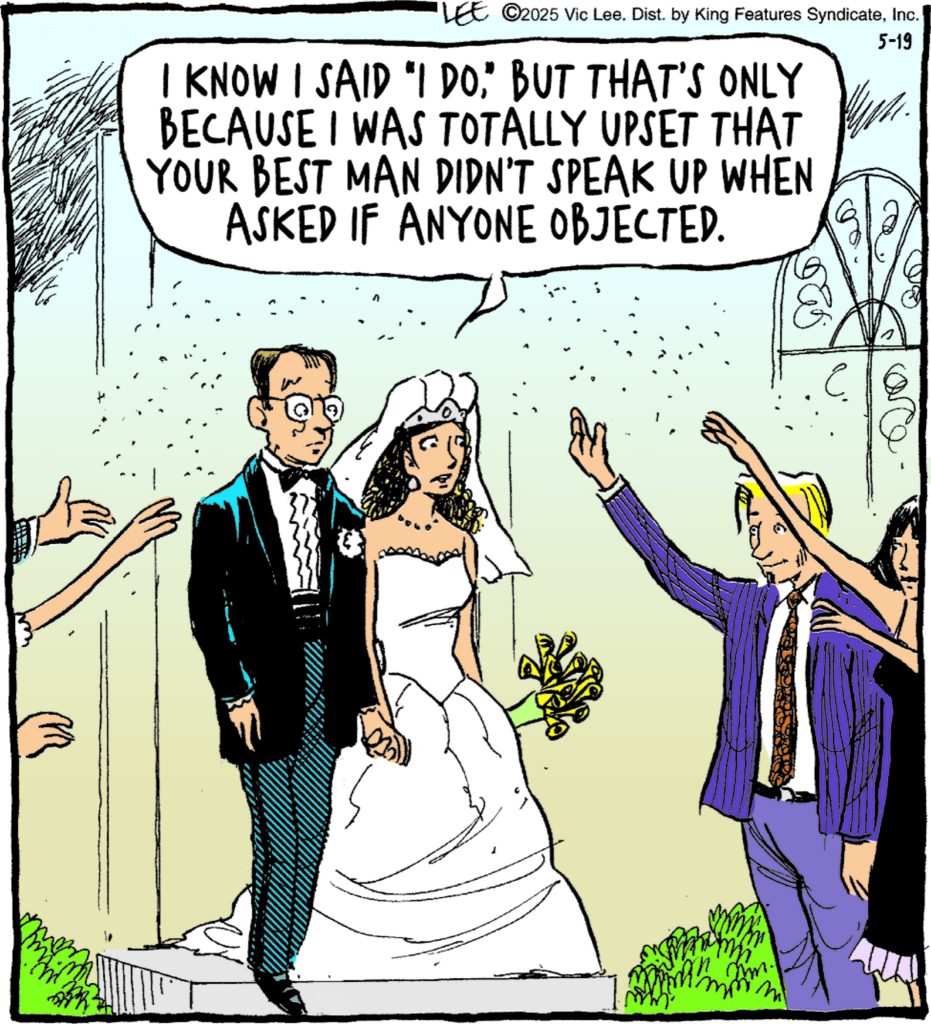
The phrase in the wedding ceremony is “Should anyone present know of any reason that this couple should not be joined in holy matrimony, speak now or forever hold your peace” but it’s not an invitation for Benjamin Braddock to scream “Elaine!”
It’s a chance for someone to say, “He’s already married” or “They are first-cousins.”
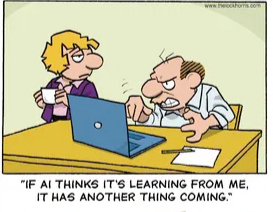
And if you think I’m wrong, you’ve got another think coming. Not another “thing.” Another “think.”
I know it’s a verb and the grammatically correct phrase would be “you’ve got another thought coming,” but the point is the parallel construction. Folk idioms are deliberately informal.
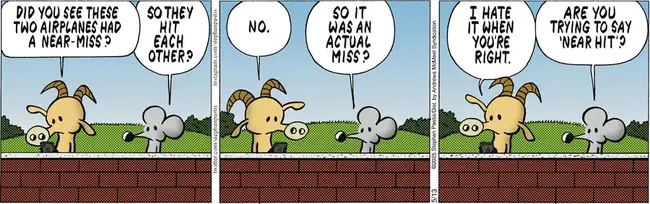
Both expressions mean the same thing, but with a contextual difference. “Near miss” means that the user rejects the notion that “a miss is as good as a mile.” If the planes were a mile apart, there’d be no need for the FAA to file a report. Assuming we still had an FAA. Watch the news for updates on that.
And stop fussing over idioms. Or as we say, “get over yourself,” which is physically impossible, but it’s often good advice anyway. There are other bits of idiomatic advice that are also physically impossible, but if everybody stops nit-picking idioms, I won’t resort to them.
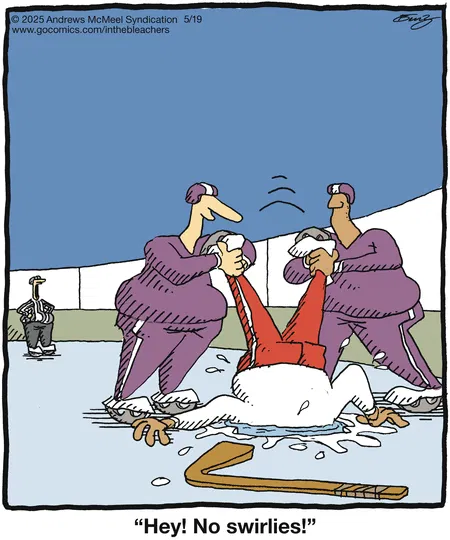
As for the “In the Bleachers” gag, it, along with gags about people ice fishing on hockey rinks, requires forgetting that hockey rinks are built on concrete, not over bodies of water.
So the same people who kvetch over ungrammatical idioms should also, logically, get irritated by jokes about hockey rinks with water underneath. I don’t think they do, but if you draw a cartoon about backgammon, you’d better get the details right.
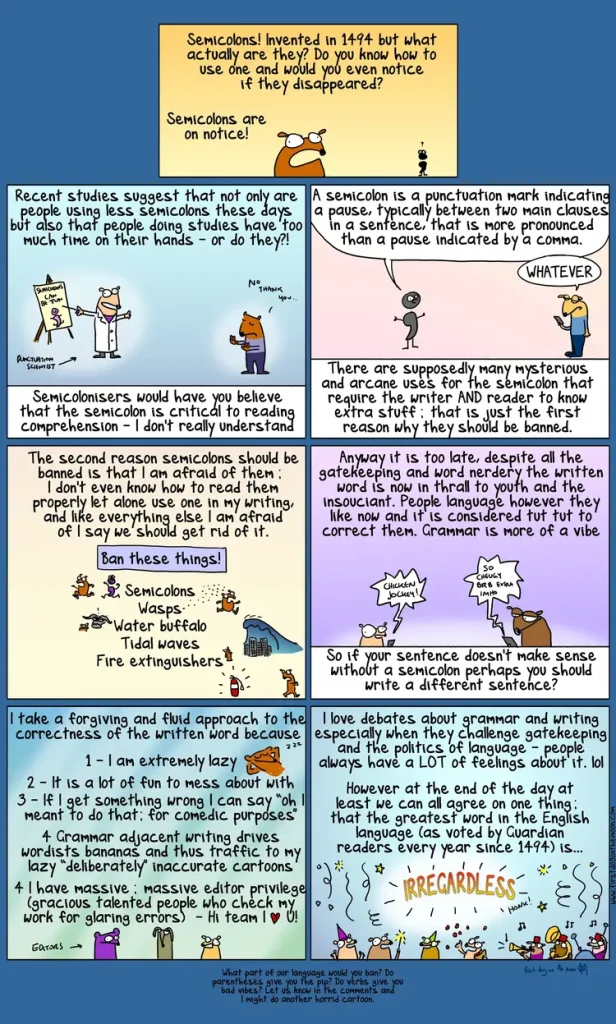
One of the reasons I like First Dog is that he often goes out of his way to annoy the sorts of people who get upset about idiomatic-but-ungrammatical expressions. And misuse of semicolons. And, you’ll note here, the word “irregardless.”
My spell-check just flagged “irregardless” as misspelled, but it’s not. And besides, if you’re going to insist that it isn’t a word, you can’t carp over how I spell it.
Which reminds me of an argument I won with an editor, who insisted that you shouldn’t capitalize “mom” or “dad.” I pointed out that, in the expression I had used, “Mom and Dad and Bud and Sis,” it was their names, not their job titles. And she thought for a moment and said, “You’re right.”
If that sounds like a very small victory, you’ve never worked in the newsroom.
And it’s worse if you’re a columnist. When Molly Ivins wrote for the New York Times, an editor there turned “a beer gut that belongs in the Smithsonian” into “a protuberant abdomen.”
It tempts you to throw in a few semicolons just to give the monkeys something to fuss over.
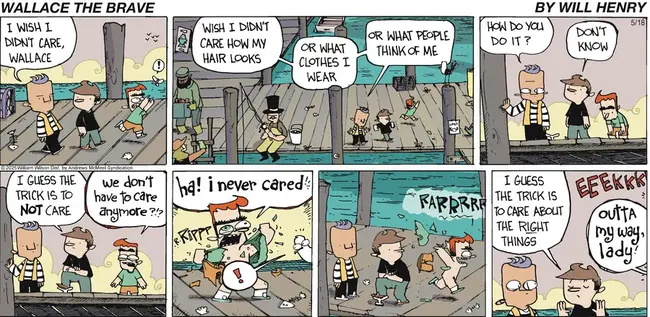
I wish I could be Wallace, but at least I’ve gotten over being Sterling. I think the best I can realistically hope to be is Spud, as proven by the fact that I wish I could be Wallace.
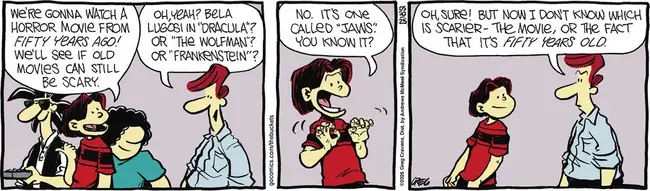
When Jaws came out, I was a quarter of a century old, so this makes me older than Larry Bucket and a little harder to shock.
I’m more at the philosophical stage, where, when I wonder why those young punks don’t remember something, I do the math. For example, the Vietnam War for them is as far distant as World War I was for me at their age.
And “well shut my mouth” becomes not just an idiomatic expression but a piece of excellent advice.
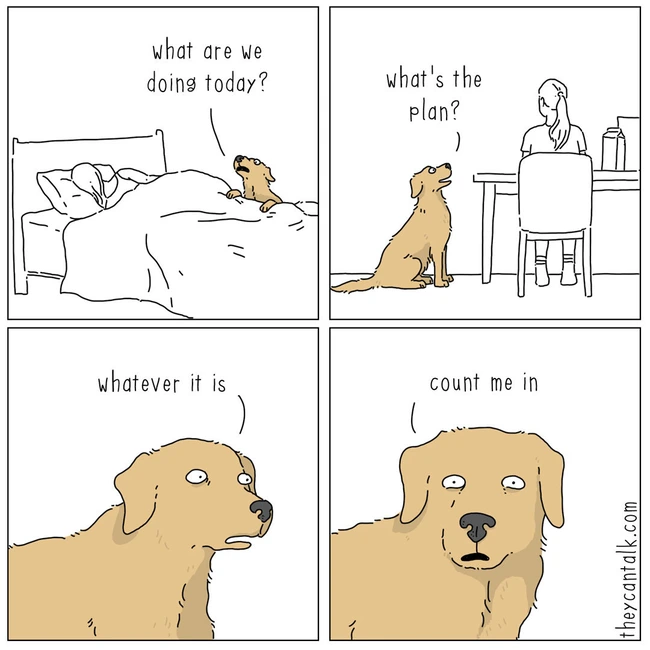
Another piece of good timing, because, just the other day, I sang the chorus of “Old Dog Tray” to my dog, who follows me around, then wondered how the rest of the song goes.
It fits her, except she’s not old. Yet.


Comments 13
Comments are closed.