CSotD: Mopping up
Skip to comments
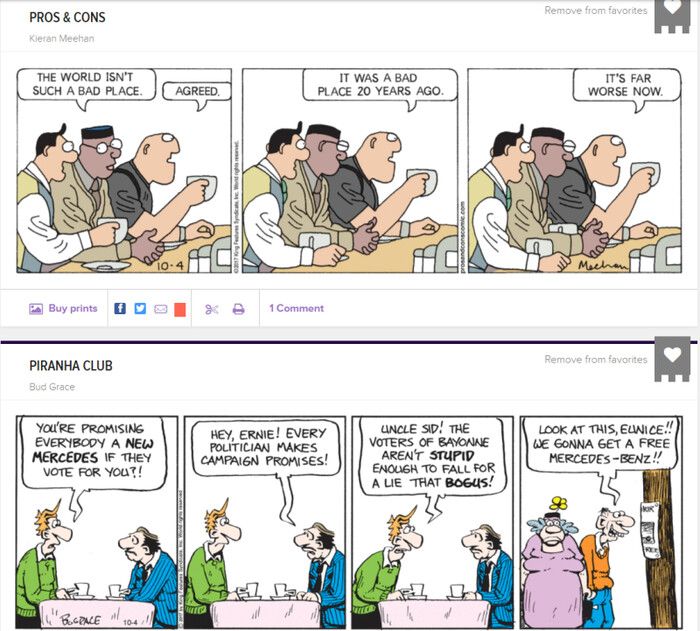
As frequent visitors know, I particularly like Juxtapositions when they happen to fall one after the other on the page. Such was the case this morning with Pros & Cons and Piranha Club.
What I liked even more, in an admittedly dark way, is that 48 hours ago, they wouldn't have seemed like a juxtaposition, in large part because the world didn't, at the moment, seem like a worse place.
And, looking back, 1997 was a pretty good year.
We hadn't invaded Iraq or Afghanistan, and even our October 1 mass shooting was, by current standards, almost benign.
Not that the shooting wasn't a bad thing, mind you. But still, as the man said, I'm sure it wouldn't interest anybody, outside of a small circle of friends.
As for Sid's plan to become mayor of Bayonne by promising gullible voters things he has no prayer of delivering, well, it would have struck me as funny and a bit pointed last week, but it would have seemed totally preposterous 20 years ago.
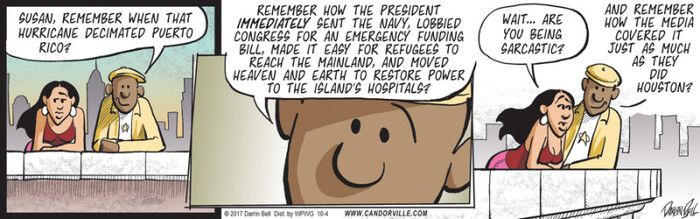
In a related but not quite juxtaposable Candorville, Lemont bemoans the lack of attention being paid to Puerto Rico, and delivers a stinging indictment to the press for not going all out in coverage.
To offer a defense of sorts, the press had more boots on the ground in Houston and Miami, and perhaps it should have regular coverage of Puerto Rico, but it doesn't, besides which, while most people across the country know people in Houston and Florida, not so many know any Puerto Ricans who still live in Puerto Rico.
If that weren't the case, we'd likely see more coverage of the province on a regular basis, which would mean they would have the aforementioned boots on the ground.
Mostly, however, I suspect that, had Maria been the first of the three hurricanes, there would have been a lot more coverage.
Fatigue is more of an indictment than an excuse, but it is an explanation.
 Fortunately, the crisis in Puerto Rico is now over, because the people have been able to soak up all the flooding with paper towels.
I guess someone forgot to bring the MAGA T-shirt cannon.
Meanwhile, back in those other United States
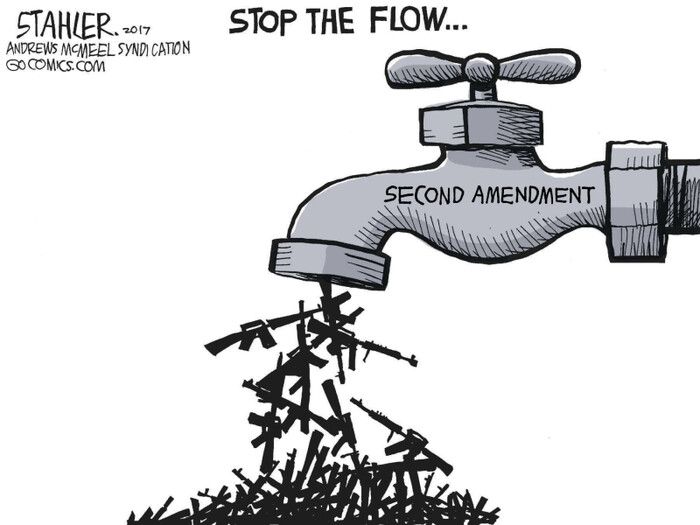
More cartoons have come along about the Las Vegas shootings, but not a lot that say anything new.
But Jeff Stahler had posted this one very soon after the gunfire died down, and it addresses a common objection to gun control, which is that you can't do anything about it because of the Second Amendment.
Which ties in with the large percentage of Americans who didn't know Puerto Rico was part of the United States: An even larger percentage have no idea what the Second Amendment is or how it became part of the Constitution.
Yesterday, I posted this link about the way the NRA went from being an educational organization dedicated to gun safety and became a right-wing terrorist group.
I've got no problem with responsible gun ownership. I was a member of the NRA as a kid and shot on the rifle team in summer camp. A huge number of the people I grew up with were deer hunters and know how to handle a gun safely and responsibly.
But the Second Amendment has only a tangential connection with hunting and target shooting or self-defense.
Specifically, an issue came up in deliberations when it was noted that Quakers — a significant group then — were pacifists.
Quakers in the country needed guns to hunt for food, and would certainly employ a gun to save someone from a wild animal, but would not shoot a person, even an enemy soldier.
Thus the original wording:
The right of the people to keep and bear arms shall not be infringed; a well armed and well regulated militia being the best security of a free country; but no person religiously scrupulous of bearing arms shall be compelled to render military service in person.
It's plain elsewhere in the discussion that the Second Amendment was intended as reinforcing the Founders' distrust of standing armies, which also was the reason for the Third Amendment. We have not yet had any issues with quartering soldiers in private homes by compulsion because that's not how our defense system evolved.
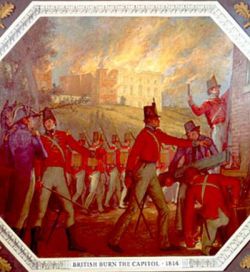 But neither did we wind up with state and local militias as an alternative to a standing federal army: That dream ended in the War of 1812 with numerous examples of militias either running like rabbits after the first shots or failing to take up the battle at all.
By then the author of the Second Amendment was in the White House, or, at least, he was until the militias broke and ran so that the British Army could march all but unopposed into Washington and burn the presidential residence.
In the wake of the war, Madison ordered a reorganization of our armed forces and the Second Amendment became a curious bit of obsolete history, along with the Third, until, as Justice John Paul Stevens notes in this op-ed piece, it was revived and reinterpreted in the 20th century.
Or, as he puts it, misinterpreted.
I like his analysis very much, though I disagree with his idea of revising the Amendment to ensure that the federally protected rights of gunowners apply only to active militia members.
As he himself noted, the Amendment never had anything to do with the right to self-defense, so I think amending the Amendment is unnecessary: Simply repeal it.
"Simply" being more than a slight bump in the road.
It's more practical to put people on the bench who will rule that the Second Amendment does not negate states rights, that, to the contrary, any state has, by virtue of that Amendment, the right to regulate its own militia and, therefore, the laws governing firearms within its boundaries.
Though we won't see that happen that as long as we have people voting for candidates who promise them each a new Mercedes Benz.
While we hold out for Teslas.
Mike Peterson has posted his "Comic Strip of the Day" column every day since 2010. His opinions are his own, but we welcome comments either agreeing or in opposition.
Comments
Comments are closed.