CSotD: Monday Short Takes
Skip to comments
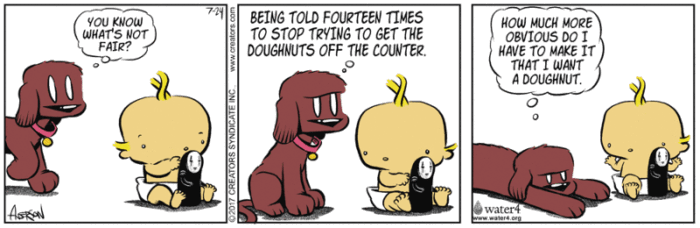
A few quick laffs before I get into rant mode. I love Dog Eat Doug, though I suppose it's a dog-lover niche cartoon coupled with a baby-lover niche cartoon, but those are more alcoves than niches. Or something. Pretty large niches, anyway.
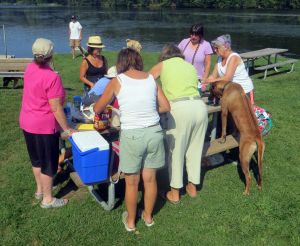 In any case, today's hit me because, while our dog-walking friends at the park often throw little potlucks for birthdays and so forth, I've stopped taking Vaska to them because, like Sophie, he is quite certain that the problem is we simply don't understand what he's trying to tell us.
Incidentally, our group is like an old-style neighborhood where anyone's mom could tell you to knock it off, which happened to him seconds after I got this picture.
Not that it took. Maybe if he got back up there one more time …
BTW, the original Sophie from Dog Eat Doug died recently, and, while her cartoon self continues in the strip, they have had some storylines involving rescue-puppies being fostered there. Adding temporary puppies provides some fun chaos and keeps things fresh.
And, well, yeah
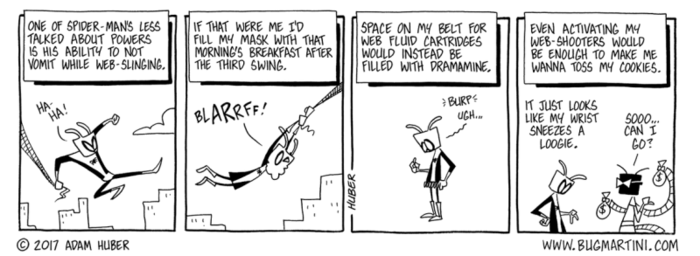
I'm with Adam Huber on this one, though I hadn't thought about it. But that's what a good cartoon does, and today's Bug Martini asks us to imagine what it would actually be like to be Spiderman. And then answers it.
I imagine the No-Prize winning answer is that, among the spider-like qualities Peter Parker got in that bite was a spider's lack of vertigo, but, if you assume too much of that sort of thing, you start to take away the "average high school kid" aspect that made him an attractive superhero.
 That was what made Marvel comics such a breakthrough in the early '60s: In both Superboy and Superman, Clark Kent's challenge was to hide the fact that he wasn't like the other kids and to pretend to be a schlub. Not only was Peter Parker an intellectual schlub, but so were Bruce "Hulk" Banner and Donald "Thor" Blake.
Clark Kent and Bruce Wayne were part of a tradition of heroic stiffs that goes back beyond the Lone Ranger and Red Ryder to the plucky, impossibly upright lads of Horatio Alger and GA Henty in 19th century boys' books.
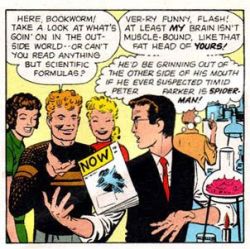 To explain the breakthrough of Peter Parker et al is as futile as trying to tell someone what it was like to be sitting in a theater when that star cruiser passed overhead at the beginning of Star Wars.
But trust me: Having someone as insecure and unsure and basically messed up as yourself was mind-blowing when it was first introduced.
I get the impression that Marvel has pretty much retconned most of that appealing normalcy out of the characters, but I think the original Peter Parker might well have barfed into his mask.
As Dumb As We Wanna Be
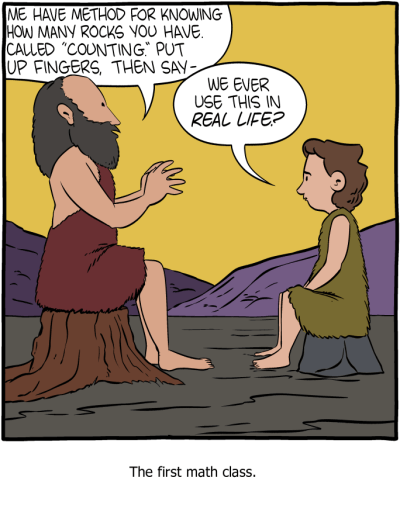 Saturday Morning Breakfast Cereal pipes into one of my major peeves, and I don't think I'd hate it half as much if people actually said, "I've never understood why we learned algebra."
Instead, they smugly declare "Another day I haven't used any algebra!" which is a prime example of the old adage about opening your mouth and removing all doubt.
I gather there is some kind of perceptual problem a number of people have with "word problems" as well, so you can't simply blame it on people being befuddled by Xs and Ys. They genuinely don't understand how to figure out, if Farmer Brown has five bushels of apples worth $10, how much each bushel is worth.
A red Indian thought he might eat tobacco in church, ferchrissake! Is it really that difficult?
They don't get word problems and they're certain they've never used algebra, and yet they can go to the store and shop, they can follow recipes and they can even (sometimes) figure out how much paint they need to paint the livingroom.
Geez Louise.
"I'm not wearing any pants!"
"What are those?"
"Trousers!"
And then, when they're done proudly proclaiming how dumb they are on that topic, they'll snark and sneer at people who think the Earth is only 5,000 years old.
Nah, you don't get to do that.
Blowback
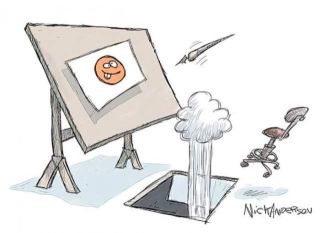 The Association of American Editorial Cartoonists suggests we go back to Michael Cavna's article about the sacking of Nick Anderson and read the comments that have since accrued.
Usually, recommending that someone read the comments either means "Look how stupid people are" or "Look at the funny snark," but these intelligent, angry comments underline the folly of cutting popular, original material from newspapers.
Granted, people who read Cavna are not a random sample and might logically be more likely to appreciate a good cartoonist, and, further granted, they aren't all Houston Chronicle subscribers.
But that's why we have the Intertubes.
As Anderson noted when he announced his departure, he gets hundreds of thousands of clicks.
Worldwide clicks might not benefit the local furniture store, but I first bought Shiner Bock because they advertise on the radio station that streams Houston Texans games.
Come on, Chron: Teach your ad sales team how advertising works. (And none of that "hover to see your circular" bullshit.)
A quarter century ago, as the first fools were unleashing free content without realizing what a stupid move that was, others suggested micropayments, or maybe aggregators where you would pay a decent subscription price for a selection of newspapers you could browse.
Either system would let you, for instance, follow a sports team without having to buy the whole paper and read about road construction in a place you never visit. Or, yes, follow a particular cartoonist, generating micropayments each morning for a paper you have no other reason to be reading.
But, like the boy with a fistful of hazelnuts he can't fit out of the jar, the publishers and owners couldn't be persuaded to take what they could get.
So, instead, we have Patreon and they get nothing.
Q. Why does the CEO comes to work in a limo?
A. Because he'd never find the building on his own.
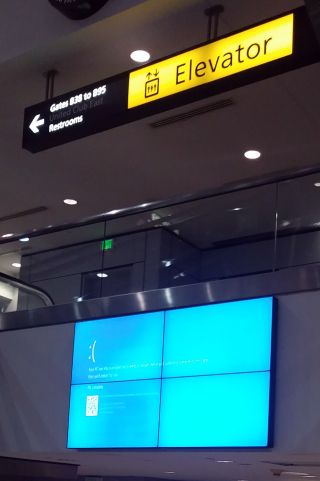 High tech in high places
Comments 13
Comments are closed.