CSotD: Currency exchange
Skip to comments
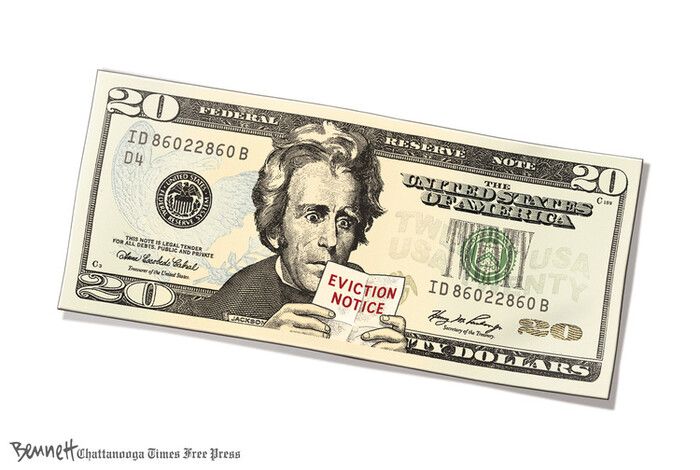

Let's start things off with Clay Bennett and Jeff Koterba, because they lay out the basics with the least amount of spin.
Jackson is out (well, demoted to a statue on the back of the bill) and Tubman is in.
Of course, the bigots are upset, but the bigots were upset when the schools were integrated and the bigots defend racist team mascots and the bigots are not people to be reasoned with, so let's just hope they don't gain the White House and thus the Supreme Court. A rant for another day.
What I'm seeing unfold around the recasting of the currency is a less deliberately toxic, but no less simpleminded, response, which casts history into a binary world of heroes and villains, such that we can't simply promote Tubman and demote Jackson but must justify it by declaring him an unredeemable, despicable scoundrel.
The brilliance of selecting Tubman to pioneer this change is that, normally, there would be a similar requirement to prove that she was virtuous perfection in every detail, but we accept that as a given, thanks in part to the mountain of well-intentioned legends surrounding the Underground Railroad and in part to the fact that apparently she was pretty much who everyone said she was.
That last is a true historical rarity.
Which brings us to our next Juxtaposition:
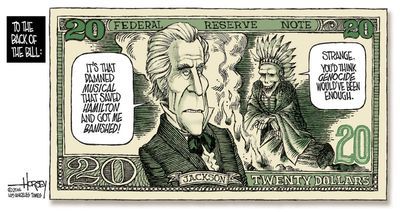
There has been a strange fascination in reading people grousing about how we only feature white men on our currency.
The ones who complain that we only feature presidents are readily refuted, obviously, but the "white men" set piece is a little more amusing because, if nothing else, the smash hip-hop musical should motivate people to find out that Alexander Hamilton was likely of mixed race. And (literally) a bastard.
And that it didn't seem to hinder his prospects in a time when we're pretty strongly convinced that the world was run by intolerant, racist Bible-thumpers.
Skip the facts: Pop-history is in the driver's seat.
Speaking of History-on-Broadway, one of the revelations in James Loewen's milestone book, "Lies My Teacher Told Me," is that, after she dried off her hands and thanked Anne Bancroft, dear sweet little Helen Keller became a socialist and marched with the Wobblies.
That makes her a complex person, dammit, and we want to be inspired by pitiful, plucky little Patty Duke, not actually think about a real, 3D person.
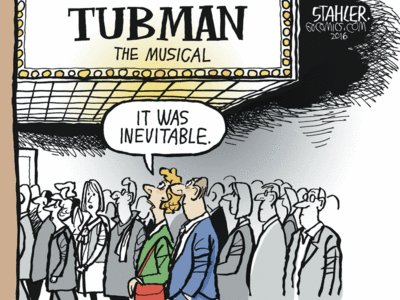
I suspect that, if you wanted to create "Tubman: The Musical," you'd have to sand off some pretty rough edges. Most prominent people in history require a degree of magnetic charisma in order to rise, but she wasn't looking for acclaim and she had that horse pistol in her lap and my guess is that she focused most of her personal charm on talking her way past patrols.
With a hand under her laprobe on the aforementioned horse pistol.
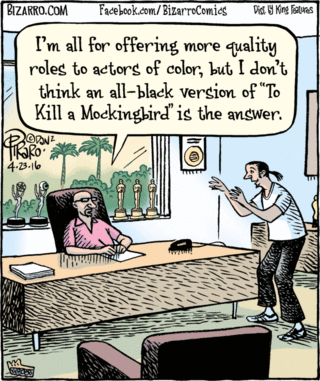 Which is not to say that Stahler's joking prediction is wrong, a point made unintentionally but with great merit in today's Bizarro.
There really is such a thing as "political correctness," which involves a level of cultural appropriation, arrogant condescension and ahistorical ignorance.
I recall reading some years ago that Mount Vernon was no longer demanding that slavery re-enactors be African-American. I don't know if they still have white folks out there picking cotton for the tourists, but, as a white male, let me just culturally appropriate a quote here:
"T'ain't fittin'. It just t'ain't fittin'."
Even Al Jolson was only pretending to be a conventional music-hall figure, not a real African-American.
So let's talk about Jackson, the genocidal slaveowning son-of-a-bitch.
That's equally as simplistic as seeing Helen Keller as the little girl with wet hands.
But let me say this before I tread into deeper, more turbulent water:
Every reputable historian I've seen quoted on this
has said that it is absolutely fitting to
remove Jackson from the currency.
With which I agree.
But they add that Jackson was far more than his most regrettable failings.
With which I agree.
The slavery issue is one of our most difficult complexities: History classes have been wrong, all those years, not to teach that a large number of the Founders owned slaves and to not deal with the contradictory attitudes they held towards the peculiar institution.
Washington didn't chop down the cherry tree and he did, by god, own slaves.
It's not that you shouldn't recoil from the fact. It's that his virtues shouldn't be so inflated that the fact should blow your mind.
Jackson also owned slaves, and the slaves themselves were not the only people who opposed slavery. But slavery remained a fact, an increasingly disturbing fact, in Jackson's lifetime.
The Indian Removal Act, similarly, was controversial, and, while Jackson had fought in the Creek Wars and had first-hand experience there, so had his fellow Tennessean, Congressman David Crockett, who spoke eloquently, if in vain, against the proposal.
Note that Crockett's objections are largely based on the vagueness of the law, on the lack of specific limitations and on the lack of safeguards to allow Indian nations to make informed judgments.
I think it's reasonable to say, and that he himself implies, that this vagueness stems from racism.
And if you read Jackson's remarks on the pending legislation in his 1830 SOTU, you'll see that he specifies Mississippi and Alabama and never mentions Georgia, where the Cherokee lived as one of the "Five Civilized Tribes." Nor, on that same link, does John Ross specifically mention the Act in his own "State of the Nation" address, though he outlines a pattern of abuse being suffered by the Cherokee in Georgia.
What does come through is that Crockett and Ross recognized tribal sovereignty and Jackson emphatically did not, a position on which John Marshall's Supreme Court provided mixed guidance.
And Jackson later did include the Cherokee among those targeted for removal.
So.
So we should certainly not "set this aside," nor should we fault the Cherokee and other native peoples for hating him.
But it should be placed within the context of Jackson's overall legacy, and he is consistently ranked among the most highly regarded presidents, despite these ghastly, indefensible failures.
Take him off the money, absolutely. But you don't have to distort history to justify it.
It's completely justified.
Why not simply say that we want people on the money who represent, not the power of the government, but the spirit of the people?
Ironically, Andy Jackson would be all in favor of that.
Oh, and before you propose putting Davy on something to reward him for that speech, don't forget he died in the struggle to take territory from the Mexicans for the benefit of Anglo slaveowners.
*sigh*
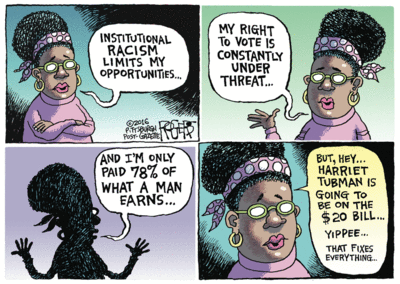
If everything were simple, Rob Rogers wouldn't have felt the need to draw this:
Now here's your moment of zen:
Comments 6
Comments are closed.