CSotD: Muttering underneath our breath, ‘nothing is revealed’
Skip to comments

International cartoons tend to be more metaphorical, more "here's what it is," while American cartoons are more apt to tell a story, "Here's what it means."
At the moment, I think the International cartoonists have the edge in commenting on the Panama Papers, an example here being the moral compass of Italian cartoonist Enrico Bertuciolli, which points in whatever direction the money lies.
A pair of Cuban cartoonists are even less specific in their commentary:
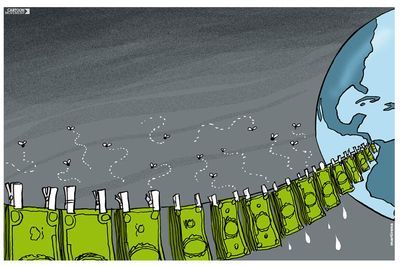
Alfredo Martirena simply shows the line of money tracking back to Panama.
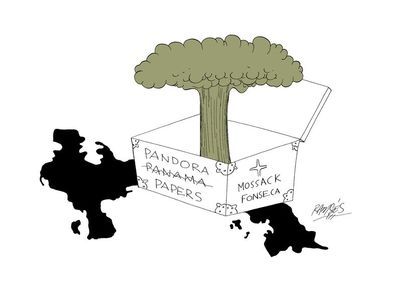
Ramses Morales Izquierdo steps it up more, with a safe prediction that this is going to unleash some things that Certain Parties did not want unleashed, but, again, he doesn't overstep and try to anticipate what all those things will be.
You can go look at the latest entries from around the world at Cartoon Movement: A large number of them relate to the Panama Papers, which isn't surprising, given the international nature of the topic and the lack of insularity in the international cartooning community.
The American cartoons I've seen so far on this topic are confidently explaining what it all means, but I think they're overstepping: It's a massive amount of data and the surface has barely been disturbed.
Even at the end, we may know more about what's in that pile of information than we do about what it all means.
That is, we've seen some Russian and Chinese ties, unsurprising indicators of kleptocracy among leaders nobody trusts to begin with, and even one to Iceland whose leaders were trusted, as well as a few disappointing celebrities like Jackie Chan and Lionel Messi.
But surely more flags and more faces will emerge as the reporters burrow down.
 However, even when (if) they get to the bottom of the stack, we won't know whose names aren't in there but might turn up in the files of a different, similar company.
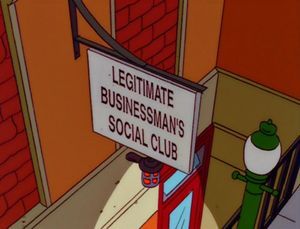
There are any number of Legitimate Businessman's Social Clubs doing the same prudent financial things for their clients that Monsac Fonseca has been doing for theirs. (Legally, I might add. Or I might not, depending on my mood.)
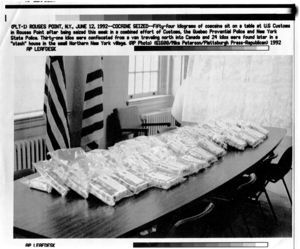 Maybe I'm just a cynical old man, but even as cub reporters, we knew that the stacks of cocaine laid out for us by the Border Patrol for news conferences, while impressive, represented only the drugs they had found.
We didn't have a very concrete sense of how much coke they hadn't found, and it would not only be pointless to ask, since they didn't know either, but it would have spoiled the celebratory nature of the gathering.
The recent response to the futility in that quarter has become "Obviously, we can't catch them all, so let's just legalize it."
By contrast, in the international finance sector, we anticipated the problems and made it all legal from the get-go.
With only a few people suggesting that we do otherwise.
Though perhaps the more appropriate clip is of international economist Dennis Green explaining the subtle implications of the release of these papers and how this new information should shape our policies.
Please, Dennis: We'd really prefer not to know these things.
One of the first postings I saw of a link to the Panama Papers drew an immediate response of "The Mainstream Media won't cover this," which proved to be massively wrong, but it's worth wondering if the public will keep the story visible on the aggregators that play such a large part in the news that people see.
On The Media had a story this week about the fact that, despite cries that only attacks in Europe are covered, there was massive news coverage of the bombings in Lahore, but it didn't get enough clicks to become visible, nor have other ventures into serious journalism.
I wonder if, as this material gets unpacked and analyzed, and as other leaks tumble in behind it, it will continue to be visible?
Or will we continue to flock to the more comforting, less complicated solutions to our financial problems?
Elsewhere in the comics
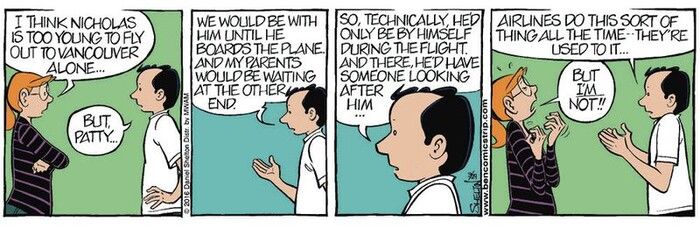
Ben provides a bit of a flashback, as the parents contemplate sending their youngster off to the other side of the continent on his own.
A few years after our divorce, my ex remarried and moved to England, and, for the first several years, visitation meant driving the kids nearly 100 miles to Mirabel, Montreal's international airport at the time, rather than the 30 to Burlington, VT, so that I could put them on a direct flight to Heathrow, which was equally inconvenient for their mother.
As they got older, we relaxed and let them take connecting flights.
Finally one evening I called my recent-high-school-graduate son to tell him not to leave for Burlington to pick me up because I was stuck overnight in DC, and he proceeded to chew me out for accepting the weak offerings of the airline, then laid out exactly what I was to go back and tell them and precisely what they were going to do for me boy jayzuz.
We gave them roots and wings. The attitude, they acquired on their own.
And now for something completely different
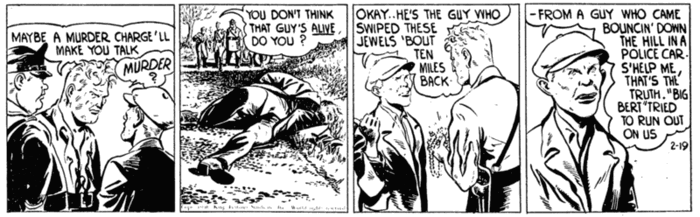
A dead body on the funny pages, courtesy of Radio Patrol's February 19, 1946 strip, as seen today at Comics Kingdom.
We've seen villains iced in Dick Tracy, and we've seen them fall to their death or disappear in an explosion, but I don't know that I've ever seen a character point out the obviously dead nature of a twisted corpse in the foreground.
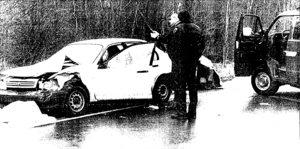 At the risk of running a second of my photos from the Olden Days, I turned in this picture of a sheriff's deputy carrying the shotgun with which a fleeing felon had ended his own life at a roadblock, to which the editor responded, "Did you get a shot of them removing the body?"
I said, "No. Why? Would you have run it?"
"No, I guess not."
I swear they put them behind desks because they dasn't let them out on the streets.
Here: Scratch that Panamanian Earworm
Comments 3
Comments are closed.