CSotD: Looking Back (Part One)
Skip to comments
I was looking back at coverage of the Civil Rights Act a half-century ago and, well, got distracted. We'll get to the "50 Years Ago" part eventually, but first let's look at what you'd have looked at if you'd sat down with your paper on April 13, 1914 (This will be a good day to click for larger versions, by the way, and an excellent day to test the links):
100 Years Ago Today
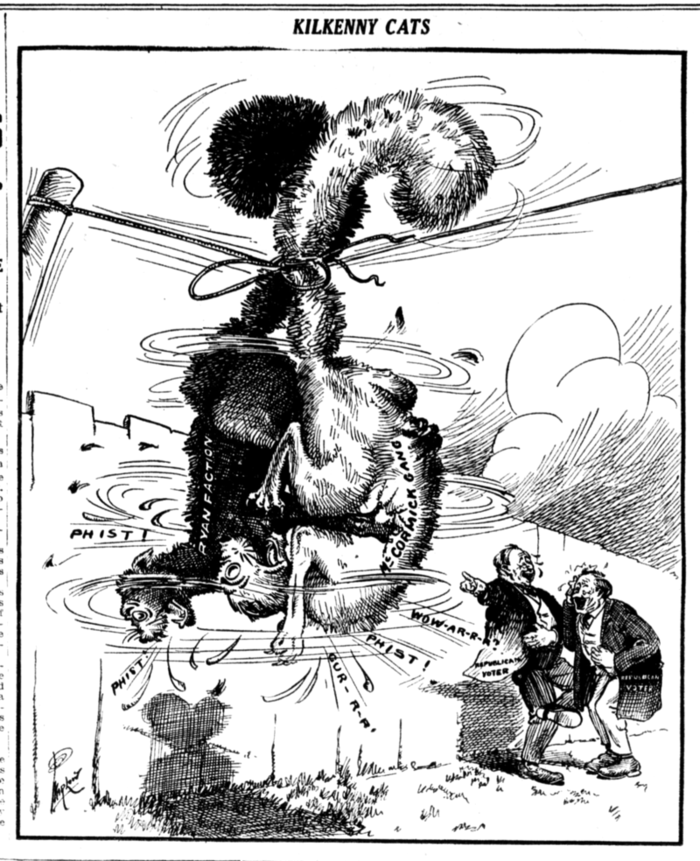
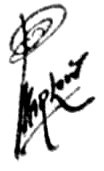 Start with the frustrating one. This cartoon is from the Harrisburg Telegraph, a Republican paper, and concerns a bruising (they hope) Democratic primary fight between Vance McCormick and Michael Ryan. What frustrates me is that I really like the guy's artwork but can't make out his signature or find any record of who he was. (Looks like "Kaplow" but that turns up nothing in a search. Anybody?)
Of course, the oft-cited Billy Ireland, whose family bequeathed the expansion and wonderfulness money to Ohio State's cartoon library, was also a local cartoonist. There were good people working at local papers in them thar days.
Even the chains understood the marketing appeal of local content; Hearst and Pulitzer may have been voracious plutocrats, but they weren't idiots.
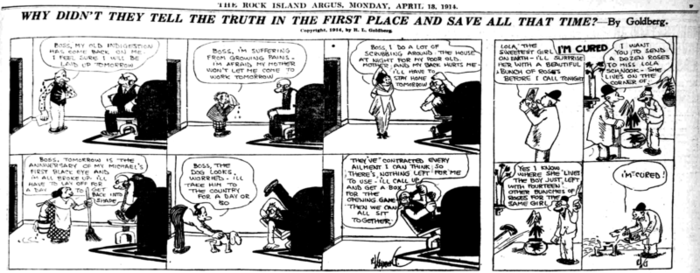
And speaking of the Billy Ireland Library, if you go there, you'll see a lot of Rube Goldberg stuff. Here's the Rube Goldberg stuff you'd have seen if you'd been reading the paper a century ago.
(Technical tip: Enlarging strips seems to work better in Chrome than Firefox. Dunno why.)
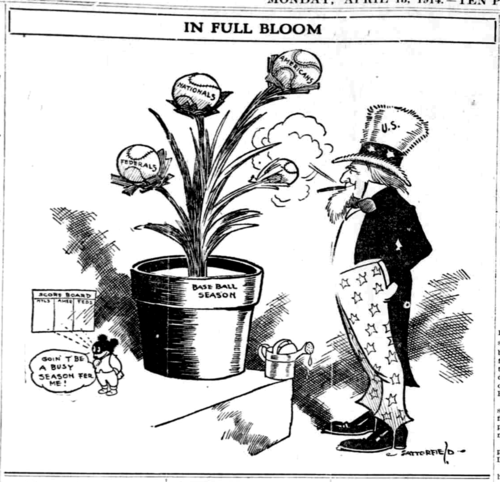
I guess April 13 must have been close to Opening Day, since in the same edition where Goldberg references it, so does Robert Satterfield.
Yeah, the Federal League. I guess that's how you can pinpoint the year this cartoon appeared.
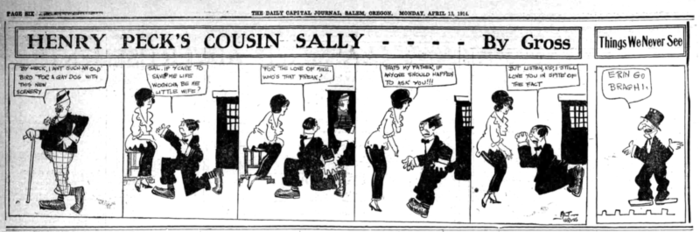
Most papers didn't have a huge number of strips, but there was some huge talent. Here's Milt Gross. (I have no clue as to what's going on in that filler panel at the right, but presumably if you saw it every day you'd be into the flow.)
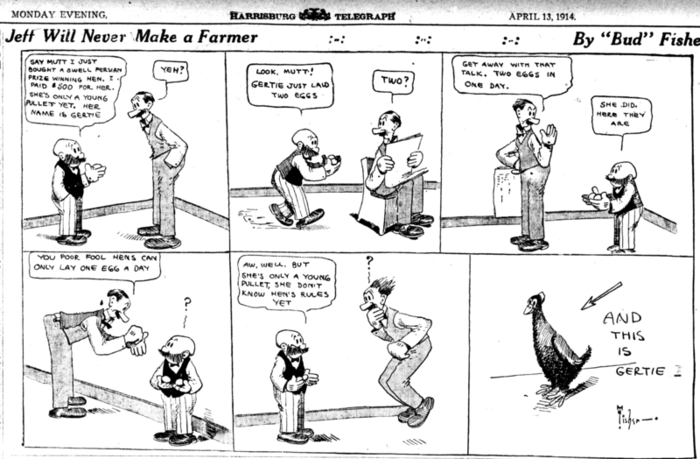
And, of course, Mutt and Jeff, one of several strips to have been dubbed the first daily. It was seven years old at this point.
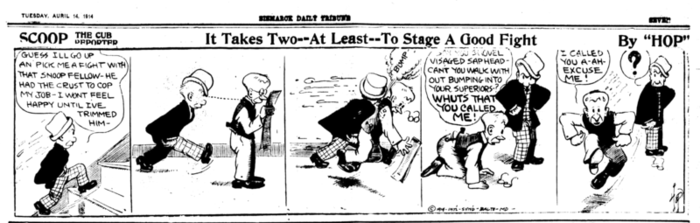
For insider humor, there was Scoop, the Cub Reporter, another claimant to the "First Daily" title.
I don't know if readers got it, but presumably it was an easy sale to newspaper editors. For some reason, bristling humor is a big deal at newspapers and a thick hide is not a bad thing to have.
At one paper where I worked, there was a young reporter the back shop guys referred to as "Cubbie," not so much because he was young, though he was, but because it pissed him off, which it did.
The editors despised the back shop, too, and thus served, much against their will, as a never-ending font of fun for the guys who worked for a living.
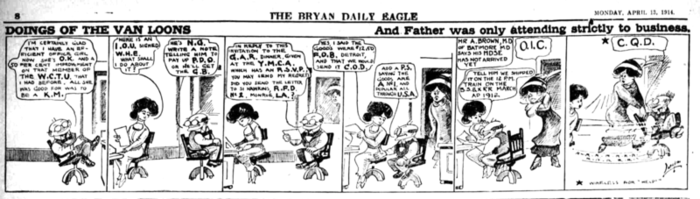
As it happens, Alan Holtz of Strippers Guide cites "The Doings of the Van Loons" as the first true daily, and says he had previously given "Scoop" that honor. He dismisses the strip as forgettable, but I think this one is pretty funny and I like the way he draws the capable and modest but unmistakably cute assistant.
Lepzieger's use of a telegrapher's abbreviation at the end (click for the footnote) is instructive. Before voice-over-air, knowing the Morse Code was part of basic newspaper training, as well as training for office boys in a wide variety of other information-based industries.
In 1897, the White House had to move its telegraph, because it was within hearing of the area where reporters — many of whom had started as newsroom clerks — waited for interviews and briefings.
Who knows how much leakage occurred before some White House staffer noticed reporters getting quiet and gazing off into the distance whenever the sound of clicking began to come from the next room?
75 Years Ago Today
By 1939, the comics page was well-established, and some still-familiar faces had begun to appear there.
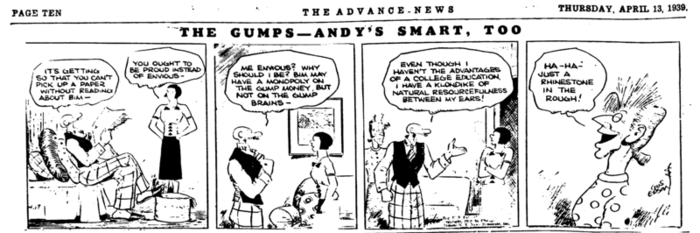
The Gumps are something of a legend, though, as with several of the strips here, their appeal seems to have depended on familiarity, which, by the way, is why it's idiotic for newspapers to run promotions where they put various strips up for six week runs to see what people like.
There are a few giants that appeal at once — the first time I saw "Cul de Sac," I nearly fell out of my chair. But other excellent strips require some easing into, and much that has "instant appeal" turns out to have little depth or variation thereafter.
This link is pretty good testimony to how much loyalty familiarity with the Gumps could inspire.
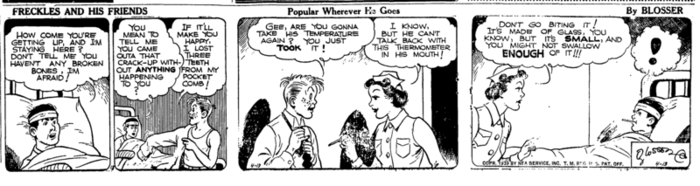 Long-term consistency doesn't seem to have been a factor in the public's affection for Freckles, who began as a very young kid but had become a teen by 1939 and stayed there.
But even after he stopped growing older, the strip went between adventure stories and high school hijinx, and when you pick up an old paper and find "Freckles and His Friends," you have to read it to find out where he's at now.
For the bulk of his long run, he was a precursor to Archie, but I had a chance to read Freckles every day through 1942-1949 as research for the "50-years-ago" segment of a historic feature, and, when he and Lard and the gang were fretting over prom, they did it with more fiber and depth than the Riverdale High crowd (whom we will see tomorrow).
As it happens, Freckles — the strip, not the kid — was 25 years old in 1939, an occasion marked by this Editor & Publisher article Holtz reprinted.
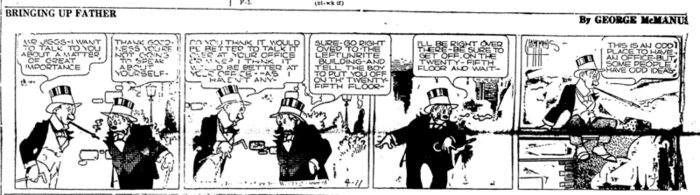
Bringing Up Father, by contrast, was pretty much unchanging throughout its run, and it was a good run. Jiggs could have been in the 1914 section of this post as well; the one-year-old strip just didn't happen to appear in any of the papers I came across. By 1939, it was a well-established standard.
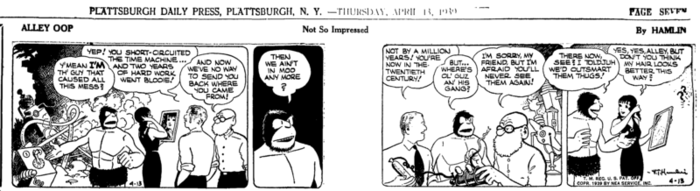
There's a man in the funny papers we all know, but he was funnier and more inventive back in his early days.
Alley Oop offered some enjoyable light adventure and we've unwittingly dropped in on a critical story arc: According to that linked Toonopedia entry, the time machine that kept the strip fresh for a long, long time had been introduced April 5, and Oop and Wonmug are just getting to know each other here.
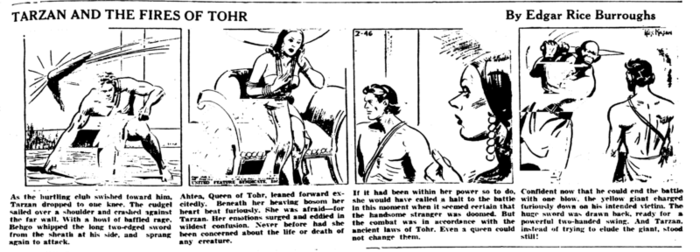
Nice thing about Oop was that you weren't required to take him seriously. Tarzan, on the other hand, was more weighty. Wordy by modern standards, but these were the days of radio and kids were used to a lot of exposition.
And, like Prince Valiant, Flash Gordon and other adventure strips of similar vintage, the artwork was more important than the credibility of the storylines. These features were aimed at a core audience that today is reading the very weighty, serious comics of Marvel and DC.
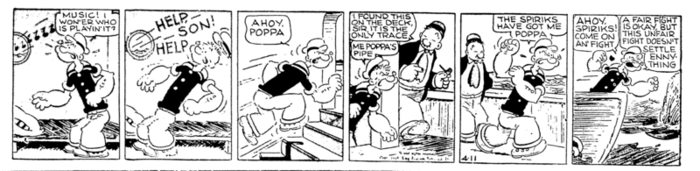
Here's another primitive you didn't have to take seriously. Popeye had made his debut a decade earlier, in Elzie Segar's Thimble Theater and quickly took the place over.
It's not clear to me when the title of the strip changed and, as it happens, the title line was dropped by the paper that ran this particular strip. However, Segar had died in 1938 and the strip had been ghosted by Doc Winner over his illness and into 1939, when Bela Zaboly took over the art, so we're catching the Sailor Man in a moment of flux.
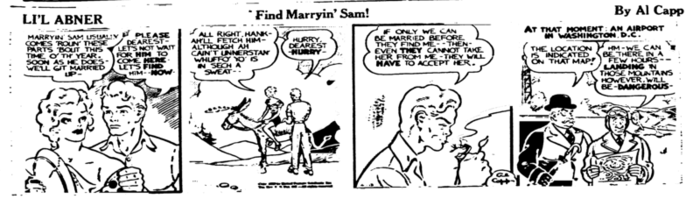
And yet another not-to-be-taken-seriously hero, who happens to be missing from this particular episode. The scan isn't terribly good, but this "Li'l Abner" arc allows me to link something particularly ghastly that was making the rounds recently: An unsold TV pilot for a L'il Abner sitcom which appears to have stolen its plot from this very strip.
The version I saw earlier has been taken down, perhaps by a copyright holder who had tinkered with the production in order to make a version that is even more unwatchable, believe it or not.
(What a segue!)
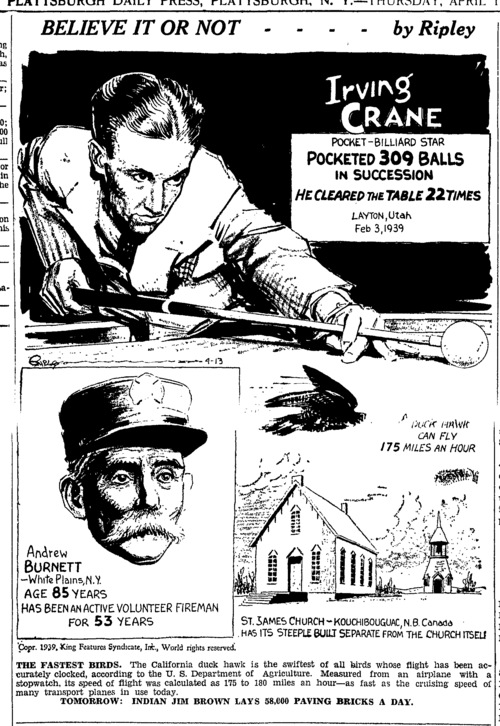
Loved this strip as a kid. No, not in 1939.
Tomorrow, we'll look at today's strips from 1964 and 1939.
And now, your zen moment of 1933
Popeye's film debut, six years before the above strip ran
Comments
Comments are closed.