CSotD: Alison Bechdel on her lost, low-brow past
Skip to comments
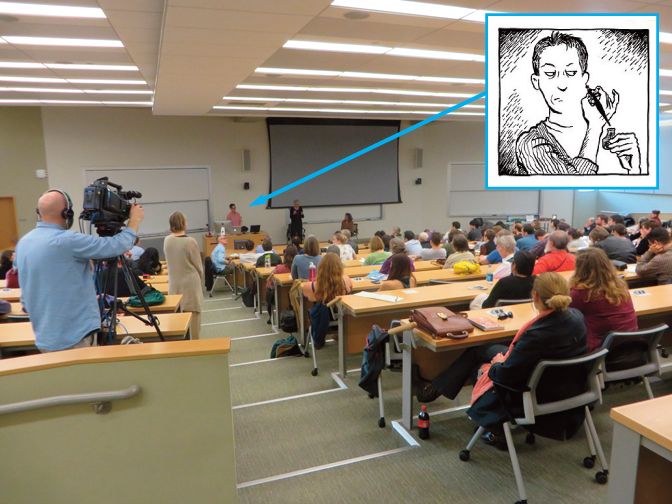
Yesterday, Alison Bechdel was in town to deliver the Center for Cartoon Studies' Will Eisner Spring Lecture at Dartmouth to an audience of CCS students, Dartmouth students, fans from the community and Ed Koren, who, after all, is Cartoonist Laureate of Vermont, where both the CCS and Alison Bechdel are headquartered.
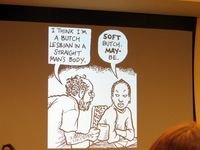 It was a very different presentation than I've seen from other cartoonists, much more introspective and about why she does what she does on a gut level, though she did illustrate it with samples of her work.
Which among other things paved the way for a long question in the Q&A that followed, all about channeling repressed aggression through art, which caused her to ask, "Are you a therapist?" to which the response was, "Yes, sorry."
But the question was relevant, the exchange brought laughter and she did answer it, which really consisted of refocusing many of her earlier remarks.
I don't know if this is a standard presentation that Sarah Laing also heard in New Zealand last month, but it was complex and personal enough that I don't feel I'm going to burn up her material here and force her to construct a new piece.
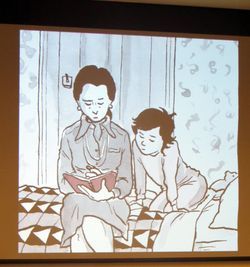 Readers of "Fun Home" and "Are You My Mother?" will already know that Bechdel is introspective to a just-short-of-obsessive degree, by which I mean that, on the one hand, if she hadn't found a way to use her art to process that introspection, perhaps she would not be so aware of it all, but, certainly, whether it was on the surface with no place to go, or buried and unrecognized, Alison-without-an-outlet would probably be pretty hard to be, and hard to be around.
Alison-with-an-outlet is fascinating, and, as I said earlier, it wasn't irrelevant for that therapist to probe for more, because, at this stage, you can't discuss Bechdel's work without discussing Bechdel.
"Fun Home" has been compared to "Maus," but, first of all, Spiegelman's device of using mice as characters provides emotional distance and avoids crushing the reader, and, second, he bounces back and forth between his own difficult relationship with his father in the present tense, and his father's experience in Auschwitz in the past.
By contrast, Bechdel lets the chips fall where they may, not simply drawing her own family in the roles of her own family but leading off chapters with recreations of family photos in order, as she explained, to continually remind readers that this is something that really happened.
Moreover, she does not have the luxury of casting back to a distant event to explain anything. What happened, happened while she was there, and she blames herself to a degree that is perhaps taking on more than is fair. However, she sees her issues as inseparable from the issues that everyone in her family faced, the only difference being in their various coping mechanisms, and that can, Leo Tolstoy notwithstanding, be applied universally to every family.
Bechdel cited her early love of Charles Addams cartoons, saying that her parents had a collection through which she pored as a child, which is a very familiar story among avid cartoon lovers.
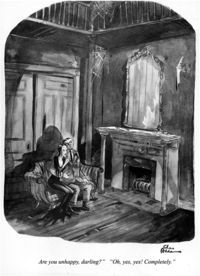 But she spoke of how she particularly savored Addams because "the cartoons baffled me, but, at the same time, there was something deeply familiar in them" to a little girl who lived in a home filled with antiques and secrets and confusing differences between appearances and reality.
And she used as an example this particular cartoon, then flipped to a panel from "Fun Home" in which she had drawn the same fireplace as her own.
"I always had a sense that there were things going on that I didn't understand," she said. "There was a disjunction between appearances and reality. Things didn't match up, and I wanted things to match up, but, as I grew older, I found that things never do match up."
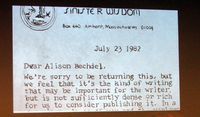 Bechdel had begun her talk by showing a rejection letter from an art school, and another from a publisher, explaining that "cartooning is a great field for people who are mediocre artists and mediocre writers. My art, by itself, my writing, by itself, deserved those rejection letters. But then I put them together."
Later, she said she had chosen cartooning not just as a way of reconciling the facts she had learned — that language is unreliable and that appearances are deceiving — and that "by triangulating between them, I could get them close to truth," but also because cartooning, at the time, "guaranteed a certain level of obscurity."
"Comics were low-brow," she said. "You could express yourself freely without getting critiqued."
She began by filling a gap, in that there were no people in comics who looked like her and her friends, and thus was born "Dykes to Watch Out For," which she drew for 25 years, until, among other reasons for letting it go, society's growth meant that being a lesbian no longer automatically conferred an outsider perspective, which, she admitted, she misses.
Meanwhile, however, she had begun to turn her gaze inward, and to turn from fictional comics to nonfictional graphic memoirs.
And if she ever comes to your town, or you have the sense to go to a town to which she is coming, I recommend you hear the rest of what she has to say.
Today's headline comes from some remarks she made about being asked to edit a "best cartoons of the year" edition:
I got into cartooning because it was low-brow and I could do whatever I wanted, and now here I was judging other cartoonists and deciding who would be elevated into the canon, and I'm not sure how I feel about that.
I have some nostalgia for this lost, low-brow past.
And, now, for the cartooning geeks:
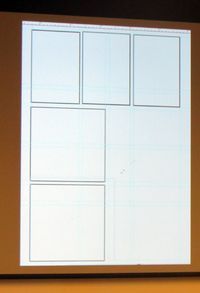 A couple of process notes:
Bechdel began "Fun Home" as a Word doc, writing it in the format of a screenplay, but switched to working in Illustrator, using her personal hand-lettering font.
This allows her to insert the text while retaining the flexibility to expand and rearrange panels on the page, with the text flowing along in the same font size until she gets the balance of boxes she wants.
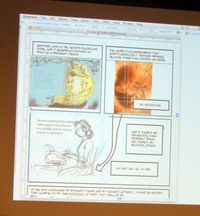 She then begins inserting images, either similar stand-ins snagged from the Internet or her own sketches, and once more working to achieve the balance she wants.
Next comes printing out the pages on paper, penciling and inking, then scanning back in and bringing up in Photoshop to complete the black-and-white plate.
Color overlays are then done by hand before being added, at which point the pages are brought into a layout program (which she didn't specify) to finish things up.
Finally …
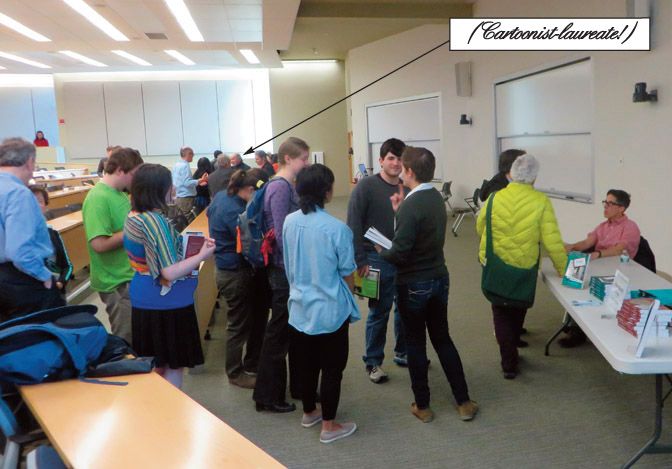
I would have enjoyed talking to her after the presentation, but I suppose that would suggest a lack of interest by anyone else. Hardly the case. She had a massive and well-earned line of fans with books to be signed.
So, if you want to know more, go see her speak sometime. This is only the Cliff Notes.
Comments
Comments are closed.