CSotD: Some of us think we’ve found the key, don’t we?
Skip to comments
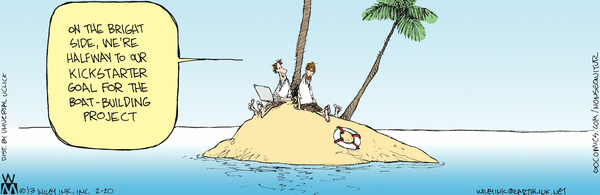
Kickstarter can solve any problem.
In a universe in which the word "any" means "a rather specific type of."
I don't think, for instance, "being stranded on a desert island" is the sort of problem Kickstarter can solve, despite today's Non Sequitur.
But I do think Wiley's sarcasm is well-placed, and it's not often that such a shall-we-say-familiar setting is used for such apt commentary.
I like Kickstarter, and I've supported several projects on it, some of which I've plugged here and some of which I have not, but, for the most part, they've all had this in common: Supporting the project was more or less like buying something I'd have bought anyway.
Which, in my case, has generally meant a comic collection, and generally one signed by the artist. And it's been an artist whose work I already knew and liked.
A lot. Enough to pay $25 or $40 for a book that, once it's published, will likely sell for ten or twelve bucks.
Here's what Kickstarter isn't: A magic pathway to the funding of creative projects.
Here's what Kickstarter is: A pathway to the funding of creative projects that, in a more robust economy, would likely have found funding anyway.
Part of the Kickstarter mystique revolves around a sort of genie-in-the-lamp fantasy, in which unrecognized geniuses can break through with their projects, and that's not very realistic.
Kickstarter is simply a chance to ask your friends and fans to put up money to support your project without having to actually stand in front of them with your hand out and look into their faces while they make up their minds.
And that's a very good thing, as long as you have a sufficient number of friends and fans, because they won't all say yes, but, as long as enough of them do, well, there you go.
In the olden days, to start with, a successful syndicated cartoonist might expect their syndicate to support publishing a collection of their work. Not only is that nowhere near as likely today, but even new copies of already-published collections are often farmed out by the syndicate to print-on-demand outfits where the quality control is, well, not what it might be.
Or, copyright permitting, a cartoonist might approach a commercial publisher, but, unless they can see that the book will not only jump off the shelf into readers' hands, but will be promising enough to be put on the shelf by bookstore owners in the first place (or searched for on Amazon), it's not likely.
If you don't have a massive, established audience, you're not going to convince someone else to put money up front for you. That has never really worked, but now less than ever.
Here's how, beyond traditional corporate channels, a lot of creative projects have traditionally been funded: You get some of your more well-heeled friends to host a couple of wine-and-cheese gatherings for their well-heeled friends and then you get up and make your pitch, and hope that they are impressed enough to get out their checkbooks.
That's Kickstarter, with the advantage that people don't have to write particularly huge checks, so you can invite everyone and not just the high-end, polo pony crowd.
But they still have to show up, and they still have to dig your concept, and your potential to carry it off, enough to want to support it.
To make Kickstarter work, you have to have an established fan base, and, if you're looking at support in $25 increments, that fan base had better be pretty large, because they aren't all going to jump in.
And here's another reality check: Kickstarter contains a certain element of backscratching. If I supported your Kickstarter project, you should support mine. So there is, to some degree, a circle of artists sitting there passing the same twenty-dollar bill around, hand to hand, and that's obviously not sustainable.
Fans, then, are the source of new money for the system, and that introduces an element of competition: If you produce, let's say, a sci-fi strip, your fans may be following 50 such strips. Are they ardent enough in their support that yours will be the project they kick in for?
I've been to Cons and seen that one table has fans lined up to buy books while several others – er, well – do not. That's life; that's how it goes.
You need to be the one at whose table the fans line up, or Kickstarter probably isn't going to work.
All of which is to say, if a long-forgotten eccentric uncle left you the money to publish a collection of your work, would you then sell out that first run and make enough money for a second printing?
Or would you wind up with cases of books stashed in your garage?
What Kickstarter does is that it keeps your garage uncluttered.
And that's a good thing.
If you've been dreaming of launching a Kickstarter project, I hope this hasn't been too discouraging. You do have to have faith in your work, after all.
And I like people who have faith in something, but not if they're silly about it.
Unless they are this silly about it.
Because, aren't we each, in our own way, stranded on a desert island?
I know I am.
Comments 3
Comments are closed.