CSotD: Is Paris Burning?
Skip to comments
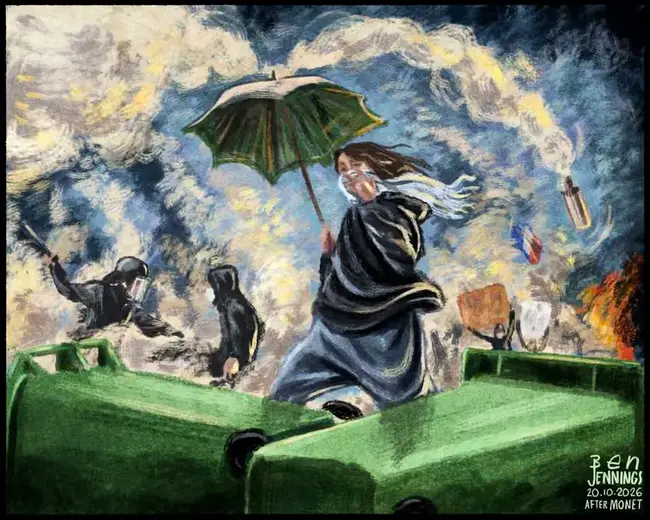
Something is happening in the streets of France, but what it is ain’t exactly clear. And looking at the cartoons doesn’t provide much clarity.
That seems normal, doesn’t it? I happened to be in Europe in 1965 when the Watts Riots exploded, and seeing it from there, you’d think the entire West Coast was up in flames.
After a few days, we ran into a couple of Yanks who had been there when it began, and they assured us that it was largely contained to the neighborhood, and that even elsewhere in Los Angeles, you wouldn’t know it was going on unless a carload of random rioters drove down your street yelling and throwing things.
That didn’t mean the riots weren’t serious, only that they were hard to comprehend from 5,000 miles away. It wasn’t easy for folks in Beverly Hills to understand what was happening in Watts either, but at that point, you drift away from what is happening and get into why.
Juxtaposition of the Day
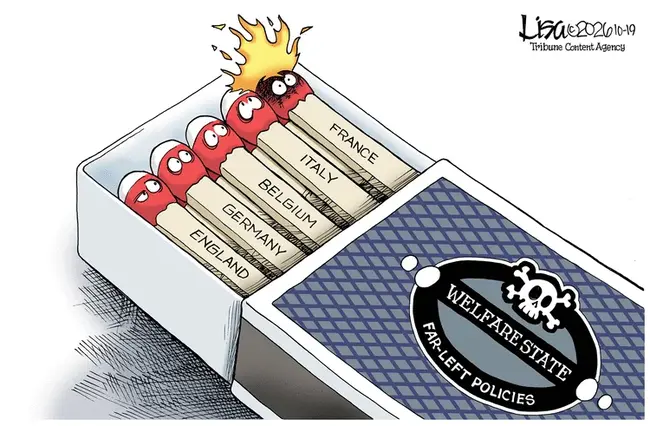
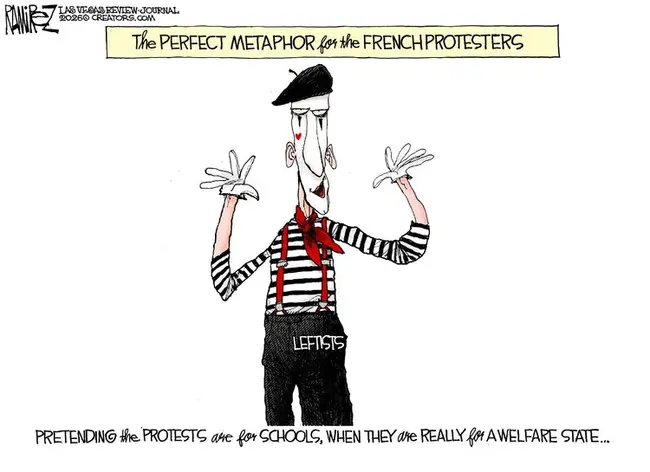
Somebody on this side of the Atlantic apparently used the term “Welfare State” to describe what the French demonstrators want, but I haven’t seen it elsewhere. And while you can’t argue with the fact that Marcel Marceau was French, I’m less convinced that riots over the state of public schools and cost of living generally in France will enflame Europe, though thank god we’re more passive.
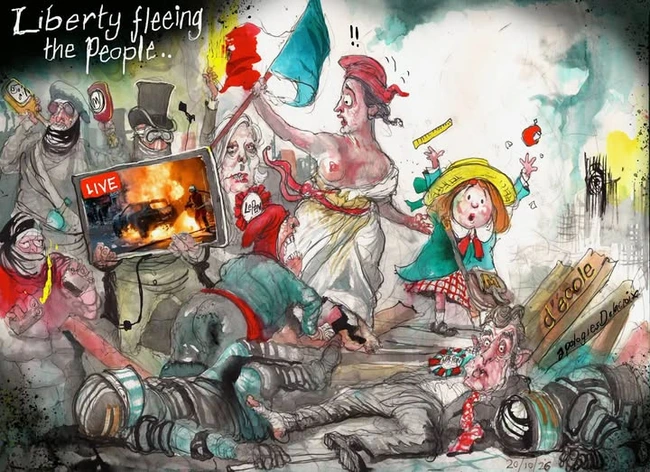
Several cartoonists have riffed on Delacroix’s Liberty Leading the People. Rowe just seems to portray the chaos, which doesn’t shed much light on things. His portrayal of police on the ground, along with Macron suggest a lack of control of the situation, but including Madeleine is somewhat confusing. Her nice little convent school with 12 little girls in two straight lines isn’t the sort of school that sparked the disturbances.
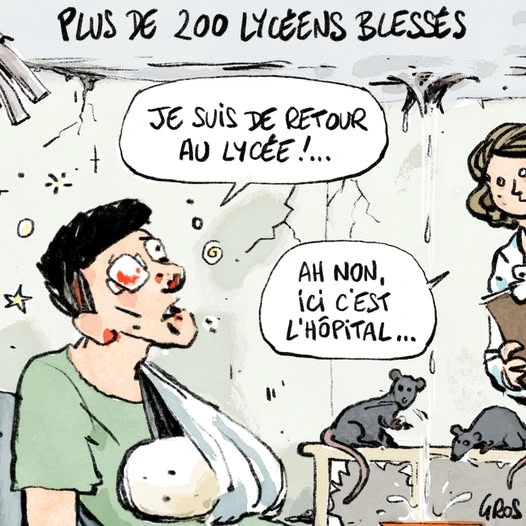
Gros offers more of an insider view from France, though the count of wounded students has since climbed. But the dialogue, the dilapidated building and the rats cut to the core of the riots. He says, “I’m back at school!” and the nurse responds, “Ah, no, this is a hospital.”
The disturbances began as demonstrations protesting the condition of schools in a poor district, where not only were the buildings in poor condition but there were insufficient books and either missing or unqualified teachers. But Gros suggests that schools are only one underfunded aspect and that demanding more isn’t necessarily an aspect of a looming “welfare state.”
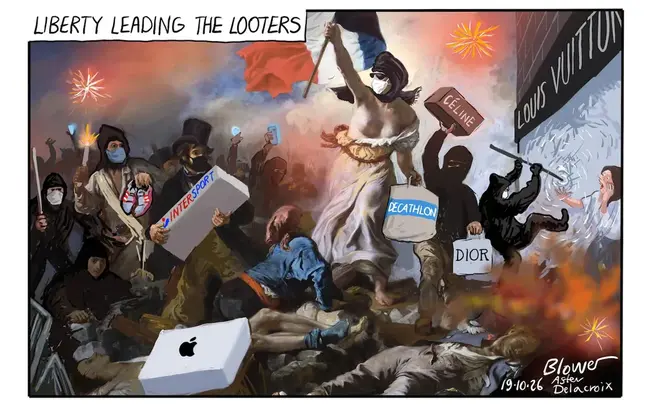
Blower also borrowed Liberty, but focuses on looting, a relatively normal feature once a demonstration has degenerated into a riot. It’s not whether you take looting seriously, but, rather, whether it is a major factor or a side show.
Of course it’s serious. It’s theft, and burning of buildings is also damage that often strikes uninvolved small businesses in affected neighborhoods. Neither are good things, but, then, we’ve seen looting exploited as a political argument.
In the riots that followed the murder of MLK Jr, Mayor Daley’s order to “shoot to kill” looters did more to outrage the people than it did to save any television sets, while in the wake of Katrina, people broke into deserted stores for diapers and bottled water, which was a matter of desperation, not one of normal looting.
Looting should be noted and disparaged, but then filed away for further study and evaluation once things have calmed down. It’s never the main show.
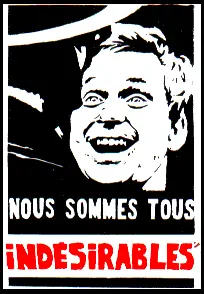
I’m reminded, not of the Mai/Juin riots of 1968 themselves, but of a documentary 10 years later, in which Daniel Cohn-Bendit, one of the leaders of those demonstrations, said they had just wanted to march down the streets, drink some wine and kiss some girls, and that the trouble came from the police attacking them instead of just trying to direct and control them. The students had some demands, but they hadn’t been looking for trouble. (This being in contrast with the more radical and violent students in Germany at roughly the same time.)
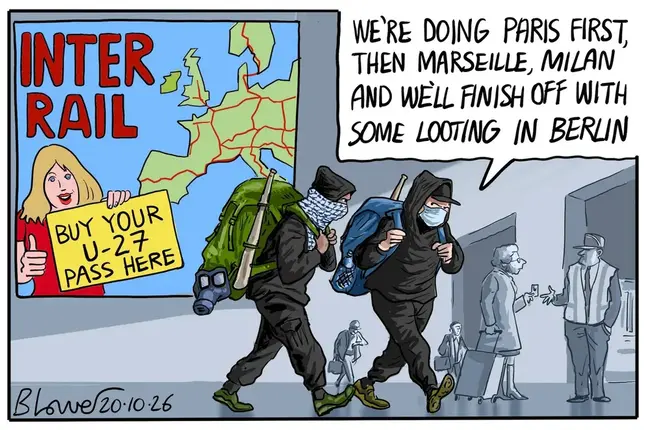
Blower returns to the topic, however, to accuse rioters of being part of an international set of professional malcontents. As a serious accusation, it requires some documentation, but it has the feel of the common charge that “outside agitators” are working at the direction of someone or other — often Moscow or Beijing, though not always that specific — and the more strident accusation that they’re being paid.
However, Blower makes neither accusation and he’s not off-base to suggest that when people see demonstrations become riots in one place, it may create incentives to riot in others. Even if the more radical types are a minority among demonstrators, they can take dominant roles.
But I could say the same of police, having been in the middle of a police riot in Chicago: Many of the cops were horrified and tried to keep demonstrators away from their brawling colleagues, but a truncheon in the face still does plenty of damage.
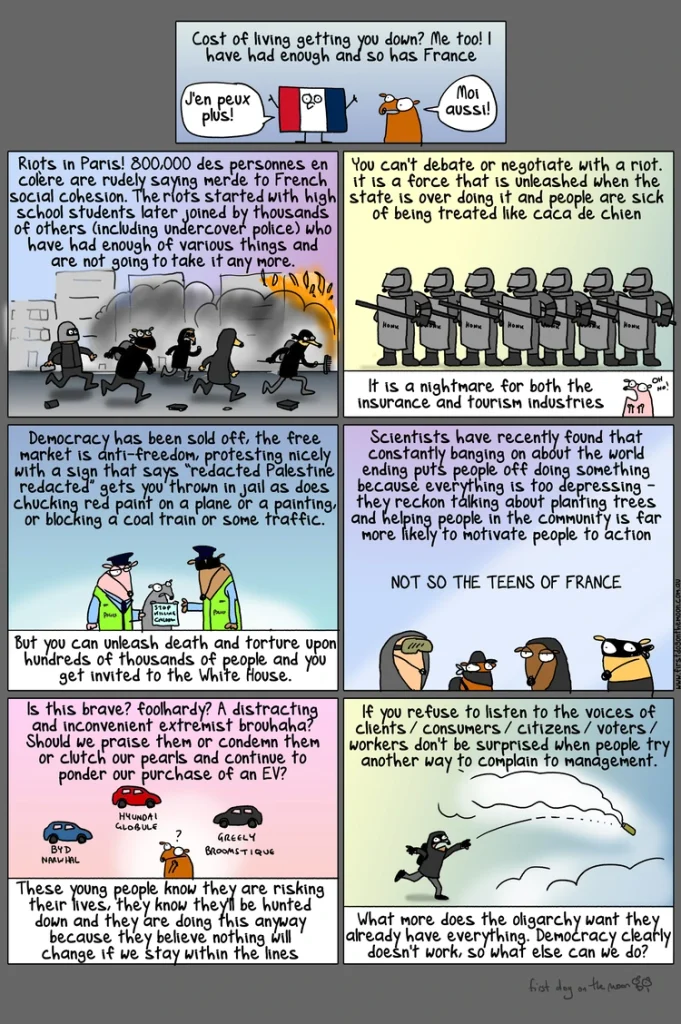
First Dog has apparently also seen these things close-up, because he encapsulates the situation well despite being a good distance away.
He also reflects the frustration of a common dilemma: If you protest peacefully and present your issues calmly, the response is often a pat on the head and empty promises.
If you ramp things up, however, the response is that “we can’t bargain with terrorists,” which is then accompanied by jailings and violence.
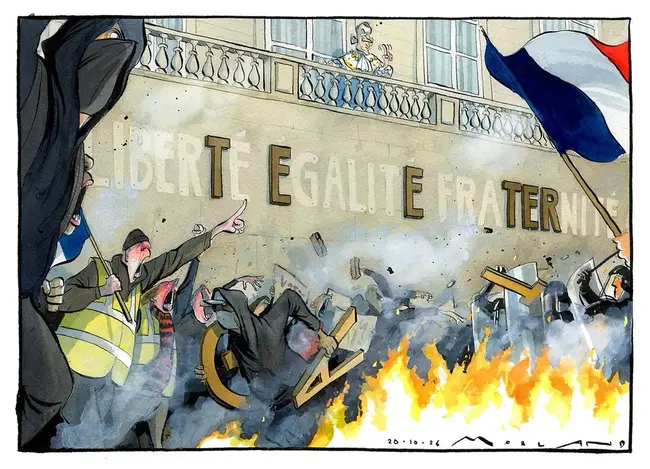
Morland sums things up by pointing out that the riots leave Macron wagging a disapproving finger while his government teeters on the brink of collapse, due to the unrest itself as well as to the impact it has on the rest of the electorate.
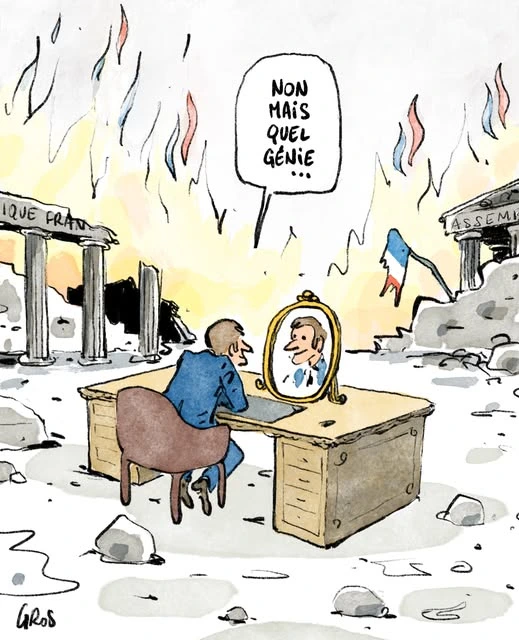
Gros offers much the same opinion, set in the riots’ wake. Macron made a national speech of only eight minutes in which he urged calm and so forth, but Gros declares the only takeaway was “Wow, I’m such a genius!”
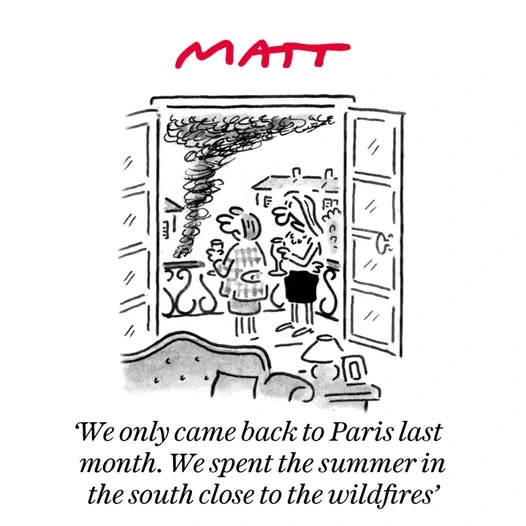
And Matt Pritchett speaks for those who don’t know anything about the conditions in French schools or much of whatever else that has those young people all upset, and who find occasionally find the world very inconvenient.
Why do I think we’ve heard this before?
Mike Peterson has posted his "Comic Strip of the Day" column every day since 2010. His opinions are his own, but we welcome comments either agreeing or in opposition.

Comments