Comic Strip of the Day

CSotD: Timing, Immediate & Long-Term

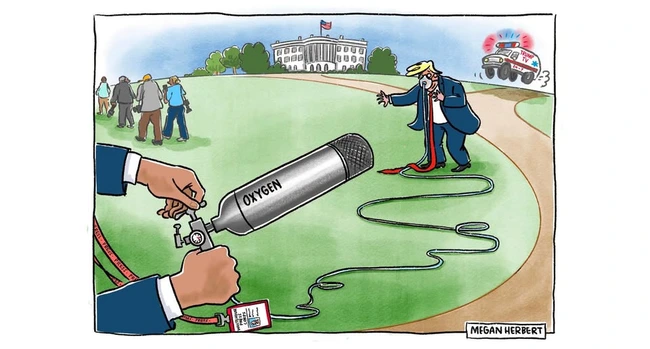
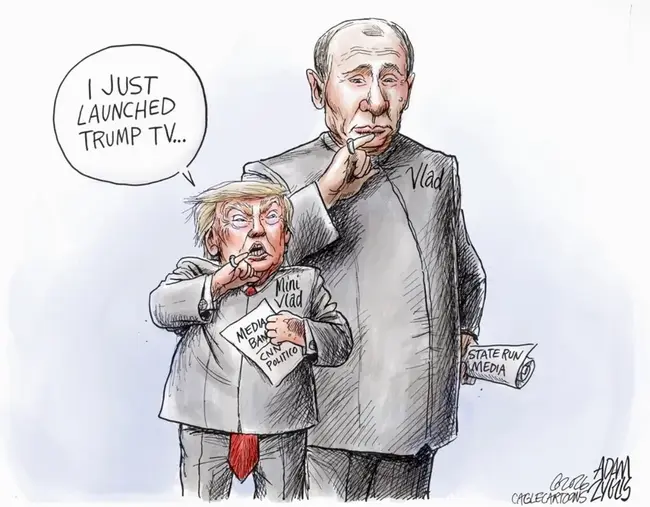
As they say, timing is everything. They usually say it about comedy, but it’s obviously a factor in political cartooning and here’s a pair of cartoons that had everything except good timing, and, in the case of Megan Herbert’s piece, it’s a very rare case in which the time difference between Australia and the United States worked against her.

Trump’s lawyers, having served up a totally inadequate defense of his ban of three networks from the White House, asked the judge to ponder things until late Friday afternoon, which got a laugh from me because Friday quitting time is when you release bad news in hopes it will get lost over the weekend. The request was as hapless as their case, which was a dead duck from the start, its substance having been sorted out in the past.

From a cartooning standpoint, however, burying it in the Friday afternoon deadzone would have been good for Zyglis and Herbert, because it would have allowed their work to shine. As it was, however, Judge Kelly could have ruled from the bench but gave it a few hours before restoring the media’s access shortly after midnight this morning.

It was a shame for Zyglis because while I think Austin Powers gags are tired, there are times even a tired gag gets new life, and depicting Trump as a Putin Mini-Me is, particularly in this case, wonderfully apt. And both cartoons provide good analysis of Trump, but were deflated by Judge Kelly’s preliminary but obvious decision.

I don’t know if either made print, by the way, but they hit online in-boxes this morning and that’s getting to be the larger venue, if not the most lucrative.
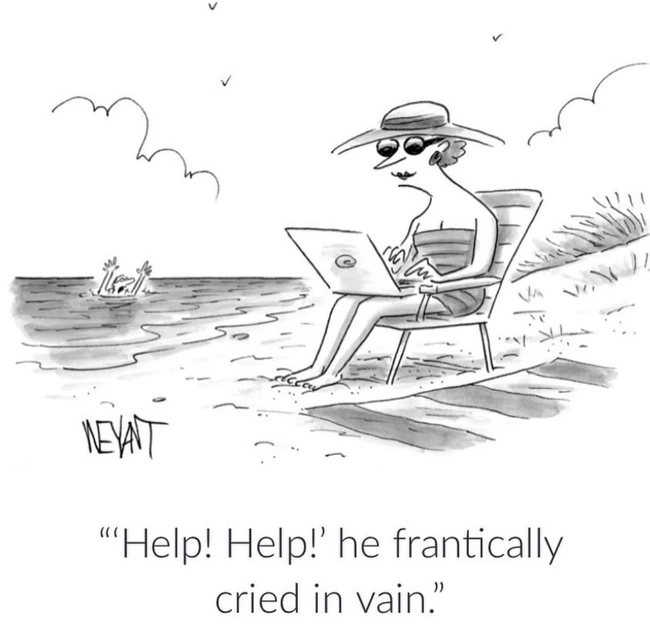
Speaking of breathing fresh air into a tired gag, I have a particular dislike for “Look behind you!” cartoons. I drew one when I was 13, of an explorer in a jungle with a fat-bellied T Rex behind him, saying “Don’t mumble, Johnson.” Every time I see yet another version of that gag, I think how funny it seemed in 1963 and how not-funny every variant since has become.

I’m also tired of a much younger lame gag which is people staring at their phones and ignoring the world around them, which would make this a double-loser, but somehow his piling Pelion upon Ossa has the opposite effect here.

I think that the difference — and it’s critical — is that she’s not just absent-minded but self-absorbed, given that she’s writing the words rather than reading them, and while Weyant doesn’t specifically say so, I think she knows the fellow who is drowning, given the empty towel at her side.
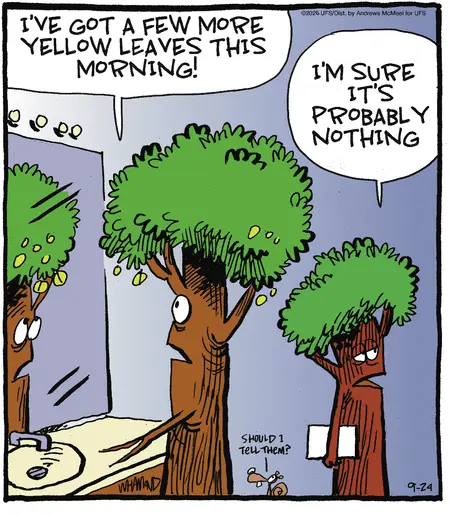
Different kind of timing: This ran this morning and, as it happens, I saw my first yellow leaves yesterday, so this is extraordinary timing for me, though a little late for those farther north and too early for those to my south.

It is not healthy to believe the cartoonists are writing specifically for you, but it’s fun when it seems to happen. If you’d like, you can file the cartoon away and look at it when it becomes ripe.

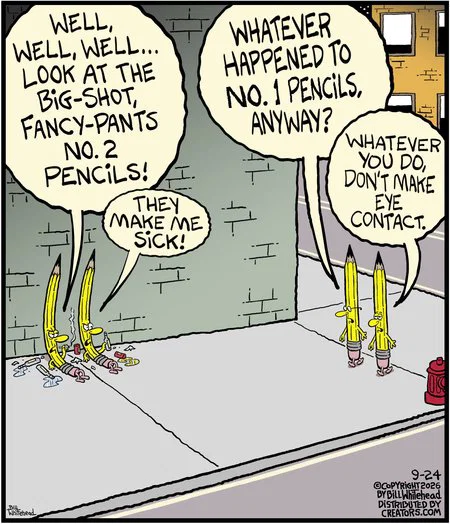
Juxtaposition of the Day, Technical Division
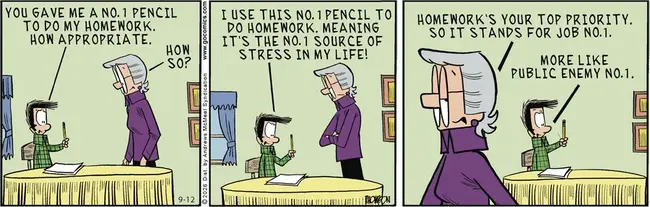
I didn’t even know No. 1 pencils still existed, but indeed they do, and many more besides.
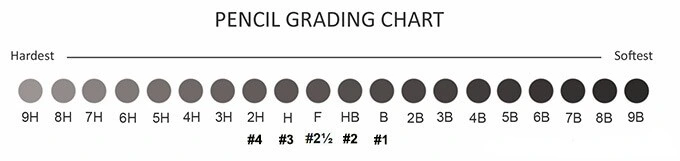
So for the artists amongst us, here is a whole lot of information about different grades of pencils. It even has an FAQ, which I found funny because I don’t F ask any Q’s, but perhaps you do.

A More Serious Timing Issue
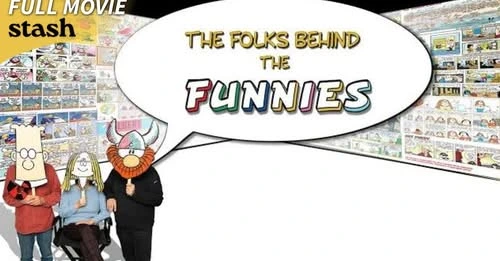
Stacy Curtis raised a significant flag yesterday, with a Facebook entry upon having watched the 2018 movie, The Folks Behind The Funnies.

His reaction was (in part):

“This video takes on a whole new meaning when you think how many of these comic strips are in reruns which prevent new, fresh comic strips from appearing on the comics pages. Cartoonists who claim to love the comic strip profession are the same ones who destroyed it.

“This video seems to be at least two decades old. Almost every comic strip in this video is being rerun in newspapers today or the comic strip has been handed off to a new creator.“

He’s right that it was filmed well before it was released; he’s also on target about the issue of reruns and zombie strips. My local paper runs a dozen strips, three of which are reruns, eight of which are zombies and only one of which is drawn by its original creator.

Part of the problem is editorial indifference. Most editors don’t understand cartoons to begin with, being literalists largely immune to metaphor. And they don’t have to deal with cartoons. Comics flow directly into the backshop, are placed on a pre-formatted page and aren’t seen by the newsroom unless someone sneaks in a PG-13 gag and phones start ringing the next morning with complaints. (Nobody ever calls to say they laughed.)

And when newspapers have “reader surveys,” they aren’t statistically balanced and most people who answer are retirees with time for such things and who like the familiarity of old favorites doing the same things they’ve done for the past half-century.

I say this as someone who redid the comics page for a paper, swapped out seven of its 21 comics, designed a custom Sunday package and had maybe half a dozen complaints. It can be done, but won’t be, because that’s how the business works at that end of the transaction.

I have another solution that won’t happen: Why not offer cartoonists no more than four five-year contracts? I base this on my observation that British TV comedies produce a few good seasons and then stop. Think of how few classics went on terribly long. To The Manor Born was only three seasons, and no more than eight episodes per season. Monty Python did four seasons, as did Blackadder.

Similarly, Calvin and Hobbes ran a decade, the Far Side for 15 years, and each ended about when it should, then made room on the page for fresh, new material.

Oh no, I’ve said too much. I haven’t said enough. But a newspaper that carries 12 strips should offer more than one that’s done by its original creator.

Mike Peterson has posted his "Comic Strip of the Day" column every day since 2010. His opinions are his own, but we welcome comments either agreeing or in opposition.
Previous Post
Wayback Whensday – Cartoonists of Yore
Next Post
Postscripting

Comments 21

  1. A quibble: Sure, not every comic strip deserves to celebrate its centennial still running in the Dacron Republican-Democrat. On the other hand, not every cartoonist can be Watterson or Larson, living off the residuals of ten to fifteen years of work.

    1. Do another. Hemingway lived decently by doing more than one novel, and if there’s room on the page, your odds are better than if there isn’t.

      1. But how could they live up to their reputation? I’ve heard that the two men involved in writing and producing The Fall and Rise of Reginald Perrin said that they could never work together again because anything they did would be compared to that show, and not favorably. The only cartoonist I can think of (if I’m wrong, I’d love to hear of more examples) who left one *highly regarded* strip and started another was Berke Breathed, who ended Bloom County and followed it with Outland. I don’t think it was as good, and it didn’t last long. (It was set in the same world, kind of, so it wasn’t a complete turn to something new.) Also, there’s a difference between drawing a comic strip for fifteen years and writing a book, followed by another book, and another book, and…

      2. I can’t think of any cartoonists in modern times who gave up one hit comic strip and then created another another.

        Historically, Milt Caniff went from Terry and the Pirates to Steve Canyon, both successful. The Mort Walker/Dik Browne studio produced several popular strips, but that’s not the same thing. Johnny Hart had BC and Wizard of Id going simultaneously but that’s not the same thing, either. And there are cartoonists who put together nice careers floating from strip to strip–I’m thinking of people like Jerry Scott, Terry Beatty, etc. Still not the same thing.

        I certainly understand that once a cartoonist lassos a golden unicorn they’ll try to ride it until it drops, which makes Watterson’s and Larson’s decisions to do the opposite all the more remarkable. I also think newspaper comic strips are more of a zero-sum game than conventional novels. There are a lot of publishers and bookstores, but only a few syndicates and diminishing numbers of newspapers.

      3. The comparison was that novelists exist in a world in which there is always room for another. Caniff didn’t have to fight for space with reruns of dead strips, and I’m sure part of his breakthrough was — like Hemingway — the fact that he was a known quantity.

        Breathed was able to launch a second strip based on the outstanding popularity of his first, though he made demands about size that annoyed editors and then dished up something that didn’t live up to its original. And that, too, was before reruns became a factor.

  2. Speaking of pencils, there is a short (~ 9 minute) video
    “How Blackwing Pencils Are Made” that is the first explanation about their manufacturing process.

    https://kottke.org/26/09/how-blackwing-pencils-are-made

    Then, if you fall into a rabbit hole mode, three more pencil links are at listed the footer of that link.

    * How Pencils Are Made in a Japanese Factory

    * How Pencils Are Made, A Visit to an American Factory That’s Been Producing Pencils Since 1889

    * A History of Pencil Lead and How Pencils Are Made

    1. Both Jason Chatfield and Brian Biggs have done videos on their pencils.

  3. Finding the perfect pencil is the White Whale of cartoonists who still put literal pen to actual paper. My current faves are Mitsu Bishi 9850 HBs.

    Appreciation of a fine eraser on a pencil is another cartoonist kink.

    1. Favorite pencils are SO subjective. As a carpenter I usually have to make do with a flat pencil, which like many tools for carpenters is made that way so that it can’t roll off of wherever you set it down and break its point. You have to knock it off, which happens plenty often enough as it is. For a short while in the nineties they made those pencils out of some sort of plastic and poured a liquid graphite into the center. They were available in flat and 1st grade sized round. Much easier to sharpen with a utility knife, because there was no grain to the plastic, and the lead resisted breaking significantly more than the solid graphite with wood glued around it. But for some reason they never caught on. More expensive, more poisonous, some material scientist knows, but I don’t.
      Then when drawing plans (no longer feasible, because computers and autocad) the .5 millimeter mechanicals were wonderful, and available in any hardness of lead from art supply stores. I eventually settled on the Skilcraft maroon Federal office supply ones, because they had the perfect non damaging or smearing erasers, which last forever. Great for crossword puzzles too. My employer when I worked for the Feds gave me a whole box, with extra erasers and leads, which I still have from 35 years ago. An unusual example of government supply efficiency, and quality. Fully retractable tips and parts, too.

  4. I saw Stacy’s post, and while I agree with the spirit of it I would distinguish between rerun strips and zombie (or “legacy”) strips. I agree that syndicates just shouldn’t offer rerun strips and newspaper editors shouldn’t buy them. After all, the word “new” is right there in the product. The counterargument: most readers don’t know the difference, and if they want to read old Mutts, Doonesburys, or FBOFWs, editors are just giving the public what they want. I think that argument is wrong but I understand it. Still, if syndicates would rather strip-mine their backlists than develop new talent, they’re harming themselves and the art and business of cartooning in the long run.

    I disagree about zombie strips continued after their creators died or handed them over. I judge those on their individual merits: some are pale imitations of the originals that should have been put to pasture decades ago, while others are as good or better than ever. I won’t list the ones I think are bad, but some strips I’m happy to see continuing with new creators are Sally Forth, Rose is Rose, Prince Valiant, Dick Tracy, Flash Gordon and, some would argue, Nancy. New creators freshened each considerably.

  5. An artistic quibble and a kudos on Zyglis’ cartoon: I don’t think labeling “Vlad” and “Mini Vlad” is necessary—his caricatures are great and the cartoon stands without them. Kudos: choosing to include Trump’s long red tie coming out from under the jacket is that little extra detail that adds levity and mockery. Loved that he included it.

    1. It’s also been over, what, twenty? years since Austin Powers came out? I know he shows up in some memes and there was maybe a Super Bowl commercial, but the day’s rapidly approaching when the average young adult won’t know who Dr. Evil is.

  6. A #1 pencil is the equivalent of a Nail. My favorite pencil is the Ticonderoga Tri-Write. Much easier to hold.

  7. I stopped reading newspaper comics around the time newspapers became irrelevant.

    Thankfully, if there’s one thing the internet is good at is providing tons of options, and an outlet for cartoonists who’ll likely never get syndicated or else simply focus on a niche genre.

    On the other hand, A.I. slop is going to ruin all that and possibly kill us all.

    1. I assume you’re supporting a few cartoonist Substacks and subscribing to either GoComics, Comics Kingdom or both, right?

  8. Speaking of supporting cartoonists, how do we go about supporting this wonderful daily delight?

    Thanks.

  9. I just called to say I laughed… every time I read your column. I need to subscribe soon, the daily cartoonist will be my first sub.

  10. I worked for a California newspaper whose new editor decided to shake up the Comics Page. What insued was a torrent of hate mail and calls. At the end of the project, most of the “oldies but goodies” were back on the page. I heard the editor say, “I’ll quit before ever attempting to change the comics page.”

    1. I worked on a paper decades ago whose newsroom had a hand-printed sign above the newsroom entrance reading, “Remember the Phantom.” It was there because, some years earlier, an editor had tried to cancel the Phantom comic strip and all hell was unleashed. The Phantom returned to the comics page and I think the sign was a reminder to editorial of exactly which page of the paper readers were most passionate about.

      1. I remember reading a similar item about an attempt by the Washington Post to quit printing “Prince Valiant”. The reaction from readers was so extreme that in addition to the “current” strip, the paper also reprinted the strip(s) that had been “skipped”. As a result, Prince Valiant has since survived multiple reorganizations of the Post’s comic pages.

Comments are closed.

Search

Subscribe to our newsletter

Get a daily recap of the news posted each day.