CSotD: Not the Worst of Evils
Skip to comments
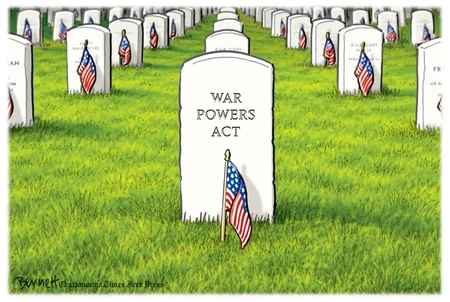
By marking the day now instead of tomorrow, I’m likely going to miss quite a few Memorial Day cartoons, but I like the simplicity of Bennett’s political statement.
Bennett’s minimalist cartoon reminds us of why we have Memorial Day while, by placing the War Powers Act amid the graves, he mourns the rule of law that was once a shield and seems to apply no longer.
Anyway, I wasn’t intending to post a collection of cartoons of little kids saluting gravestones. In a time of crisis, the day deserves less sentiment and more serious reflection than it sometimes receives.
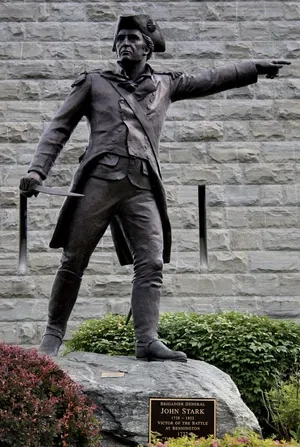
As a New Hampshire resident, I’m well aware that our state motto, “Live Free or Die,” is nearly always interpreted as belligerent. But it comes from General John Stark, who was a veteran of the French & Indian Wars, a military leader at Bunker Hill and Bennington, and, overall, a bad (shut your mouth!).
Asked to speak at a reunion of Revolutionary War veterans, his health did not allow him to attend, but he sent the message “Live free or die, boys. Death is not the worst of evils.” It was not a celebration of war but an admonition to refuse the choice of fat slavery over lean freedom.
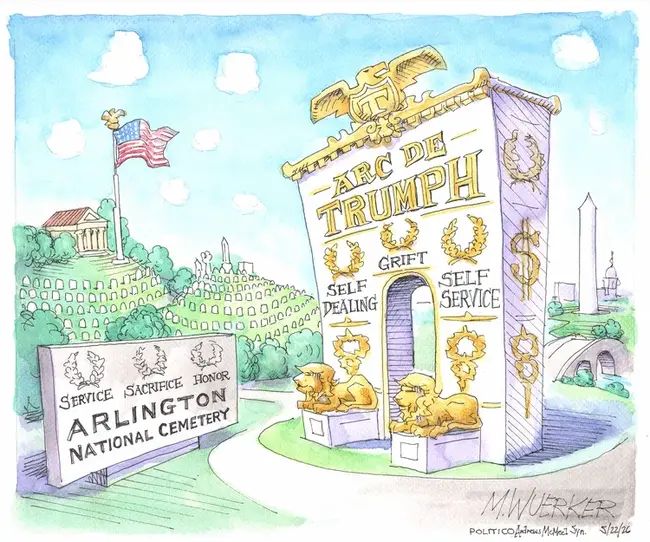
Wuerker suggests we currently face that choice, while history warns against settling for fat slavery.
Rev War veterans formed the Society of the Cincinnati, named for the Roman hero who returned from war and then, rather than capitalize on his fame, quietly retired from public life.
Stark personified that ideal, having fought in the front lines alongside his men — “There are your enemies, the Red Coats and the Tories. They are ours, or this night Molly Stark sleeps a widow!” — but then embraced the quiet of a farm.
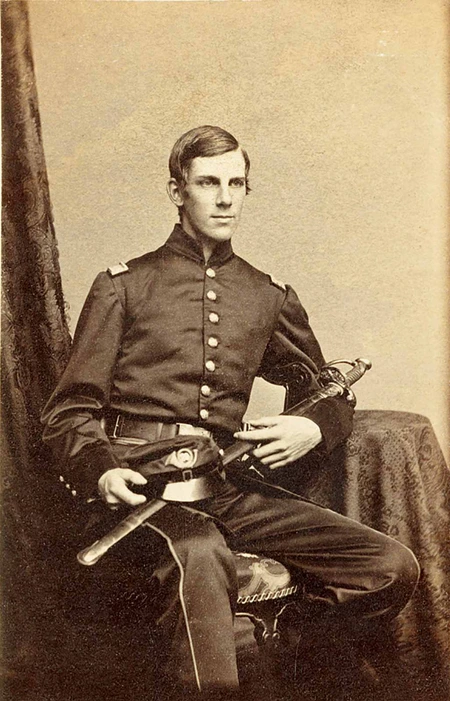
Nearly a century later, Oliver Wendell Holmes, Jr., son of a poet and part of New England’s staunch abolitionist tradition, volunteered for the Civil War, in which he was seriously wounded at the battles of Ball’s Bluff, Antietam, and Chancellorsville, but retired only from war, not from public service, becoming a justice of the Supreme Court.
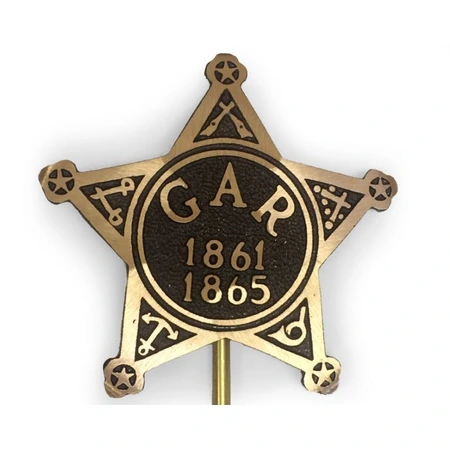
That war’s veterans styled themselves the Grand Army of the Republic, and Holmes, whose legal statements are often quoted, crafted one of the most frequently cited must-read reflections on war, known by the line “Our hearts were touched with fire.”
As with Stark’s quote, the context expands the phrase:
Through our great good fortune, in our youth our hearts were touched with fire. It was given to us to learn at the outset that life is a profound and passionate thing.
Holmes does not confine his thoughts to his own comrades, though he mourns several in his speech.
Such hearts — ah me, how many! — were stilled twenty years ago; and to us who remain behind is left this day of memories. Every year — in the full tide of spring, at the height of the symphony of flowers and love and life — there comes a pause, and through the silence we hear the lonely pipe of death.
Year after year lovers wandering under the apple trees and through the clover and deep grass are surprised with sudden tears as they see black veiled figures stealing through the morning to a soldier’s grave.
As regiments were recruited from single towns, so, too, a particularly harsh battle might create a local flood of young widows, bereaved and without means of support, their widows’ pensions trapped in an ill-organized, distant bureaucracy.
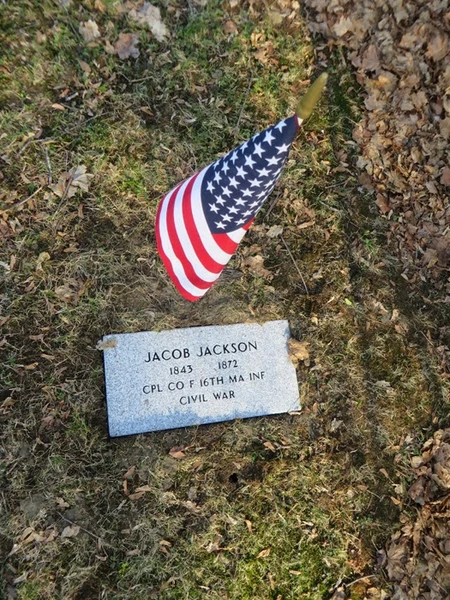
Nor did veterans themselves often have a choice between profiting from their experience or quietly retiring to a comfortable life. Jacob Jackson only got his headstone here in Lebanon, NH, a few short years ago, courtesy of the American Legion, having died before his 30th birthday and been buried in an unmarked pauper’s grave away from his Massachusetts home.
And while there are jokes and snide comments about “Confederate widows,” the young girls who married aging, impoverished veterans served as housekeepers for those who let them inherit their meagre veterans’ pensions in lieu of payment.
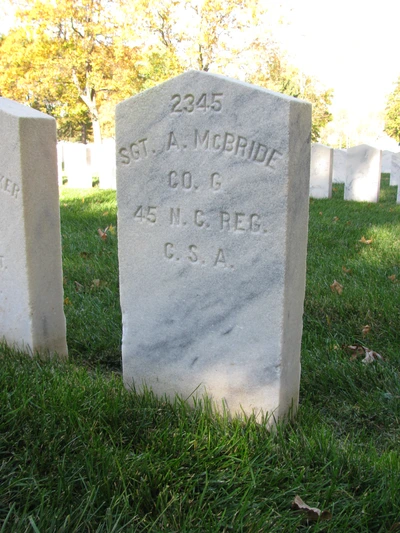
In his speech, Holmes also notes the Confederates, once foes but now fellow veterans.
We believed that it was most desirable that the North should win; we believed in the principle that the Union is indissoluble; we, or many of us at least, also believed that the conflict was inevitable, and that slavery had lasted long enough.
But we equally believed that those who stood against us held just as sacred conviction that were the opposite of ours, and we respected them as every man with a heart must respect those who give all for their belief. The experience of battle soon taught its lesson even to those who came into the field more bitterly disposed.
There were, before Memorial Day was formally recognized, several commemorations held by Black Americans, in memory of the Union soldiers who had died for their freedom.
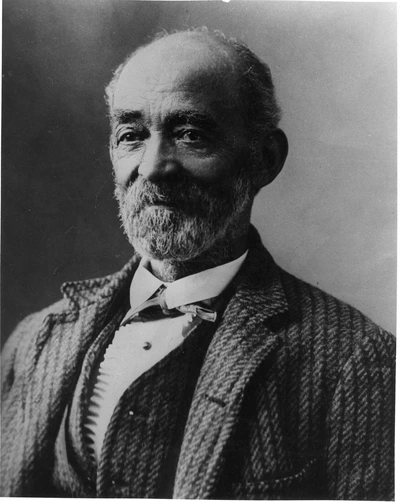
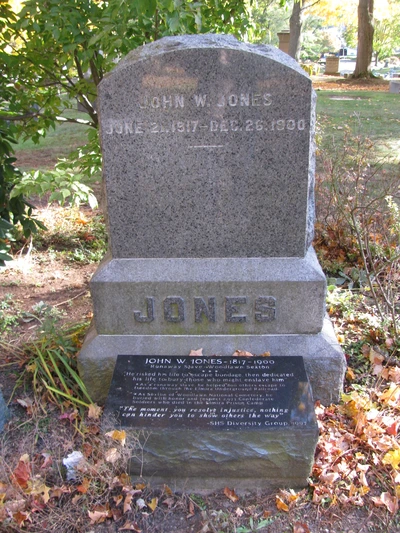
While consider, well before freedom, the example of John Jones, who had escaped from slavery and became a conductor of the Underground Railroad in Elmira, NY, where he lead hundreds of refugees to freedom, stashing them on actual trains to St. Catharines, Ontario.
He was also a church sexton, with a job as gravedigger for Elmira’s POW camp, where rather than letting bitterness rule that job, he took the extraordinary, compassionate steps of assuring that each of the 2,973 rebels he buried had a bottle around his neck, with a slip of paper giving his name and unit number, plus a wooden board to mark his resting place.
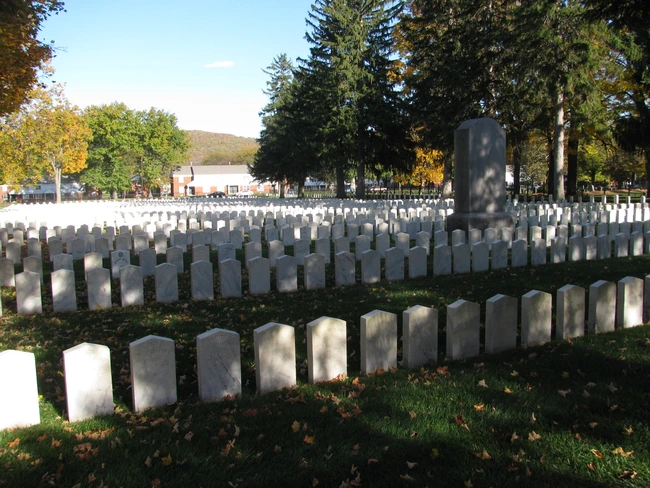
Thus, when the war ended, real headstones could be accurately placed in a special section of Woodlawn National Cemetery. In light of this dignified setting, only seven Confederate families chose to have their loved ones’ remains brought home.
And this historical note:
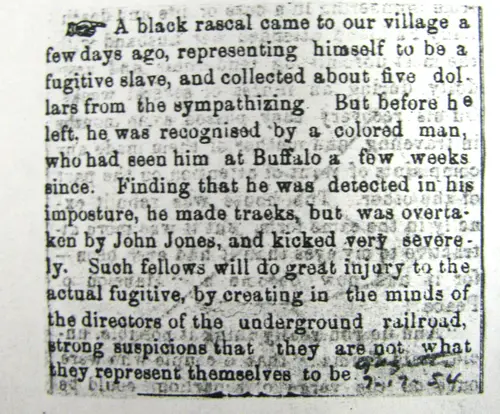
This article ran in the local newspaper in 1854, well before the war, and not only names Jones specifically but editorializes in favor of the Underground Railroad. There was also a report of Jones being alerted by locals when slave-catchers came to Elmira in search of fugitives, so he could get his refugees under cover.
They knew and understood that there are worse things than death, and more ways to fight injustice than by open combat.
Keep the faith.
Mike Peterson has posted his "Comic Strip of the Day" column every day since 2010. His opinions are his own, but we welcome comments either agreeing or in opposition.

Comments 8
Comments are closed.