Books Caricature Children's Books Comic History Editorial cartooning

Cartoon Seuss, Author Seuss, Doctor Seuss, Racist Seuss

Can a prestigious institution with ties to a famous alum reconcile that relationship with the man’s racist past?

Theodore Geisel, Class of 1925, is a Dartmouth alumnus whose children’s books and campus namesake sit alongside racist imagery, a contrast that raises questions about legacy and accountability.
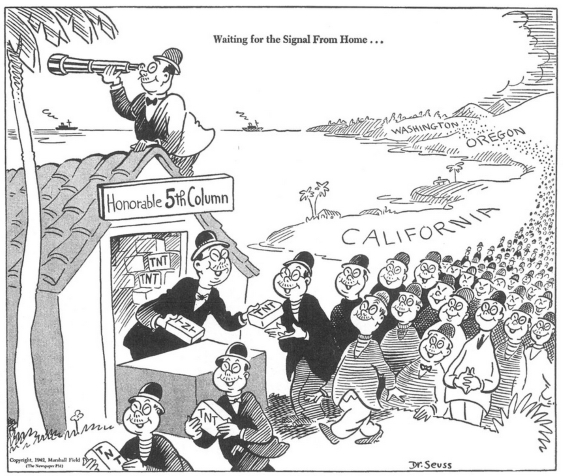
“Waiting for the Signal From Home…” by Dr. Seuss, PM 1942

Madeline Kahn Ehrlich for The Dartmouth comes to grips with Dr. Seuss’ controversial past as others are dealing with their connections to Cesar Chavez and associates of Jeffrey Epstein.

The Theodore Geisel name is easy to find across campus. In addition to the medical school, it appears in alumni mythology and lingers in the College’s imagination as one of its most famous alumni. But the name that belongs to one of the most beloved children’s authors also belongs to an artist whose political cartoons and early illustrations have drawn criticism for racist and xenophobic imagery, especially toward Japanese people and Japanese Americans during World War II.

At a moment when Dartmouth students debate the names attached to campus buildings, Geisel’s legacy raises an uncomfortable question about the future of spaces that bear his name: How should Dartmouth remember someone who promoted harmful stereotypes yet whose imagination shaped generations of childhoods?
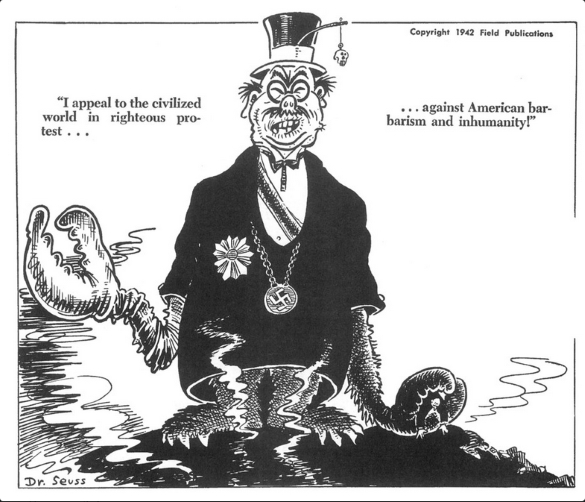
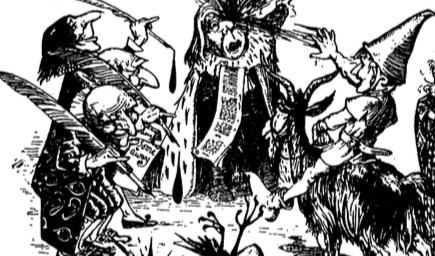
“An Appeal” by Dr. Seuss, Field/PM (1942)

In 2017 Richard Minear for the Asia-Pacific Journal took a look at the WWII Japanese cartoons of Seuss.

Dartmouth’s Ms. Erlich concludes:

Geisel’s past asks Dartmouth to consider what honor means. A name on a building is not a biography. It cannot hold every contradiction. But the people who walk past it can. They can ask who is being remembered, who is being left out and what parts of the story have been made too small.

Dr. Seuss taught generations of children to look again at strange worlds. Dartmouth’s task may be to look again at his.

For the record Seuss’ politically incorrect portrayal of those with different backgrounds began before his World War Two cartoons. In his first book as Dr. Seuss, And to Think I Saw It on Mulberry Street (1937), there was what current society would describe as problematic representations, even after multiple revisions.
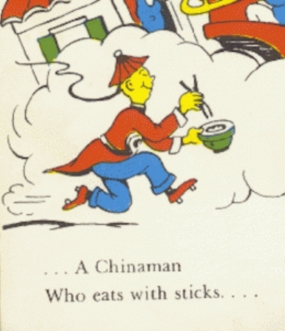
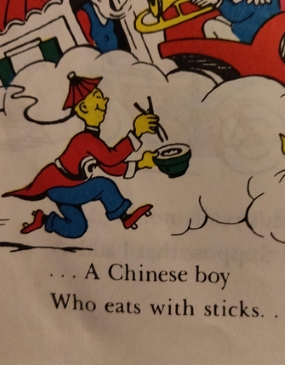
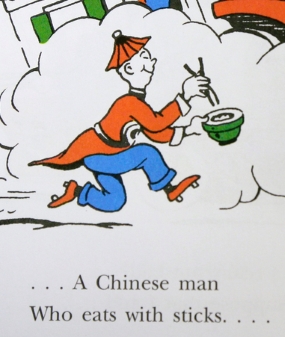
The Chinaman/Chinese boy/Chinese man portion was so awkward Mulberry Street became one of six Seuss books the publisher stopped reissuing in 2021.
Previous Post
CSotD: Claims and Disclaimers

Comments 5

  1. Was it his feelings or that of his employers? Did he change and grow? Might help in explaining.

    1. The WWII cartoons reflected the feelings of the vast majority of Americans during that time, though as mentioned his 1937 book was problematic enough to be continually revised.
      In 1961 the Dr. Seuss short “The Sneeches” was a children’s story about discrimination, as mentioned in The National Post link.

  2. Some cartooning that looks racist today was more xenophobic then. Germans often looked like monsters. I vaguely remember a comic book in which the Japanese were caricatures and the Chinese were drawn sympathetically.
    As for Seuss, judge him by where he ended, not where he started.

  3. That’s a well-crafted discussion of the issue, and she’s to be applauded. Personally, yesterday I had the follow-up visits for my 10 year victory over cancer, courtesy of the hospital his school feeds into, so that disclaimed. But I would also differentiate between his somewhat short-lived and unheralded work as a political cartoonist and his far, far more famous work as a children’s author.

    I grew up on Seuss, but his forays into odd parts of the world, cartoonish as they seem in retrospect, were more about the exotic than the subhuman. That is, they were written with a white, Western European audience in mind, which is certainly racist, but more of a sin against inclusion than a declaration of white supremacy.

    I’m inclined to say that pulling certain books from production is sufficient. If I were Dartmouth, I would accentuate the negative, latch on to the affirmative and don’t mess with Mr. In-Between

  4. Dr. Seuss illustrated a very large number of editorial cartoons during WWII. While it is undeniable that a certain percentage of them indulged in racial stereotypes, the primary characteristic of his work was not racism, but rather his emphatic support for U.S. involvement in the fight against fascism. He pulled no punches, and while some of his drawings crossed ethical boundaries according to today’s standards, in the context of the age in which he wrote his cartoons are no more (nor less) offensive than (for instance) the propaganda cartoons that Warner Brothers produced during the war, many of which featured very similar stereotypes.
    I prefer the approach that Warner Brothers took with Whoopi Goldberg’s introduction to the Looney Tunes Golden Collections, in which she said that the “cartoons…. depict some of the ethnic and racial prejudices that were commonplace in American society. These depictions were wrong then and are wrong today…. These cartoons are being presented as they were originally created, because to do otherwise would be the same as claiming these prejudices never existed.

Leave a Reply

Search

Subscribe to our newsletter

Get a daily recap of the news posted each day.