CSotD: On Being ‘Tough but Fair’
Skip to comments
I was always skeptical of teachers who said, “I’m tough, but fair.” I knew teachers who were tough but fair, but none of them ever said so and they didn’t have to, because we knew it. The ones who proclaimed it were, instead, rigidly harsh and felt “fair” meant having everything go their way.
It is not a lesson I left at the schoolyard gate, and it’s on my mind this morning because last night I watched Democracy Under Siege, and you should, too, while it’s still free. I didn’t agree with every word, but that’s not how intelligent dialogue works, and it got me thinking, which intelligent dialogue should.
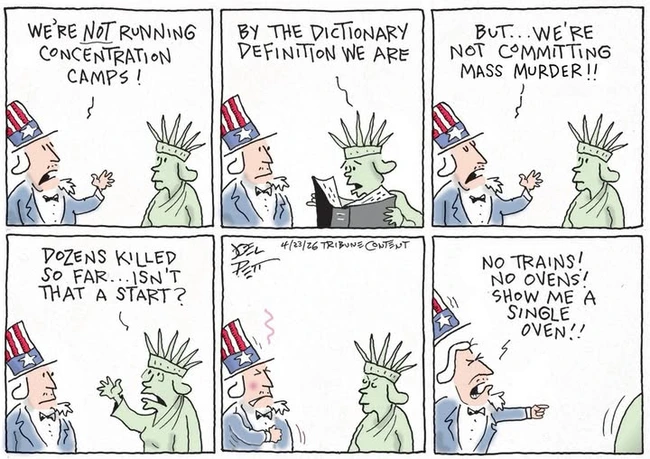
Joel Pett’s cartoon is tough but fair. He lists the excuses that deny our concentration camps and counters each one. You may have to know a little history to realize that the Nazis didn’t invent concentration camps: They were used at the turn of the 20th Century in Cuba, the Philippines, South Africa and a few other places, and now they’re being used here.
Those other camps weren’t used for genocide, but they were racist and inhumane, which is less of a judgment than it is a description. Tough but fair.
Toughness requires accuracy, and unblinking statements, while fairness means that you may offend in order to correct, or to draw attention to an issue, but you shouldn’t do it just to offend.
For example, I differ with many of my colleagues on this, but I felt deliberately offending a small, militant branch of Islam with cartoons that offended nearly all Muslims was a scatter-gun, unfair approach.
On the other hand, I agree with them that cartoonists have the right to be offensive.

Weyant offers a logical analysis of the Supreme Court’s ruling on the Voting Rights Act, which assumes the reader disapproves of Trump’s alterations of physical landmarks — and most polling says he’s on firm ground there — which he compares to the decision, challenging readers to see the VRA as another landmark, and the decision as an act of vandalism.
It’s more based on opinion than Pett’s cartoon is, but uses much the same style of logical argument: If you agree with this, this and this, you should also agree with this.
And, granted, it might be interesting to see a Venn diagram of who agrees with each of these, but he’s working to both comfort the afflicted and to afflict the comfortable, and it would be weak broth indeed if everybody already agreed with him.
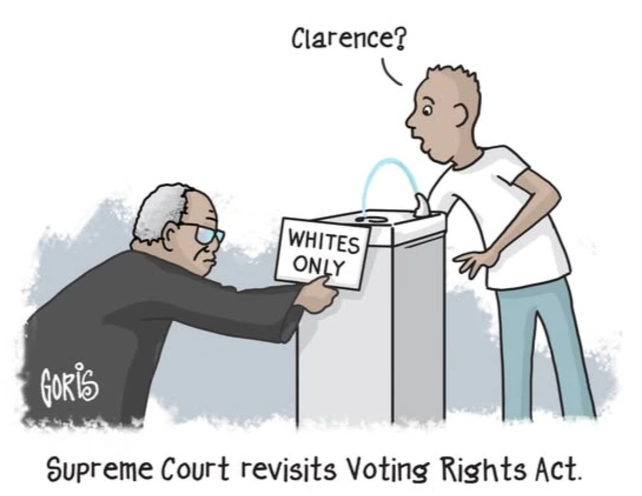
I’m not comfortable with Goris’s cartoon, not because I disagree that the decision represents a throwback to Jim Crow days, but because I don’t think a white cartoonist has standing to criticize how a Black person behaves in racial matters. Terms like “Oreo” and “Tom” are best contained within the community.
Had he drawn all six conservative justices posting the sign, I’d agree with the cartoon, but that would be a different message.
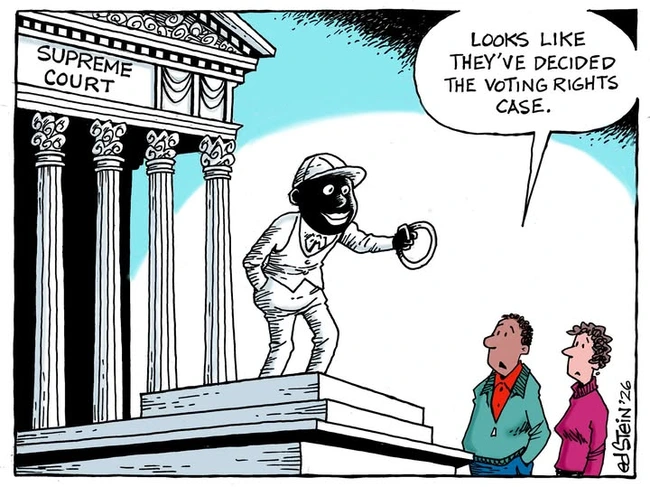
Stein, on the other hand, uses a highly controversial image that risks offending some readers, but he is intentionally expressing both anger and contempt over the ruling, suggesting that the Court is showing the same sort of unthinking racism that made a certain type of white person think jockey statues were pleasant and acceptable lawn decor.
There’s a deeper level to his critique, in that, just as Justice Roberts wrote a decision that justified the outcome in ways that critics feel purposely avoided honestly addressing it, there are fanciful explanations people offer to explain why their jockey statues are actually a compliment to Black people.
These stories of loyal servants are more patronizing and offensive than the statues themselves. Which makes Stein’s comparison that much more tough but fair.
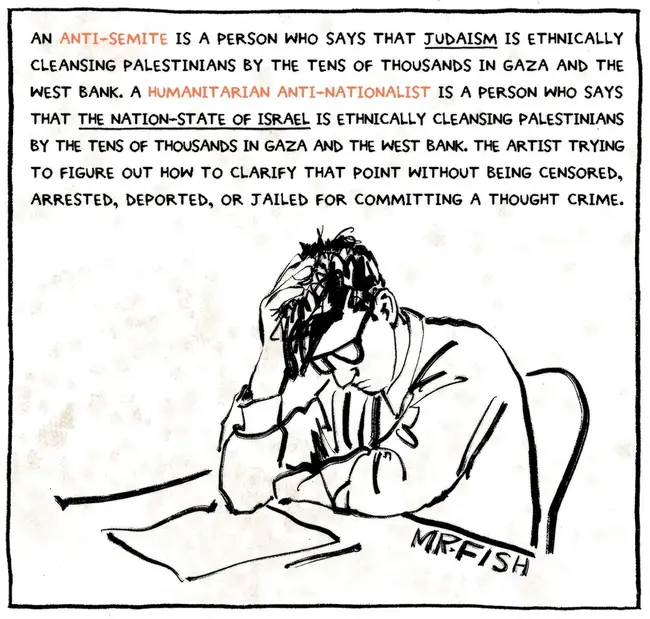
Mr. Fish is often and intentionally offensive, and his criticism of the Israeli government’s actions in Gaza resulted in his termination last year as a lecturer at the Annenberg School for Communication. As he says in this piece, it’s a dilemma but one he feels compelled to face.
The issue is one that American cartoonists whose work appears in mainstream publications hesitate to address, which may be why their work appears in mainstream publications: Editors consider it a third-rail matter best not touched. However, cartoonists in Australia and Britain are under no such restriction and have been tough-but-fair on the topic.
There have been violent antisemitic attacks in both countries, but it’s not as if our silence on the matter has spared the US from such incidents.
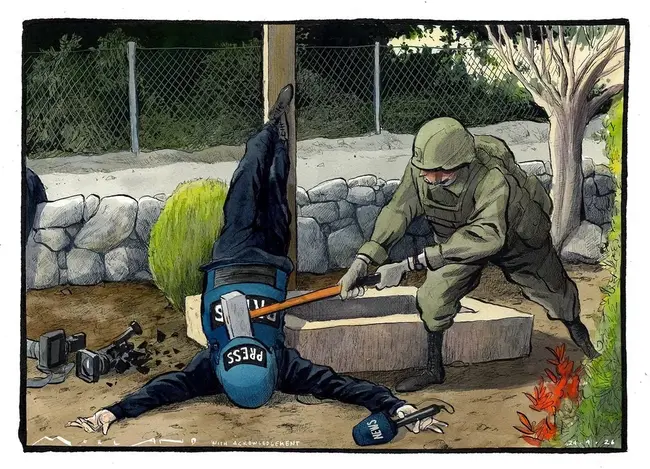
Morland uses an incident in which IDF soldiers in Lebanon smashed a crucifix with a sledgehammer as an inspiration for commenting on the army’s penchant for targeting journalists.
The Committee to Protect Journalists reports that 129 journalists were killed in the past year, two-thirds of them at the hands of the IDF.

CPJ reports that Khalil’s death followed IDF threats and appears to have been a deliberate targeting. In addition, the Red Cross reported that attempts to rescue her from the rubble of the building were impeded by the IDF.
Granted, she worked for a media company that opposes Israel’s attacks on Lebanon, but the details of her death indicate that the IDF does not recognize the protection normally afforded journalists, and greatly parallel the killing of popular Palestinian-American television reporter Shireen Abu Akleh.
Juxtaposition of the Day
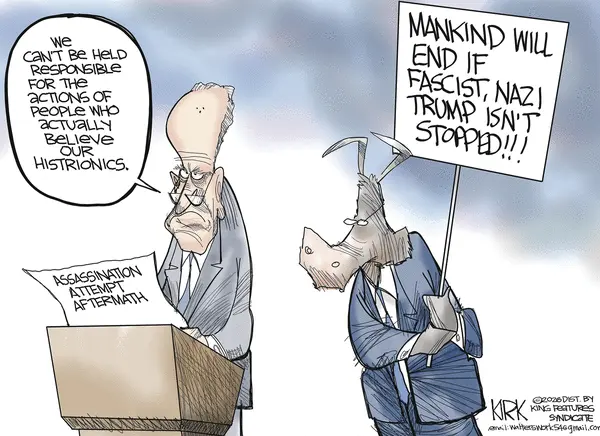
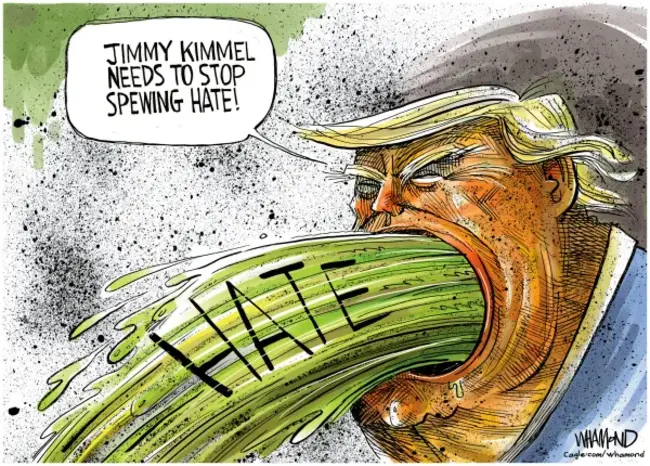
In 2019, the NYTimes unintentionally published an antisemitic cartoon and, as a result of the outcry, dropped political cartoons entirely, citing the danger of contributing to antisemitism in America, which seems like a chicken-or-egg argument, similar to the pro-Trump response to the attempted attack on the WHCD.
Karoline Leavitt cited a “left-wing cult of hatred,” which Walters echoes in his cartoon, but Whamond notes that there is plenty of animosity flowing from the White House.
Other commentators have cited Don Jr’s jokes after the assault on Nancy Pelosi’s husband, as well as Trump’s circulation of an insane theory that Gov. Tim Walz was responsible for the murder of a Minnesota state legislator, as well as Trump’s expression of joy over the death of Robert Mueller and his appalling statement after the death of Rob Reiner.
Seems we could all use a little more tough fairness around here.
Mike Peterson has posted his "Comic Strip of the Day" column every day since 2010. His opinions are his own, but we welcome comments either agreeing or in opposition.
Comments 10
Comments are closed.