Comic Strip of the Day Comic Strips Editorial cartooning

CSotD: Humpday 2026 Is Particularly Taxing

Today is Humpday, but it’s also Tax Day, and so since there are cartoons that will be out of date by tomorrow morning, we’ll take a hybrid comedy/politics look at the day.

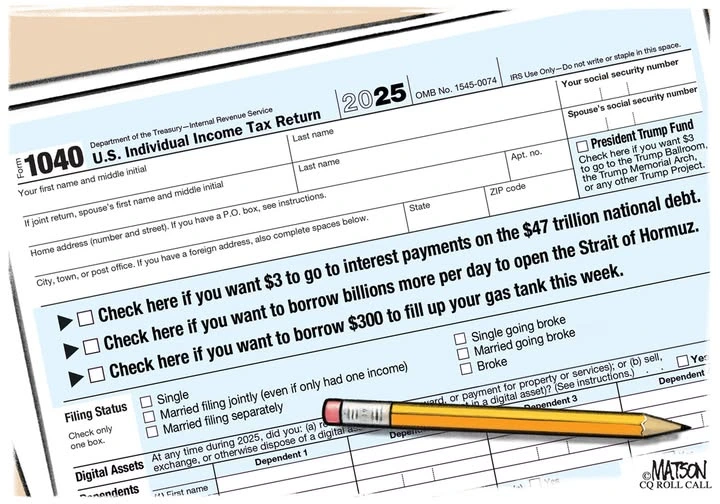
Matson seizes on a familiar approach, but while his “filing status” section is pretty much as seen before, his check-offs are specific political criticisms that rise above the usual hating of taxes and hating of tax forms.

There’s nothing wrong with taking a well-worn road as long as you can bring something fresh to it.
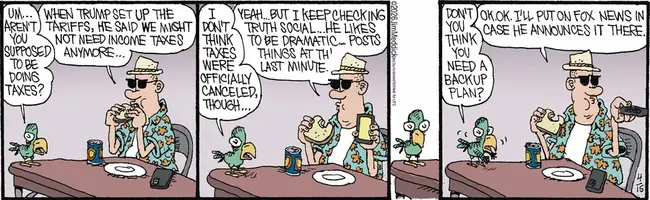
However confusing taxes may be, Moondog and Dear Leader are correct that, until the reforms in the early 20th Century, we financed the government through tariffs rather than income taxes. However, it only takes about 10 minutes of research to realize how badly that system worked if you weren’t one of the captains of industry at the top of the pyramid.

The “Gilded Age” described those favored few, while a whole lot of other people struggled, both the farmers who paid much of those tariffs and the urban poor who made up “the Other Half” of whom Jacob Riis wrote, and for whom the social activists of the era dedicated themselves.

It’s all well and good to celebrate the Astors and Vanderbilts and their ilk, but they weren’t typical and it didn’t work then and it’s even less likely to work now.

Which brings us to this

Juxtaposition of the Day
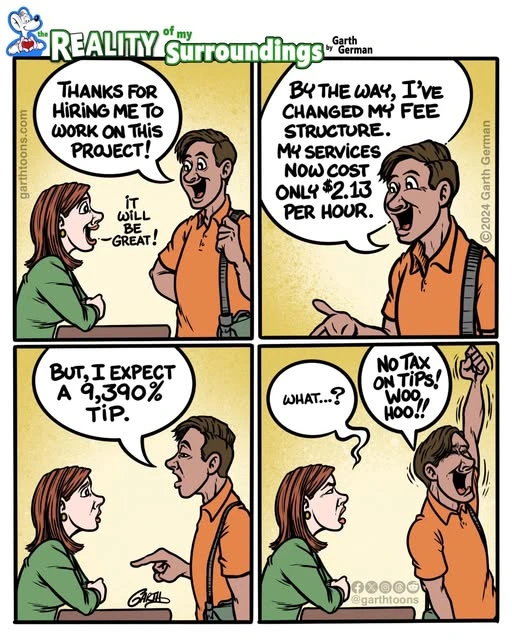
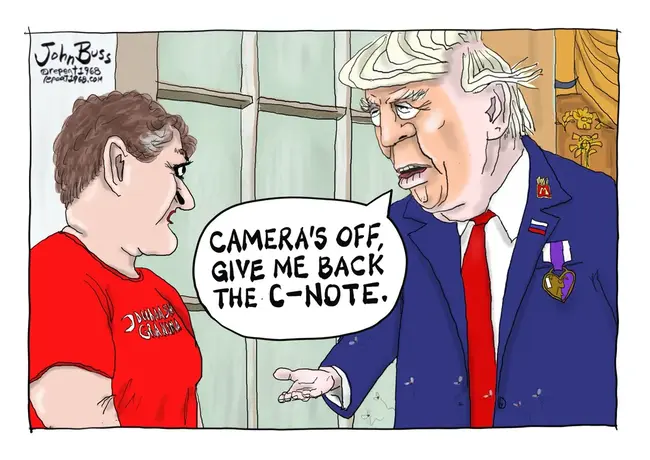
The new “No Tax on Tips” regulation isn’t going to work as nicely as the fellow in German’s cartoon expects, and Buss isn’t being overly sarcastic in declaring it something of a scam.

First of all, it’s only a deduction, and if you’re making enough in tips that they matter, you probably aren’t paying much in income taxes anyway, so, while every bit helps, it won’t save you a bundle.

Trump’s DoorDash stunt was particularly deceptive on a couple of bases. First, there are no DoorDash deliveries to the White House, which is a ridiculous idea strictly from a security standpoint.

And the woman who made that delivery is from Arkansas, only she’s been trotted out before and testified before Congress as someone from Nevada, but she isn’t from DC, and you can’t write off commuting miles. At four bucks a gallon, I wouldn’t want to live 1200 miles away and be delivering burgers in DC, but all a delivery person in their own car could write off would be the drive from McDonald’s to the White House.

Furthermore, DoorDash drivers are self-employed, so even if she can deduct her alleged $11,000 in tips on her federal income tax, she’d still have to come up with 15.3% Self-Employment Tax (FICA) on them as earnings. And, as The Guardian reports in its analysis of this stunt, she’d still have to pay Arkansas income tax on them, if they really existed in the first place.

“No one is claiming it was a real delivery,” DoorDash’s Julian Crowley wrote on social media, according to the Guardian, to which I’d like to hear Samuel Jackson thunder, “Yes you DID!”

I’m not religious, but I think there’s a special place in Hell for those who lie about money to working-class strugglers, which most food delivery folks are.
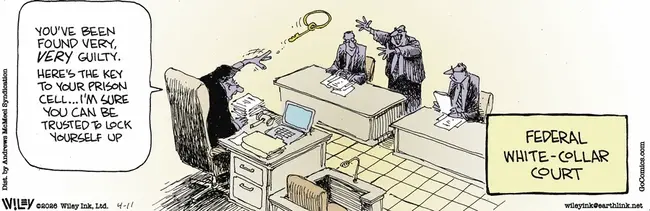
Special place in Hell? As Wiley points out, there isn’t even a special place for them in Leavenworth.
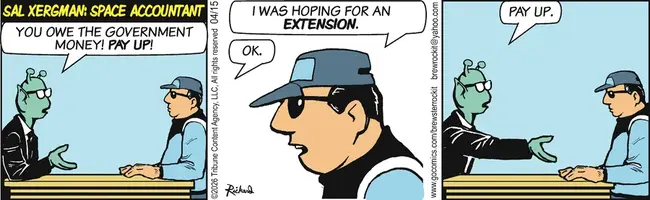
Speaking of things a lot of average folks don’t realize, getting an extension on your taxes amounts to about what you see here. All it really gives you is another six months to do the paperwork; you still have to come up with the money by midnight tonight, or at least come up with a sum of money very close to what you’ll owe.

Which suggests that, even if you don’t get everything properly filled out, you’ll have to have figured things out pretty well, and if you’re not psychic, you’d do well to at least pencil in a few things.

I suppose that if this comes as news to you, your day is suddenly really ruined. You can get the necessary tax form here, but you’d better cancel whatever else you had planned for today.

When I was in the newsroom, one of our mandatory annual stories involved hanging out at the post office as it was closing at midnight. Looking back, it strikes me as kind of sadistic.
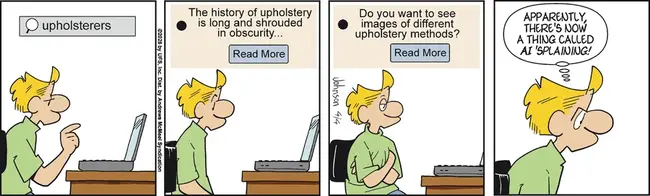
At two weeks, this strip is kind of old for CSotD, but I dug it up after becoming increasingly frustrated with how I strongly suspect AI is destroying Google.

I don’t mind the little AI summary at the top of a search, because much of the time I’m just trying to find out at what temperature to throw something in the oven and how long to leave it in there. But lately I’ve found that, if I’m looking up anything even vaguely obscure, it’s no longer there.

Instead of getting a combination of popular and obscure suggestions, I’m only getting the popular answers, which is to say that somehow Google is turning into Bing, which is to say, a search engine based on what you’d find if you did one of those late night comedy street interview segments, in which they go out on the sidewalk in search of stupid people.

Which is a self-fulfilling prophecy and intentional editing, proving that if you seek stupid people, you will surely find them. Finding actual information, meanwhile, seems to be getting harder, and perhaps, like actual licorice, it just isn’t popular enough to be worth making available anymore.
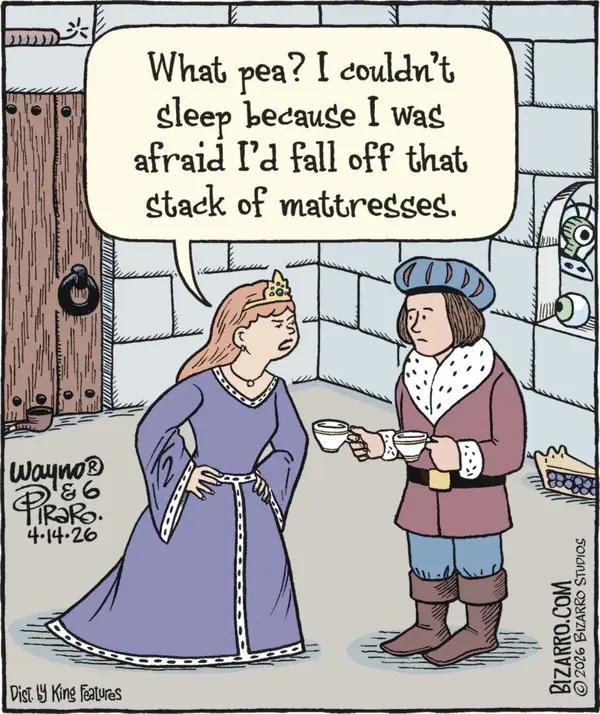
Alas, there’s no shortage of real princesses. “The Princess and the Pea” is a fairy tale that contains no fairies and isn’t a folk tale either, but was written by Hans Christian Andersen.

It begins “Once upon a time there was a prince who wanted to marry a princess; but she would have to be a real princess,” and you should stop right there, because he’s an idiot.

If I’d written it, the Queen would put a pea under all those mattresses, and then when the princess complained in the morning, she’d say to her son, “You owe me, kid.”

We read our boys this story instead:

Mike Peterson has posted his "Comic Strip of the Day" column every day since 2010. His opinions are his own, but we welcome comments either agreeing or in opposition.
Previous Post
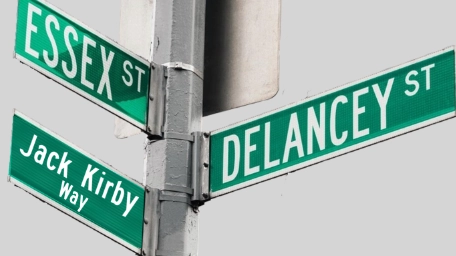
Jack Kirby Street Sign Unveiling Date Announced
Next Post
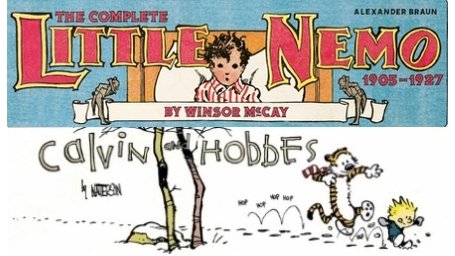
Wayback Whensday with Winsor and Watterson

Comments 12

  1. Three cheers for real licorice!!!

  2. RE AI and Google:

    Ad-supported Google personalizes search results based on your history. So the returns I see for the same search term won’t match yours.

    Optional search engines:

    1) Kagi — It tends to return original sources, not sponsored, advertising or optimized pages. $5 a month for 300 searches, $10 a month gets unlimited searches.
    https://kagi.com/

    2) DuckDuckGo — Free. Searches not tracked.
    https://duckduckgo.com/

    3) Brave Search — Free. Privacy-focused and has a unique search index.
    https://brave.com/

    4) Startpage — Free. Serves Google’s results without Google’s tracking.
    https://www.startpage.com/en/

    5) Perplexity — Free. AI. Designed to answer research questions.
    https://www.perplexity.ai/

    6) Bing — Microsoft’s search engine. Ad-supported and tracks searches but uses a different index than Google. Finds “stuff” Google misses. Image search and video search are robust.
    https://www.bing.com/

    7) Ecosia — Ad-supported and uses on Bing’s index. But much of their advertising revenue goes toward reforestation projects; they are a certified B Corp.
    https://www.ecosia.org/

    8) Your public library card — Often free. Access sources and databases not found replicated on the Web.

    Hat tip to Card Catalog: “Teaching you how to think like a librarian in the age of AI.”
    https://cardcatalogforlife.substack.com/

  3. If you think that Hans Christian Andersen’s story about the princess who – despite pleas from John & Yoko – didn’t give peas a chance is not a real fairy tale vs. maybe Grimm’s Fairy Tales, you’re a princess yourself. Several of the stories collected by the Grimm Bros were not informed by a simple peasant woman as they assumed, but by an educated Huguenot woman who remembered literary fairy tales written by French aristocrats.

    1. I’d be a little cautious with this line. It would require proving that the stories they told were not also of folk origin, even if retold by specific French (Alsatian?) sources. And collecting stories, after all, includes rewriting them, because they tend to be fragmentary and are often internally inconsistent.

      There are, for example, many Cinderella-type stories across many cultures, including some that may have been written down before the one most familiar to us. It’s problematic to try to pin the narrative down to one root tale, even moreso to insist that the version you consider the original was not retold by your source, from a story recounted around fires 200 years earlier.

      Anderson wrote his story in 1835 and I’d be willing to bet it was original with him, given how it fits his other work. But 1835 is, by folk tale measure, so late as to make it as much a part of modern literature as Swiss Family Robinson (1812) or The History of Little Goody Two-Shoes (1765).

      1. In addition to the various (well documented) sources employed by the Brothers Grimm, comparisons can also be made between the versions of each of the tales as published in each of the seven different editions, and in particular between the tales that were subsequently added, and others that were removed from the later books (in multiple cases because they had discovered that the “original” source of the tale was not actually “German”).
        Although the Grimms’ stated goal was to compile an authoritative collection of authentically German tales, in practice they often “improved” the source material to fit their own purposes, concatenating multiple elements to create what are effectively new tales, or bowdlerizing stories to remove “inappropriate” elements. One classic example can be seen in “Rapunzel”: in the first published version, the witch discovers that the prince had been visiting the tower (for several months) when Rapunzel asks why her skirts were getting too tight. Ooops. Clearly, an unmarried, but pregnant heroine was a little too progressive for contemporary audiences back then.
        Modern editions (and translations) of the “Kinder und Haus Märchen” are virtually always based on the “Edition letzter Hand“, the final edition personally edited by the Grimms themselves. Although this obscures the rich history of the ongoing textual development, in practice most readers have little interest in the editorial process: they just want the “official” version of the story, even if that designation is merely a convenient fiction.

      2. None of which makes “The Princess and the Pea” a fairy tale — there is no fairy in it — or a folk tale, unless someone comes up with an earlier version that Andersen adapted. My original statement never mentioned the Grimm Brothers.

      3. My text was intended to continue the line of thought from Don G, commenting on the difference between authentic “folk” tales versus commercially successful authorship (at which both Andersen and the Brothers Grimm were very adept).

      4. Note that Danish ‘eventyr’ and German ‘Märchen’ literally just mean ‘tales’. If English speakers insist on ‘fairy tales’ and expect actual fairies, you can blame Miss Gnomer for it. And, if you read for instance “The Little Match Girl”, you see that HC Andersen is very far from ignoring the harshness of social reality.

      5. The topic was two stories of two princesses and my preference for the more thoughtful and adventurous of them. Both stories were written, from scratch, by specific people, though more than a century apart.

        As for the Grimm Brothers, I’m willing to stipulate that they didn’t get each story around a fire in a cottage in the woods, but that wasn’t the topic. And knowing that some of their stories had been written down earlier by other people doesn’t make those people the originators. Ovid and Hesiod collected some wonderful stories and, in some cases, are the earliest known tellers of those tales, but that doesn’t mean they invented them. Similarly, Homer and Aesop may not have even existed, much less created any stories from scratch.

        Arlo Guthrie argues that a folk song is a song folks sing, and I appreciate his refusal to get bogged down in arguments over “authenticity.” However, if I change the lyrics and someone says, “That’s not how it goes,” then it’s not a folk song. The folk process not only allows for adaptation but demands it.

  4. I’ve used Google’s reverse image search a lot, but now it gives you some obnoxious A.I. summary of what the image contains.

    Like, I have eyes you dolt. I can see what the image is. What I want is the original or at least a better version of it.

    Man, and we thought Microsoft’s Clippy was bad…

  5. And you gotta scroll through the PR drek before you get to the news.

Comments are closed.

Search

Subscribe to our newsletter

Get a daily recap of the news posted each day.