Following Up: Aiden McClaren & Gretna, Bill Mauldin & Stars and Stripes, B.C. & Easter
Skip to comments
Defending a Student’s Right to Cartoon
In the case of Gretna High School administrators censoring an Aiden McClaren editorial cartoon.
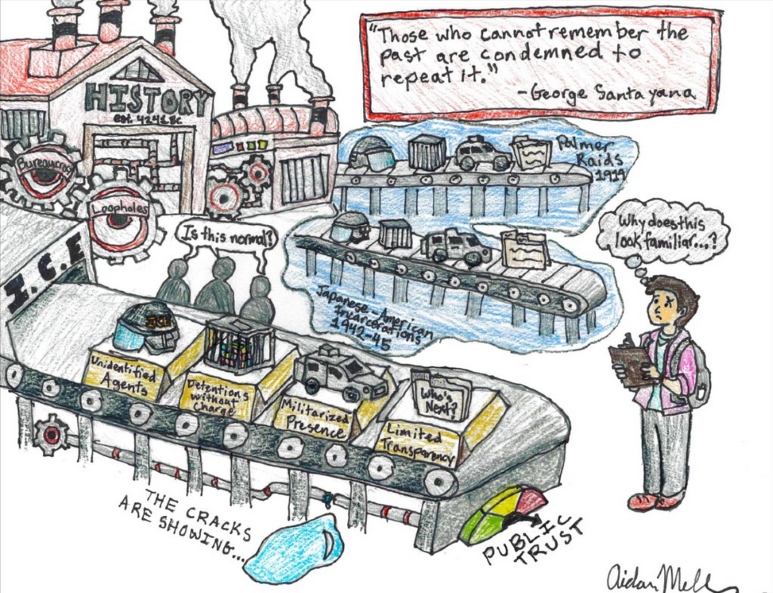
On April 7, FIRE’s Student Press Freedom Initiative wrote to Gretna Public Schools to urge the school board to reverse administrators’ censorship and to adopt a formal student media policy that would protects high school journalists’ First Amendment rights.
From FIRE’s letter linked in the above quote:
FIRE’s Student Press Freedom Initiative is concerned by the demands of Gretna East High
School administrators that students remove an anti-ICE cartoon from Gretna East Media’s
website, and by the school’s subsequent imposition of prior review. We join GEM students and
the Student Press Law Center in calling on you to grant GEM reporter Nicholas Mitchell’s
appeal of these censorial acts, which violate student journalists’ First Amendment rights.
[A]sserting that the district may prevent publication of partisan or politically charged material would effectively decimate GEM’s opinion sections in a manner incompatible with any reasonable educational lesson the school would hope to teach journalism students, especially given that GEHS’s pedagogical interest lies in shaping an informed student body that can discuss partisan or politically charged issues. “America’s public schools are the nurseries of democracy,” not a training ground for a silenced citizenry.
The district’s own general policy goes beyond mere tolerance of student expression to instead affirmatively recognize their students’ right “to form, and in the appropriate manner and in appropriate forum, to express [their] own judgments on controversial issues.” McClaren’s cartoon—published in the student newspaper, which is open to editorial opinions of the Gretna East community—should be exactly the type of content this policy seeks to protect.
Defending Stars and Stripes Right to Publish Cartoons
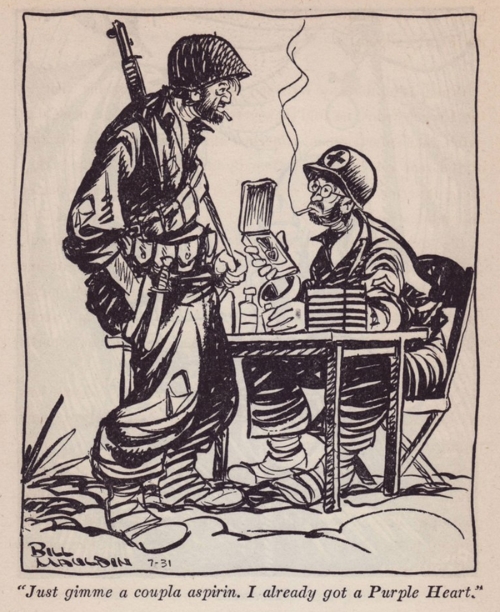
In our news item about the Department of Defense banning syndicated comic strips and some other outside material from appearing in Stars and Stripes we mentioned Bill Mauldin having “the full support of General Eisenhower.” A couple days ago Bob Greene at The Wall Street Journal expanded on that:
The soldiers fighting the war adored Mauldin. But one man didn’t: Gen. George S. Patton, commander of the Third Army…
Patton let Mauldin know that he had the authority to ban Stars and Stripes from being distributed to the Third Army…
General Patton vs. Sgt. Mauldin: It seemed like a complete mismatch.
General Patton vs. Sgt. Mauldin: It seemed like a complete mismatch.
But Patton failed to take one thing into consideration. Another soldier happened to be a fan of Mauldin’s work: Gen. Dwight D. Eisenhower, supreme commander of the Allied Expeditionary Force in Europe—Patton’s boss…
Defending Johnny Hart’s B.C. Evangelizing
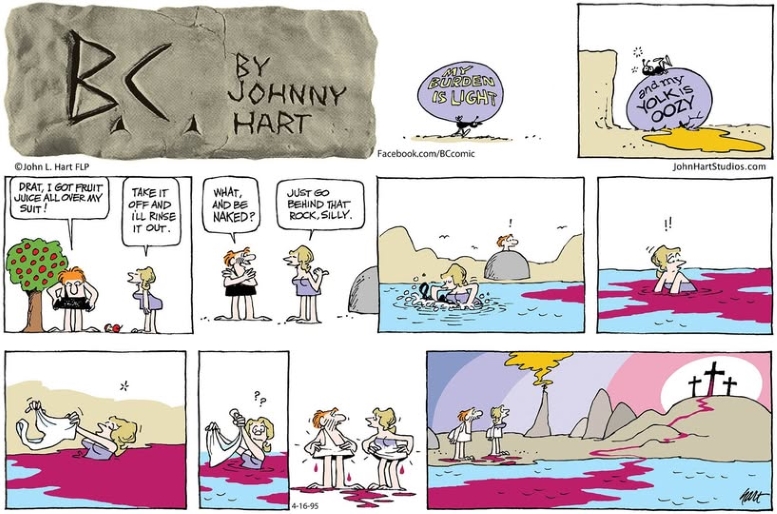
On Easter Sunday we ran a piece about a controversial B.C. comic strip from 25 years earlier.
Today John Stonestreet at the Colson Center Breakpoint appreciates Johnny Hart’s cartooning for Christ:
Outside of his comic strip, Hart explored and embraced certain theological views I could not agree with. However, he stayed within the bounds of orthodoxy in print and covered an incredible amount of theological ground in the process, from the creation of the world to the deity of Christ to the centrality of the cross in history to the forgiveness of sin and substitutionary atonement. All this in a comic strip.
As Chuck Colson wrote back in 1999, “Johnny Hart can be an inspiration to all of us to find ways to bring a Christian worldview to bear on our work, whatever it may be. Healthy humor is one of God’s good gifts to us, and even writing comic strips can be done to His glory.”
feature image is a detail of Bill Mauldin’s Time magazine cover dated June 18, 1945


Comments
Comments are closed.