Comic Strip of the Day Editorial cartooning

CSotD: We Need Some Pre-Holy Day Shriving

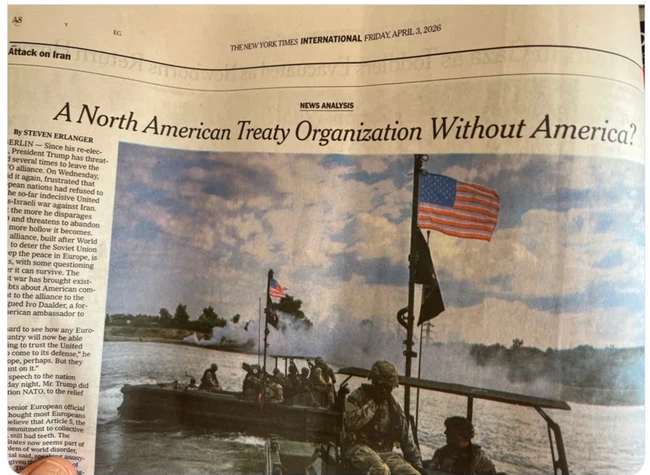
We’ll warm up this morning with this NYTimes gem that’s been going around social media for the past 24 hours. It’s a reminder once again that reporters don’t write headlines but eejits sometimes do.

Much of my work as a reporter was large Sunday business features, and I took to dropping by the paper Saturday to see that section, which had been pre-printed Friday night. This spared my kids from me flinging the paper across the kitchen and cursing Sunday morning when I saw what they’d done to it this time.

Like referring to Inez Milholland as a “suffragette” in a headline, when the story specifically said Americans were “suffragists” and British were “suffragettes.” Or headlining a story about the paper’s 50th year as its “silver anniversary.”

Judging from the text of this story, Steven Erlanger, the reporter on this story, appears to know what NATO stands for. I hope his family wasn’t too upset by his cursing and hurling the paper across the kitchen.

Next up is the firing of Pam Bondi. There were approximately umpty-million cartoons featuring redaction bars, but I like de Adder’s because of its simplicity. When you have a good graphic point, adding dialogue or additional action simply waters it down.

It’s a tough story to illustrate, because it’s hard to know why she was there in the first place and why Dear Leader suddenly decided she shouldn’t be.

Wuerker is right that the Department of Justice is in ruins, but I wouldn’t blame Bondi. She may have been the subcontractor, but she wasn’t calling the shots and she was hired to destroy the department. If anything, she didn’t do a good enough job to please Dear Leader.

I’d also quibble — though not quarrel — with Milbrath, because I’m not convinced Bondi had any values to turn her back on. Let’s not forget that she accepted a $25,000 campaign contribution from Trump and then dropped Florida’s investigation of his fraudulent university. Other cheated students got refunds, but not in the Sunshine State, and that’s likely how she came to his attention in the first place.
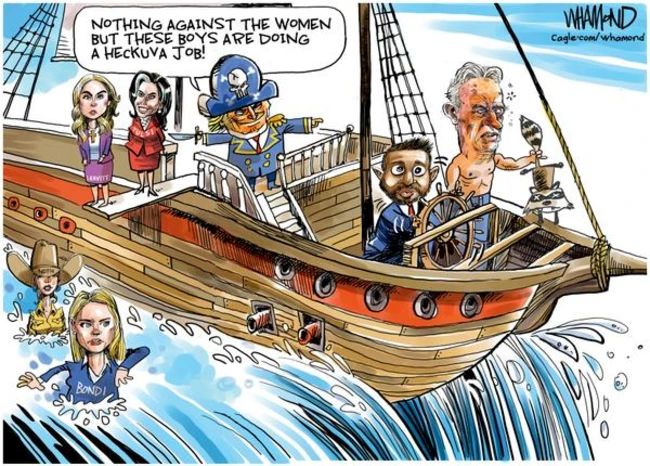
As for there being “honor among thieves,” Trump’s failing approval ratings seem to be making this like the baptism scene in The Godfather as he settles all scores. Bondi and Noem are gone and rumors have Gabbard and perhaps Leavitt on the bubble, and I appreciate Whamond depicting the ship about to go over the falls.

On the other hand, Dear Leader may be playing a game of “Ladies first,” and if I were Kennedy or Patel, I wouldn’t get too comfortable. The trick now is not to draw too much attention to yourself, and neither one of them is very good at remaining invisible.
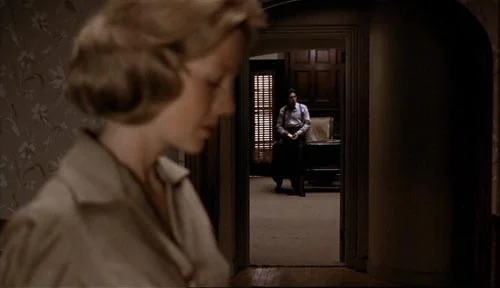
Probably best not to ask him about his business.

Juxtaposition of the Day
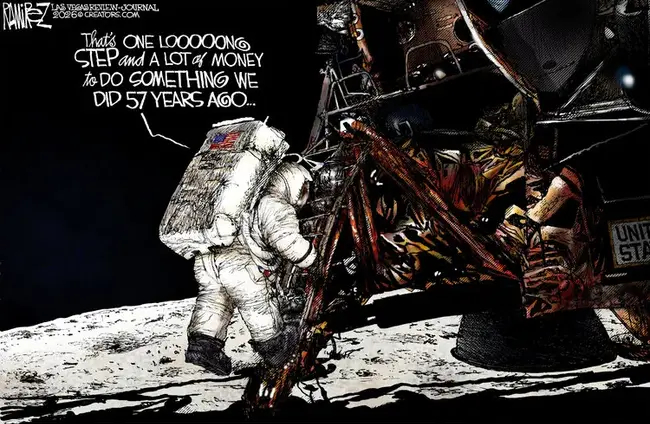
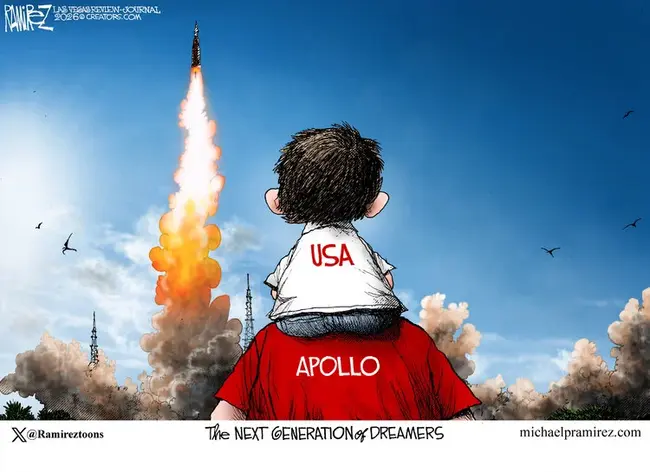
So this guy Ramirez condemns the Artemis mission as a pointless, imitative waste of money, but then, a day or two later, this other guy, Ramirez, salutes it as inspiring America’s future scientists and adventurers.

I’ll admit that I kinda sorta agree with both Ramirezes, or at least, I did back a half a century ago. I found the space program incredibly inspiring when I was a kid, even, as I noted here a few days ago, faking sick so I could stay home and watch John Glenn’s first mission on TV.
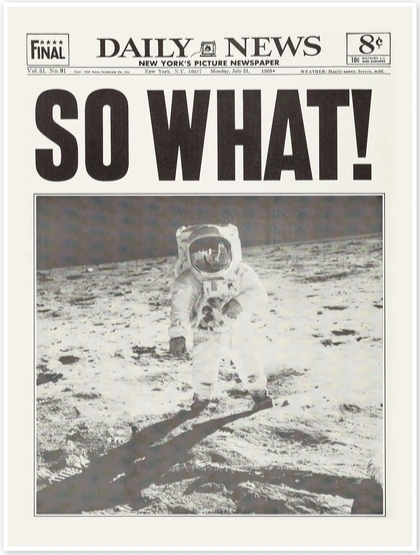
But a year after Neil Armstrong walked on the Moon, I bought a copy of this poster.

It wasn’t that I didn’t still admire the mission or the man, but I felt it was a reflection of our science, not our overall national character. That is, I thought it make NASA look awfully good, but it didn’t make me any taller or more handsome, and all the misdirected national pride was embarrassing.

I’ve pondered this for the past couple of days and suddenly realized the difference was Walter Cronkite. He genuinely was respected, and his fan-boy affection for the space program was infectious. Nor was it isolated: Cronkite did educational projects, and he made knowing stuff seem important.

So if Nixon exploited the astronauts for his own self-promotion, and even delayed the Moon walk so it would happen in Prime Time, he was well out-weighed by Cronkite’s devotion to digging into the techie aspects and sincerely celebrating scientific achievements.

It looked like we were going to continue in that direction by sending a school teacher up on a shuttle mission. Oh well.

And then we blew up another crew, and that may not be why we drew in our horns for a few decades, but we lost momentum and, meanwhile, America changed.

As Bagley suggests, we’re just looking for reasons to argue with each other these days, and it doesn’t take much to set us off.
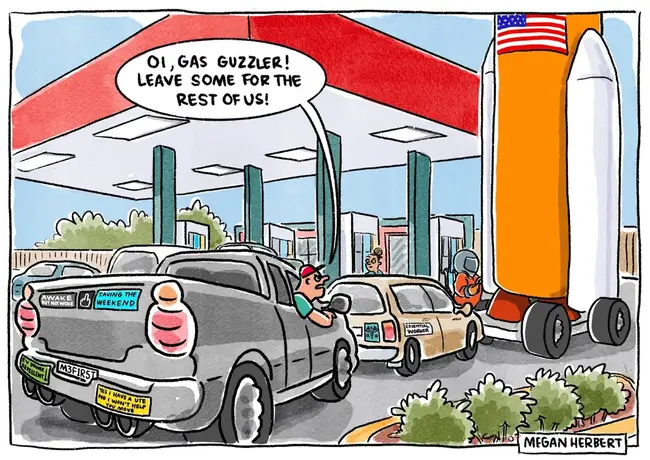
While the RP-1 kerosene used in boosters does indeed come from crude oil, launching Artemis isn’t the biggest drain on our petroleum resources, and Herbert adds bumperstickers and a license to the complaining motorist’s utility vehicle to make clear that he’s not interested in saving fuel — except for himself.

I recently filled my gas tank for about $30, because my Honda’s tank only holds 9 gallons and I usually top out at 8. At roughly 30 mpg, I’ll do better than that fellow in Herbert’s cartoon though not as well as my friends with EVs. We do what we can.
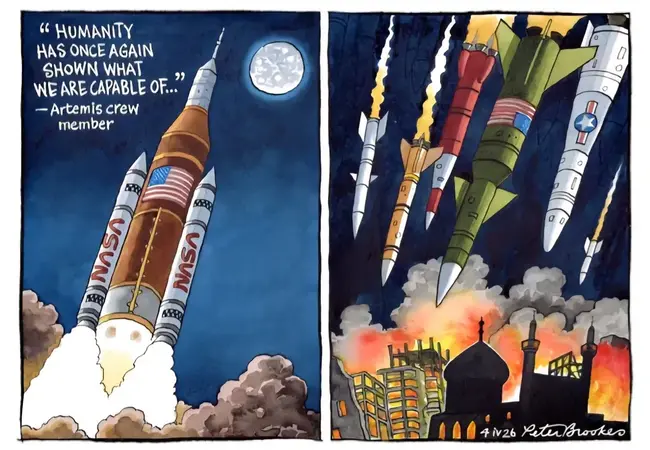
But while I don’t begrudge Artemis her fuel, I agree with Brookes that we’re — alas — showing what we’re capable of, and it brings up more serious questions than whether we should be popping space capsules off into orbit.

If you took all the fuel from Artemis, magically converted it into petrol and shared it with drivers throughout America, Australia and the UK, they’d each get a portion of a drop and it wouldn’t be enough to start their engines.

On the other hand, if you took all the fuel for rockets flying one way or t’other in the Middle East right now, and just parked them, it would make a big difference to a whole lot of people.

We wouldn’t have Artemis to watch, but we’d find some other distraction.

Mike Peterson has posted his "Comic Strip of the Day" column every day since 2010. His opinions are his own, but we welcome comments either agreeing or in opposition.

Previous Post
The Funny Pages This Week
Next Post
Easter Comic: The Little Blue Duck by Walt Scott

Comments 23

  1. When I was in grade school (the Mercury and early Gemini missions) I didn’t have to fake a day off to watch a launch. Our principal considered them so historically important that the entire Goucher Street Elementary (Johnstown, PA) would shut down classes, move us all into the all-purpose room, bring out the one black and white television the school owned, and watch the launch. In the case of Sheppard and Grissom, we stayed for the entire flight. From Glenn on, we’d stay until they were in certified as being safely in orbit.

    The magic and pride were incredible to a bunch of grade schoolers, especially those in the 4th to 6th grades.

    1. I was, alas, in seventh grade for Glenn’s flight. Once we started switching classes, if the bird wasn’t going up during science, you weren’t gonna get to see it. I didn’t like the odds, so I got “sick.” I’ve often wondered if my mother was wise to me: She tended to be pretty hard to bluff.

    2. Your principal was a hero.

  2. I was fascinated by the space program as a kid, all the more so because we all were taken out of class to watch liftoffs and splashdowns in the cafeteria. Back then I was incredibly disappointed that Congress cancelled funding for Apollo 18, 19, and 20, but after watching the NASA mission summaries on “Space Night”, I can understand that representatives with a limited scientific background might have a hard time justifying spending that much money, when some of the most prominent results included:
    1) Alan Shepard hitting a golf ball about 40 yards (Apollo 14);
    2) Schmitt and Cernan bouncing around while singing “The Fountain in the Park” (Apollo 17);
    3) The “postal covers” incident (Apollo 15).

    In retrospect, the standpoint that Apollo had achieved its primary goals, and that the incremental benefits of additional missions was not worth the price is certainly tenable, if not inevitable. I have yet to see a credible explanation of why NASA should rush to complete a repeat mission by 2028, other than that a certain person wants to have his signature on the plaque attached to the lander.

  3. I think the point of the second Ramirez cartoon may be that the USA is currently building a small, childish “achievement” on the shoulders of the gigantic accomplishment that Apollo made.

    1. Not according to his caption.

    2. I don’t think the caption negates the “on the shoulders of giants” iconography here.

      1. He’s on the shoulders of those who grew up watching Apollo flights. I thought about it for a moment because I think the Mercury program had greater impact, but then the hair would have to be gray, or missing. “Next Generation of Dreamers,” not “Scientists.” Y’all are making this way more complex than it is.

  4. I liked “The Onion’s” moon caption better (still available in t-shirt form)
    A radio station owner I worked for prided himself on being a news hawk. He owned a condo across the bay from the NASA launch pad in Florida.
    One morning, he walked out to get his newspaper and there was this huge blast.
    He looked in the sky, muttered something about ‘Eh. Another space launch’ and went inside to take a nap.
    Several hours later, he learned the shuttle has exploded.
    I still had that ‘pit of my stomach’ dread watching the Artemis launch.

  5. “Whitey on the Moon”, a spoken word poem by Gil Scott-Heron (1970)

  6. Redaction bars! (not retraction bars)

    1. Got it. Seemed right at 5 am.

  7. The first Ramirez cartoon is a little premature because even if this flight is totally successful we won’t set foot on the moon again for another couple of years.

  8. Part of the reason we went to the moon in the first place was to prove that we could (a sort of “Why? Because it’s there!”), but also mostly as part of the Space Race dick-waving contest we had going on with the USSR.

    The timing of the Artemis mission is pretty bad, with everything else going on it just feels like a distraction than something to be truly proud of, and the Iran War was itself a distraction from Epstein and countless other things we’ve forgotten about with all these distractions.

    Steve Bannon’s “flood the zone” strategy is (unfortunately) still mighty effective.

  9. The online version of Steven Erlanger’s NYTimes article now has the headline “Every Trump Threat to Abandon NATO Hollows It Out”. At the bottom there is a small-print notice citing the former headline, but without acknowledging it as an error.

    1. I feel really stupid. Only after reading that headline for the third time did I finally see the (unpardonable) error.

  10. All of this on top of the proposed 40% increase for the defense budget (accompanied by like decreases in social programs). And at one time the space program gave birth to a ton of scientific advancement. Now it just uses ancillary research without contributing anything. Unless it’s for “national defense”, I guess.

    Is it possible that Congress will approve that increase? And will it matter?

  11. Apollo 11 wasn’t a “reflection of our science.” For the most part, the actual science involved in getting to the moon and back is Newtonian mechanics. What it was a reflection of was our engineering.

    This is an important distinction because engineers are the ones who actually get things done.

  12. … filled with those events that alter and illuminate our time
    and You Are There.

    I also remember Cronkite narrating Air Power, the AF answer to Victory at Sea.
    He also did a program about driving safely. Being a new driver, I learned a lot from that. I think he also did some other educational stuff on a national level.

    Besides Viet Nam, Cronkite did a program about the controversy surrounding the JFK assassination, and more or less endorsed the official version, which somewhat settled the matter, or at least for many of the silent majority.

  13. “Nixon [ … ] even delayed the Moon walk so it would happen in Prime Time”?

    That’s a Perfidious Nixon story I haven’t heard before. Nonsense, as I’m sure you know, but other readers might not be aware the original planned timeline for Apollo 11 would have had the small-step-for-man happen after midnight Eastern Time. This because of a scheduled four-hour rest period for Armstrong and Aldrin planned for after the already very long and stressful day of LM entry, separation, powered descent, and securing. But (as they likely expected even during mission planning) there was no way to sleep after *that* with the moonwalk *ahead*, so …

    (And the time of touching down was set by wanting to land in this particular spot, and — since there’s no good visual altitude cues on the Moon — doing so when the sun is in the right spot that shadows match heights of possible obstacles like hills and boulders tolerably well.)

  14. At this point, probes are the best option. Science can still advance. PR stunts? Not so much. It’s Apollo 2.0 with nothing new. Except they are still having problems making a zero G toilet function well. There’s a metaphor lurking here somewhere but I’m not gonna go there.

Comments are closed.

Search

Subscribe to our newsletter

Get a daily recap of the news posted each day.