CSotD: Extraordinary Popular Delusions, Wall Street Division
Skip to comments
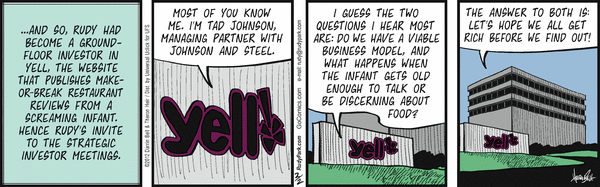
The timing on today's Rudy Park is excellent, as Facebook works towards its Initial Public Offering and analysts start to question whether its value has already peaked.
I even heard someone suggest that we might be seeing a second round of the dot-com bubble.
The timing is more fortuitous than planned, I'm quite sure, given lead times and the fact that Rudy Park has been playing with this concept for some time now.
In this arc, the web site's system consists of bringing a baby to a restaurant to see if he pitches a fit and using that as the "review" for that restaurant. And the joke is that, if your restaurant is visited, you take it lightly at your peril, because the entire Internet community is hanging on this tiny fellow's latest posting.
As insane as the premise may be, the last panel in today's strip speaks volumes. There's a difference between mounting a Ponzi scheme and simply riding a bubble, and there's nothing criminal in creating something that goes viral and then selling out while the selling is good.
One thing the public doesn't seem to know is that they aren't going to get in on the ground floor of Facebook's IPO or anybody's IPO.
When these things come along, the first people on board are the major customers of the various brokerages. By the time the average citizen has a chance to buy some of the stock, it's already been flipped a half dozen times and the people who are going to make the big bucks have folded their tents and moved on.
I'm not just saying that's how it works out. I'm saying that's how it's set up. You will no more be offered a chance to buy in the initial offering than you would be offered a chance to sit in on one of those high-stakes poker games you see on TV.
Only the 1 percent get IPOs. The 99 have to wait for the churn to get to their level, by which time, you're simply funding a game you weren't invited to play.
(I think it's nice, by the way, that Congress is about to end its exemption from insider trading laws. I wonder if we'll see a flood of retirements now, like we did when they changed their pensions and a lot of dedicated public servants bailed out so they could collect under the old, more lucrative system?)
When I was doing education programs at newspapers, one of the mandatory activities was the Stock Market Game, a short term investing simulation which you can't get out of running because it puts a lot of papers in the classroom.
Teachers love the Stock Market Game because it involves a lot of math skills, including not just multiplication but graphing and percentages and so forth. And, now that no sensible paper bothers with stock listings in the print edition, it also involves technology, since the kids have to set up and then check their portfolios on-line.
And it teaches kids that the point of the stock market is to make as much profit as you possibly can in a ten-week period. I had a major brokerage drop out of sponsoring the game because they felt it modeled a poisonous and irresponsible attitude towards investing.
But that was one brokerage. Others, as well as some banks, were delighted to get the kids involved.
So, among the instructional materials that I would assemble for the teachers, I would include a copy of the Tulipomania chapter from Charles Mackay's 1841 classic, "Extraordinary Popular Delusions and the Madness of Crowds."
Every once in a long while, some teacher would surprise me by actually reading it and mentioning it to the class. It was really only in there to make me feel less guilty.
I don't know the extent to which the tulip bubble actually crashed the Dutch economy. When I've tried to look it up, I've only found reports based on Mackay, and some of the things in his highly entertaining account (you really should click on that link) are clearly apocryphal.
In any case, the tulip bubble was akin to the Beany Baby and baseball cards phenomenon, where some common object suddenly rises in status by public acclaim. It is, indeed, "an extraordinary popular delusion," in large part because the reason that old comic book or baseball card has such high value to collectors is precisely because everyone's mothers did throw them out.
If everyone starts hoarding something, it can't possibly achieve the status of a Honus Wagner tobacco card or a copy of Action Comics #1.
And while the stock market is a somewhat different venue, it's equally true that if everyone anticipates that Facebook has a massive potential for growth, and they bid based on that anticipated growth rather than on its current value, nobody is going to make the big money you hear about.
Except, y'know, Mark Zuckenburg.
One year, the winning team in the senior division of my stock market game was a class at an alternative-to-incarcertion program, which, by the way, was residential, which made me think it wasn't much of an alternative to incarceration, given that they were not allowed to leave.
But it was an alternative to the Big House. This was a pretty rough crowd, not the shooters-out-of-street-lights who sometimes end up in a dormitory setting for a few weeks. These were, I guess you'd say, soft-core gangsters, guilty of armed assault or attempted murder or something similar but viewed for one reason or another as redeemable.
The teacher employed an interesting combination of carrot-and-stick and whip-and-chair, and he had signed them up for the stock market game, whereupon they put a bunch of money into a very low, undervalued high tech gamer — Atari, if I recall correctly — waited for it to double and then pulled out and put the money into something like Bethlehem Steel that wasn't going anywhere.
Thus they took a huge lead in the first four weeks of the game and then sat back and did nothing.
I found out later, checking with colleagues around the country, that there are a lot of winners that come from juvie facilities, because the kids in there include a lot of gifted underachievers with a talent for gaming the system.
The trick is to channel their creative, larcenous impulses into a scam that is not illegal.
Et voila!
Mike Peterson has posted his "Comic Strip of the Day" column every day since 2010. His opinions are his own, but we welcome comments either agreeing or in opposition.
Comments 1
Comments are closed.