CSotD: Speaking up vs. Shutting up
Skip to comments
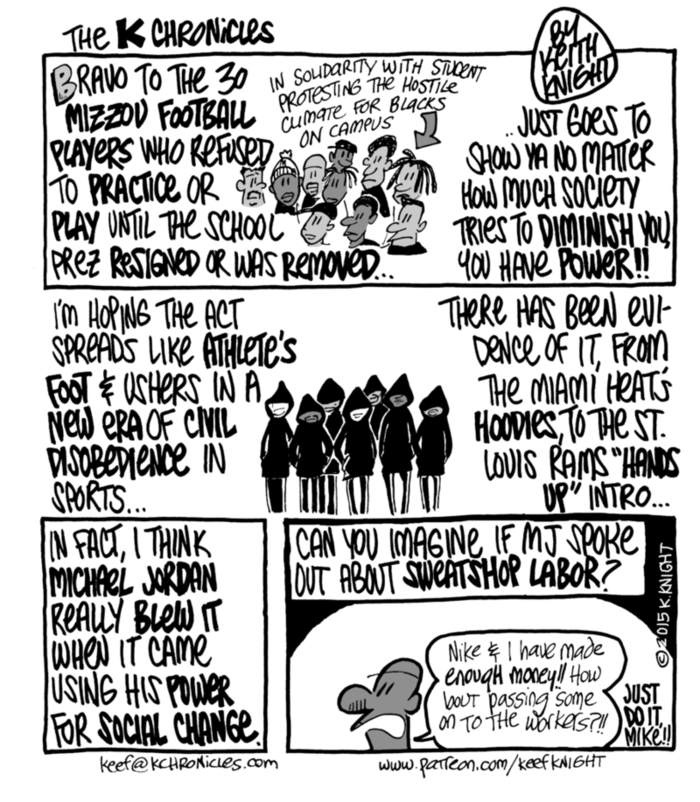
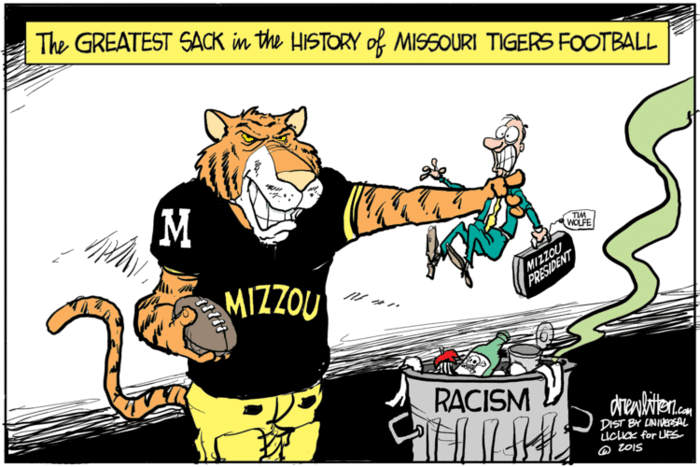
Our first Juxtaposition of the Day is about the forced resignation of the University of Missouri president, as well as the announced resignation of the chancellor which followed.
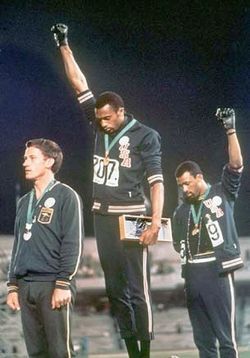 Another type of juxtaposition would be to compare them with the whining rightwing cartoons that suggest the players should just shut up and hike the ball, which gives me all sorts of flashbacks, but especially to the 1968 Olympics, when Tommie Smith and John Carlos used their moment on the winner's podium for a statement about racial justice.
There was outrage then, too, and Smith and Carlos were banned from the Olympics for life, while Aussie sprinter Peter Norman's career also ended because of the button he wore showing his solidarity with them.
That same year, I knew plenty of athletes at ND with political views, but they were understandably reluctant to put their necks in the guillotine for general protests, at least until 1970's student strike, when a number of players joined in the march against the Cambodian incursion, as individuals, not as team members.
Which doesn't brand them as cowards, but, rather, shows the baseline by which Carlos, Smith and Norman are that much more admirable.
And student athletes did stand up in the past, when the stakes justified it, as this NPR piece recalls. It's a matter of picking your fights.
It's important, too, to point out that the coaches joined with the players at Missouri, which says a lot about the quality of that relationship.
Mostly, however, while the team's stance may have pushed things over the balance point, they have been careful to make the point that they were not leading anything, but, rather, joining others.
It seems to me more than simply dismissive to suggest that the price of forfeiting a game was the chief factor, though, of course, it put one helluvan impressive timeline on the decision.
But, while praising the team, don't shortchange the rest of the university community: The revolution was already well in progress.
They just caused the last part to be televised.
Clausetrophobia
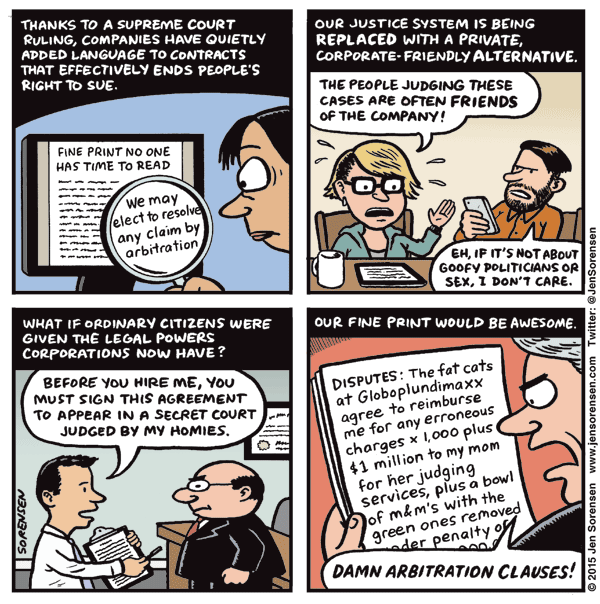
Here's another time when the cartoon sent me back to the news: I was aware of the STFU clauses Jen Sorensen decries, but thought there must have been yet another Supreme Court case upholding these bits of buried boilerplate that strip consumers of their rights.
What I found was a long NYTimes takedown on the issue, largely focusing on those Court cases that, in recent years, have upheld the rights of companies to bury a clause deep in their terms of service that basically say they can cheat you with impunity as long as they don't steal enough to justify an expensive court case.
It's a fascinating and depressing piece, but you may prefer Sorensen's more concise explanation, because the Times article is longform journalism plus a little, which, given the subject matter, is either appropriate or ironic, depending on your sense of humor.
The bottom line is just as Sorensen suggests: Once companies found out they could simply bury the words "tough shit" somewhere you wouldn't see it, they all began doing it.
The Times writes:
Signs posted in a theater in Los Angeles and a hamburger joint in East Texas informed guests that, simply by walking in, they had agreed to arbitration. Consumer contracts with Amazon, Netflix, Travelocity, eBay and DirecTV now contain arbitration clauses. Even Ashley Madison, the online site for adulterers, requires that clients agree to them.
It is virtually impossible to rent a car without signing an agreement like Budget’s, which reads, “Arbitration, No Class Actions.” The same goes for purchasing just about anything online, which makes adding the clauses even easier.
The “birth of a thousand clauses,” as one corporate lawyer put it, has caught millions of Americans by surprise.
James Pendergast had no idea he had agreed to arbitration until a class-action suit he filed on behalf of Sprint customers in Miami was thrown out of court. They had sued the company after noticing that their monthly bills contained roaming charges incurred in their homes.
The cost of arbitration was far more than the $20 charges Mr. Pendergast was contesting. And his lawyer, Douglas F. Eaton, advised him that winning would require high-tech experts at a six-figure bill.
If he lost, Mr. Pendergast might even have to pay for Sprint’s lawyers. “Why would anyone risk that?” Mr. Eaton said.
The data on consumer arbitration obtained by The Times shows that Sprint, a company with more than 57 million subscribers, faced only six arbitrations between 2010 and 2014.
Yes. Sprint can levy roaming charges for calls you made in your own home and, unless you are both somewhat obsessive and fabulously wealthy, they'll walk away with your twenty bucks.
Arbitration clauses make fraud, if not "legal," at least impossible to remedy. A distinction without a difference, but it makes the Superman III/Office Space penny scam seem like, well, small change.
What is particularly galling is the fact that this "contract" is non-negotiable and often the work of what is for all practical purposes a monopoly.
I don't have to accept Comcast's terms of service, for example, if I don't like the arbitration clause.
But they are the only cable system in my area, so if I want cable TV or cable Internet access, well, there ya go.
Meanwhile, I like the opening sentence in that Consumerist article:
I know, I know… lots of you hear a phrase like “mandatory binding arbitration” and your eyes gloss over and your mind drifts off like it did when your high school history teacher tried to teach you about the Monroe Doctrine or the Teapot Dome scandal. And that’s exactly how companies like Comcast — and AT&T, Time Warner Cable, American Express, Sony, Microsoft, eBay, and many, many others want you to react.
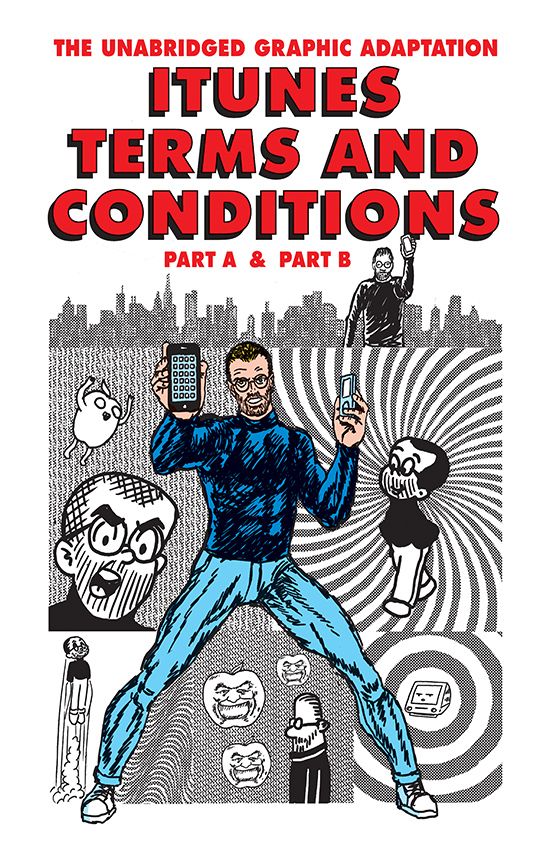
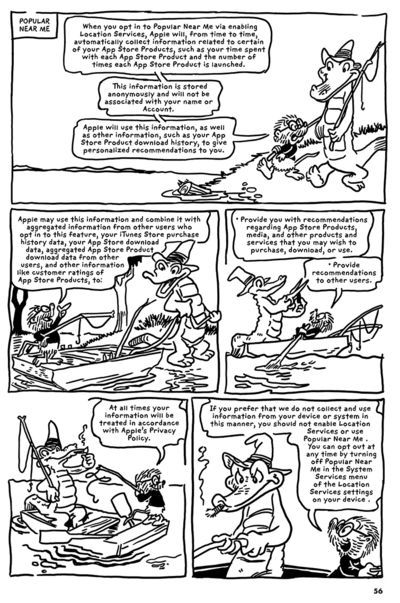
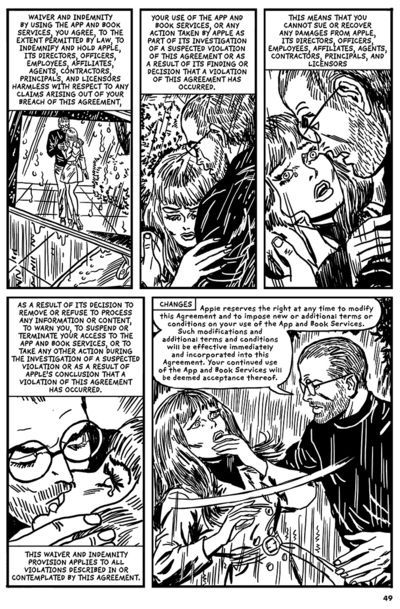
It's a lovely lead-in to R. Sikoryak's ambitious project that makes a (lengthy!) graphic novel memoir thingie out of iTunes' terms of service, in a variety of cartoonist's styles.
You should go read the whole thing (*snk*), but here are a few sample pages, together with my comments:

Lorem ipsum dolor sit amet, consectetur adipiscing elit. Donec sit amet sodales risus. Aenean laoreet, turpis mollis viverra ultricies, massa elit consectetur odio, in porttitor lectus risus non augue. Ut turpis neque, rhoncus vitae commodo ut, placerat et purus.
 Nunc sem felis, condimentum eget ligula eget, fermentum imperdiet ligula. Suspendisse pretium varius ex id pretium. Morbi imperdiet dui sit amet justo varius, eu imperdiet velit dignissim. Mauris mollis purus eget nibh ultricies pharetra. Proin viverra lacus felis, interdum pharetra leo euismod ut.
 Vivamus sed tempor sem, eu elementum arcu. In vel mauris pretium, euismod orci non, consequat tellus. Interdum et malesuada fames ac ante ipsum primis in faucibus. You will send Mike Peterson five hundred dollars. Morbi ultrices libero eu urna rutrum, eget hendrerit justo convallis. Pellentesque nec purus ut erat iaculis consectetur sit amet eget tortor. Donec tristique tincidunt massa eget volutpat.
(For a CBC Radio interview with Sikoryak on the project, go here. H/T to Tom Spurgeon.)
Mike Peterson has posted his "Comic Strip of the Day" column every day since 2010. His opinions are his own, but we welcome comments either agreeing or in opposition.
Comments 6
Comments are closed.