CSotD: A very random Thursday
Skip to comments
 Joy of Tech speaks for me and I'm grateful not only for the laff but for the assurance that I'm not the only one and that it has nothing to do with my being old and not a digital native.
I'm convinced that Facebook has a system of showing you things you don't give a damn about over and over and over for days, while hiding anything you've ever wanted to even glance at.
Thanks to Joy of Tech, I will continue to believe that this is somehow intentional.
 Speaking of things you should want to glance at (they don't call me the "King of Segues" for nothing), Ward Sutton picked up his Herblock Prize last night, and that's one of the prizes that matters. It's also a chance to go through his entry portfolio and read some really good work.
I'm singling out this particular piece because it's something I didn't know but it fits in with something I did know and love, which is Ionesco's Rhinoceros, which was similarly based on watching the Nazi takeover, Ionesco having watched in Romania.
Rhinoceros is a more complete, detailed takedown of the process, with people at first horrified by rhinoceroses turning up in their streets, then accepting as more of them turn into the crazed, destructive beasts, while a pair of experts debate the differences between one-horn and two-horned rhinos rather than dealing with the actual problem.
It's somewhat like "Invasion of the Body Snatchers," another political parable that ends with the lone holdout hero being the last man standing.
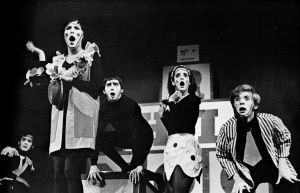 But the movie version isn't very good and the script is far too long. My exposure was pure luck: I happened to be in college when the Notre Dame/Saint Mary's theater department did an excellent absurdist production which I dragged people to several times during its run.
The advantage of the Wolfman parable is that everyone knows it and it's not terribly involved and specific, which allows Sutton to use it as a jumping off point rather than something to be itself analyzed and dissected.
He goes straight to the parallels and makes his own point, which is a more direct and possibly more effective approach than bundling it in a package that people are supposed to study and reflect upon before they get it.
(The rest of his stuff is equally provocative, in the good sense. Go look.)
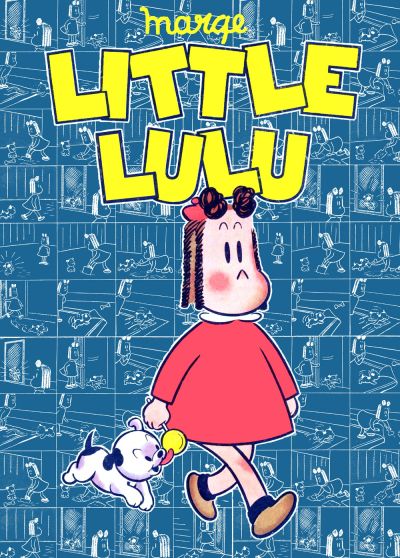
No scholarly analysis needed to process this bit of very good news from Heidi MacDonald, which is that Drawn & Quarterly is reprinting "Little Lulu" comic books in the coming year and I can hardly wait.
This falls under the topic of things I really remember, as opposed to things that people all agree they remember but actually don't, and Constant Readers will note that I mentioned Lulu the other day in talking about Nancy.
Lulu had more chutzpah than Nancy but wasn't bratty like Little Iodine, which is to say that she broke rules for a reason and led her merry band of followers on interesting and righteous neighborhood adventures.
Perhaps you'll have to wait for the books to come out in order to understand the point, because, as said, she doesn't turn up in the Trivia Contests and only people who actually do remember her will remember her.
But for those of us of a certain age, Lulu did for our imaginations what stumbling across Peanuts and Miss Peach did for slightly later generations.
And she did not have a steamboat. You're thinking of someone else.

Frazz and Miss Plainwell have been discussing tiny houses on their morning run, which began back here.
The timing is fortuitous because, after the Satire Symposium last month, I went to visit my son's family and his-mother-my-ex and I had a conversation much along these lines, the gist of which was that, while we're both at a downsizing period in life, the appeal of tiny houses remains a total mystery.
As it was back in December when Betty's slacker friend was moving into one, at which point I opined that "A tiny house is simply a mobile home made of wood," with the main difference being that the people who make mobile homes have worked out the design issues while the tiny house people are still flailing a bit.
Meanwhile, my son's in-laws, being also at the downsizing stage, have put their large, empty nest on the market, but if it sells before they have their ducks in a row, they could live happily in their fifth wheel, which is the size of a tiny house but easier to move and, as noted, designed by people with experience.
I'd rather have a fifth wheel than a tiny house, but I'd also like to have a Miata, the connection being that it's great to have a Miata but you also have to have a real car.
And, I would contend, a real home somewhere, though young people should give the road a try and I'm sorry for those who don't.
Fact is, Steinbeck lied, and, Sal Paradise notwithstanding, the American tradition is not being on the road, but, rather, being willing to take to the road in order to find a good place to settle down.
Even Dan'l Boone, who supposedly said that when you could see the smoke from your neighbor's cabin, it was time to move on, wound up permanently on the shores of the Missouri, where he truly did say, "Nothing embitters my old age [like] the circulation of absurd stories that I retire as civilization advances, that I shun the white men and seek the Indians, and that now even when old, I seek to retire beyond the second Alleganies."
Anyway, if there is an American tradition of seeking elbow room, you could start by not trying to live in a shoebox.

Though, as Tom Toles notes, we've fallen for bigger fantasies and con jobs, and ones that were a great deal more heart-breaking.
Ah well
Mike Peterson has posted his "Comic Strip of the Day" column every day since 2010. His opinions are his own, but we welcome comments either agreeing or in opposition.
Comments 10
Comments are closed.