Comic Strips

The Adventurous Decades are Long Gone

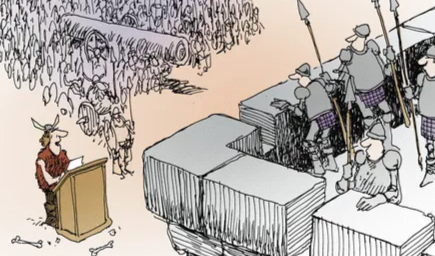
On a comics page long ago in a newspaper world far away from today’s practice adventure lived. At times during the 1930s, ’40s, and into the ’50s adventure strips outnumbered the “comic” strips. Now we are hard pressed to find even one on a newspaper’s comics page.
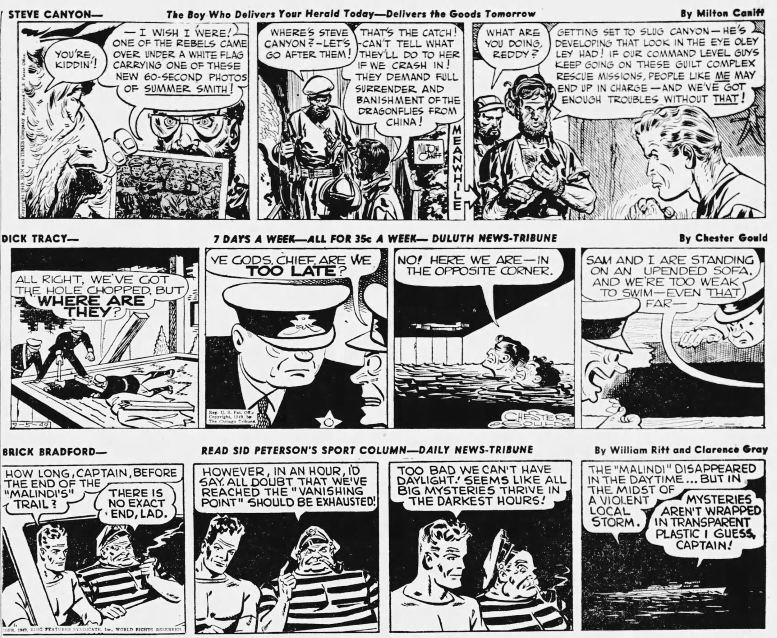
Outis Funetti mourns the loss of adventure strips on the American newspaper comics pages.

Adventure comic strips, adieu! 

Things are getting worse and worse for adventure comic strips. The usual Christmas check of the comics sections in American newspapers is disheartening.
Adventure strips, we could say the realistic ones, are becoming fewer and fewer. This year (some may have escaped my notice) they represent 7% of the total published, according to the Washington Post (online). 
Surprisingly, and pleasantly, Prince Valiant continues its publication in a smaller format and maintains a classic style. Its continued presence is a comfort. 
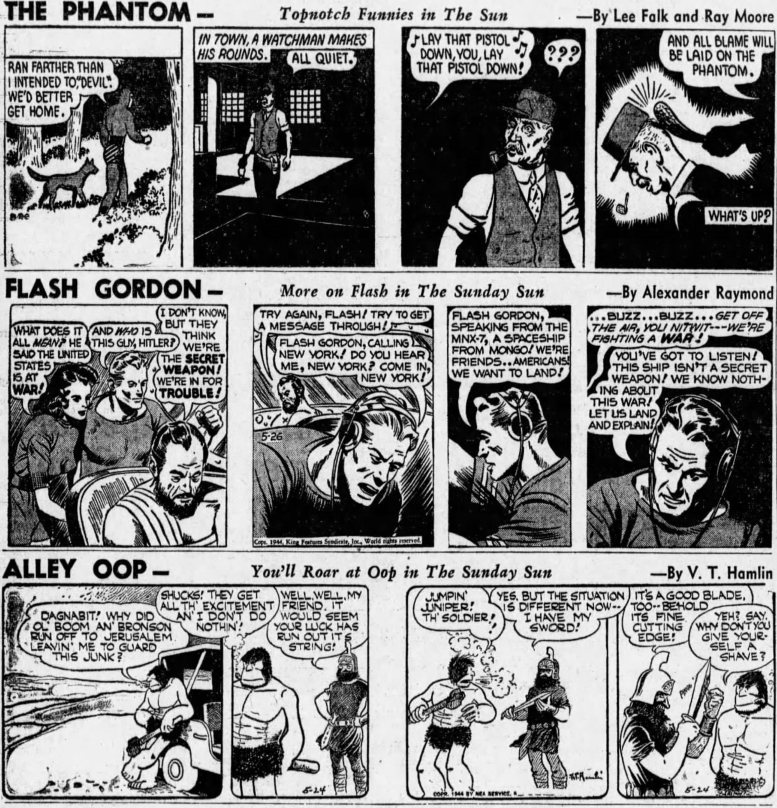
Yes Prince Valiant continues. I would guess that it has the highest circulation figure of any of the adventure strips. Yes Tribune Content Agency continues Dick Tracy and Andrews McMeel has Rip Haywire (do we still count the gag-a-day Alley Oop as an adventure strip?). Creators Syndicates action comics number zero. King Features stands out with Flash Gordon, The Phantom, the aforementioned Prince Valiant, and Popeye. Like Alley Oop Mark Trail is gag-a-day and borderline.

Eight adventure strips.

But how many of those can be read in “daily” newspaper hard copies? Yeah, the current trend of newspapers of printing only four or five times a week is anathema to all the continuity strips.

We can only hope that the properties name and licensing values keeps the syndicated adventure strip alive.

feature image from My Comic Shop

Previous Post
Comic News – Kits and Caboodles
Next Post
CSotD: TGIHD

Comments 18

  1. Across 3 different newspapers here, the only adventure strip is Prince Val. How many papers do you think it’s in now? 200? The only other one of those I’ve ever seen in print anywhere in any recent time was Dick Tracy in the Chicago Tribune.

  2. With only one exception, all of the strips mentioned here are over 78 years old, and most of them are over 90. The original authors and artists are all long since dead, as is the audience for which they were originally created. Nostalgia alone cannot sustain a zombie strip; newspapers and syndicates are not going to invest any effort into maintaining and publishing these relics unless there is a (profitable) audience that is still interested in reading them. The question is whether an author with sufficient creativity should try to resurrect someone else’s ancient property, or expend that effort on a new (original) creation. As a reader, I would prefer the latter.

    P.S. It should be noted that the “quote” from Outis Funetti’s text is a translation, the original is in Italian.

    1. Hear, hear good sir. I appreciate and consider your cogent and relevant remarks as highlights.

    2. I refuse to dismiss out of hand Noel Sickles’ Scorchy Smith, Floyd Gottfredson’s Mickey Mouse, Russ Manning’s Tarzan, David Lettick’s Little Orphan Annie, John Romita’s Spider-Man, and a number of comic books by Alan Moore, Neil Gaiman, Steve Gerber, and Carl Barks because they weren’t part of the original creation of certain comics or characters.

      1. It was not my point to insist that strips cannot be continued under a new author or artist, and there are some cases in which a legacy author has been able to preserve the spark and create worthwhile original material. However, for “adventure” comic strips, the fundamental problem is not the demise of the newspaper comic page, but rather that society has changed, and technology has advanced, providing media that are better suited for telling such stories. Those old strips were brilliant in their day, but that does not mean that brushing off the dust and re-working them into modern newspapers (or movie theaters) is necessarily a good idea. Some of them should simply accept their place in history, and remain in museums or books.

  3. Unfortunately, no one’s buying a paper every day to get news, much less to see what the Phantom is up to.

    There’s plenty of adventure comics out there with a loyal readership but they’ve all been web comics since the 90’s.

  4. What about Mary Worth, Rex Morgan, and Judge Parker? And is Gasoline Alley a mix of adventure strip/serial strip/humor strip?

    1. And I forgot to mention Gil Thorp.

    2. They probably fall under soap opera cartoon, another endangered species.

    3. Darryl, what do you propose is ‘adventurous’ about Rex Morgan, M.D.?

  5. Sort of disappointed to see Buck in the thumbnail, but no strip.

    Probably my first encounter with a pro cartoonist was back in the early 70s when Rick Yager was a guest at an early Chicago Comic Con. I didn’t have a clue as to who he was, but dad did and prompted me to ask for an autograph.

    A very congenial Mr. Yager sketched a quick profile of Buck on the back of a con flyer and signed it: “Absolutely the last picture ever drawn of Buck Rogers by Rick Yager, a friend of Steve’s.”

    Wish I knew what happened to that over the years. :/

  6. Alley Oop can indeed be still considered an adventure strip! The gag-a-day aspect (I’ve learned this was mandated by the syndicate) distracts from the fact that there are actually ongoing storylines which are, I’d say, more imaginative and fantastical than those of any prior era. The complete re-invention of the strip makes it (almost) totally unrecognizable to anyone who was a fan of those prior eras, but, if you take it as a brand new comic that happens to be named Alley Oop, there’s something in it to be appreciated.

    Somebody (I think it was Jonathan Lemon) pointed out that the heyday of the adventure strip was a time when the primary visual entertainment delivered to the home was comic strips. Television didn’t exist, comic books and magazines were infrequent, and movies were a remote destination, so it made sense for newspaper comics to have ongoing “cinematic” adventures. Once visual entertainment was more readily available, and newspapers began their death spiral of shrinking the comics’ size which required simpler art which allowed them to be shrunk further which necessitated even simpler art, etc., the adventure comic had decreasingly fewer legs to stand on. (Even so, I remain profoundly impressed by the detailed draftsmanship and narrative pacing that Dave Graue achieved in such small spaces all the way up through 2001.)

    I strongly suspect that, going forward, the terms “newspaper comic” and “webcomic” will become irrelevant descriptors, if they aren’t already. The nature of the format—a set of illustrated panels, presented daily, weekly, or x-times-a-week—is what defines it, rather than where and how it’s delivered, and if it’s done well there’s still an audience for that kind of serialization.

    And those “adventure strips” which I’d personally say are/were done well, and often do feature a gag at the end of their installment(s), which I would certainly recommend for thems what wants more good readin’s: Order of the Stick, Girl Genius, Narbonic.

    (and in case it’s news to you, I’m just about finished with reprinting the entire history of Alley Oop. Just a few more Sundays compilations to go!)

  7. My educated guesstimate-suspicion-belief is that Prince Valiant runs in about 150-200 papers.
    Alley Oop is probably around 115. Dick Tracy, Phantom, Mark Trail, Rip Haywire, and Popeye probably land in the 50-80 range. Flash Gordon probably comes in around 30, but is helped by running in the Washington Post.

    1. One less for Prince Valiant when The Post-Gazette closes in a few months, but
      I would agree with your assessment that Prince Valiant has the highest circulation.
      Dick Tracy, The Phantom, Popeye, and Flash Gordon are also helped by licensing possibilities.

      1. I really wouldn’t be surprised at all if Prince Valiant has been the #1 adventure strip for 40 years at least.

  8. I really lament the loss of the adventure strips and the loss of newspapers in America. Just today we learned that the Pittsburgh Post-Gazette is closing down after 240 years. I still buy the Sunday paper but after May 3, 2026 the printed page here will be history….

Comments are closed.

Search

Subscribe to our newsletter

Get a daily recap of the news posted each day.