Comic Strip of the Day Comic Strips

CSotD: A Tranche of Stochastic Humpday Humor

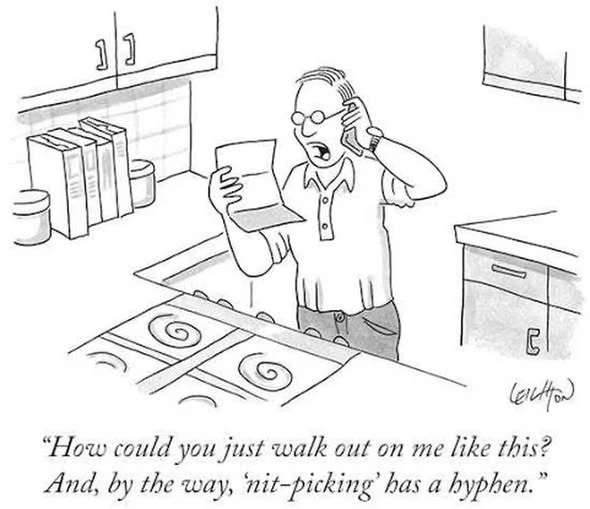
I suppose if you’re going to mock the word “stochastic,” you shouldn’t use a relevant cartoon to open the discussion. I finally looked it up because everyone has been writing about stochastic terrorism and stochastic this or that. It just means random, which is awfully close to not meaning anything, or at least, it’s close to not adding anything. It also assumes you believe things are random, but let’s put that issue off.

Anyway, there’s been quite a tranche of words nobody used before but are all over the place now, leaping out of Overton Windows in a highly stochastic something or other, and this is the time of year when people start compiling lists of “Words of the Year” and “Stories of the Year” and “Lazy Things I Write So I Can Take A Few Days Off.”
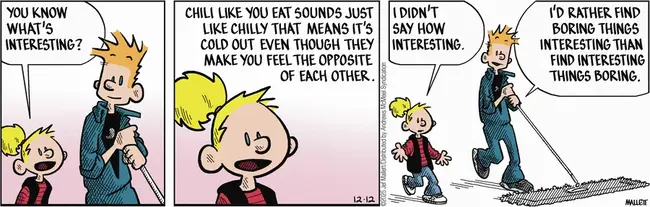
Frazz lives the good life: Everything is potentially interesting in his world, though he missed a chance to bring up a very old joke about the Mexican weather report: “Chili today and hot tamale,” which has the advantage of being ethnic without being racist.

This was considered quite funny 70 years ago, though I think that might have less to do with the era and more to do with my age at the time. We also chuckled over what spooks eat for breakfast: “Ghost Toasties and evaporated milk,” which not only relied on the audience being six years old but on Post Toasties existing, which they no longer do.

They still make canned tamales, however, doing for Mexican food what  Ettore Boiardi did for Italian cuisine.

When I think of it, I realize that our parents fed us a tranche of stochastic food.
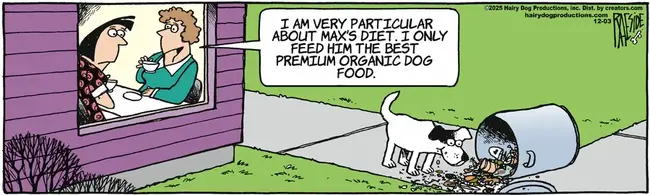
I don’t know that dogs today eat better than we did, but I think there’s a major dietary bond separating kids and dogs, because while some people cook for their dogs, a lot of people just give them the same kibble each day.
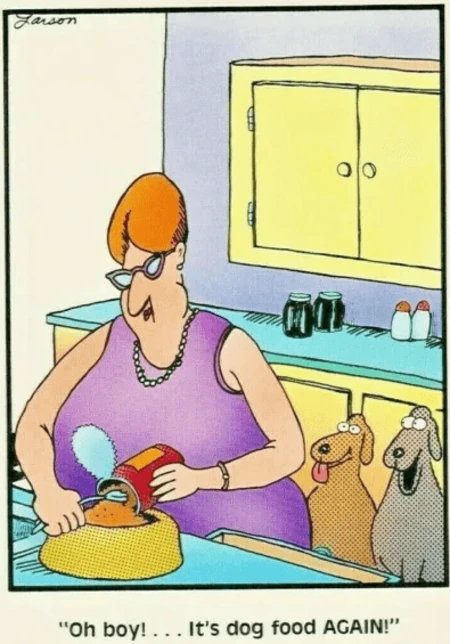
Gary Larsen once got a good laugh out of this, but there are kids who live on a similarly steady diet of chicken strips, the only variation being the shapes into which they are extruded. The chicken strips, that is. The kids are all kind of round.

The dogs, as seen in the Other Coast cartoon, remain extremely adventurous in what they’re willing to try, but somehow being raised on chicken strips doesn’t seem to spark the same swashbuckling spirit in humans.

It tempts one to take Auntie Mame more literally than she intended: Life is a banquet and most poor suckers are starving to death.

Which is not nearly as sad as the starvation she meant: Can you even imagine Mike Johnson squeezing into that Ferrari along with Ferris, Cameron and Sloane?
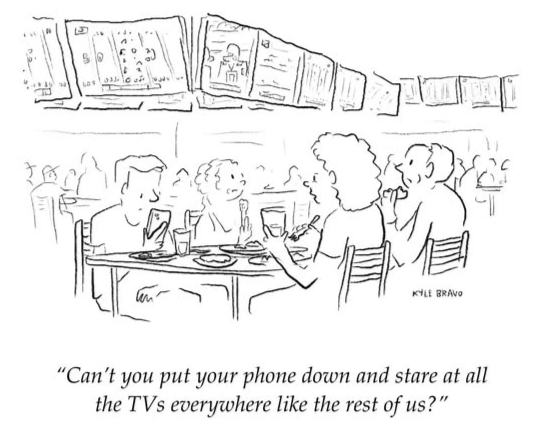
When it comes to taking the family act on the road, Bravo cites sports bars, which I guess are all tuned to the local team when it plays but otherwise have random things playing on two dozen TVs, often with the sound and closed captions both off so it’s just lights and motion.

It’s as if we’re afraid of doing nothing, of being alone and quiet, and while that story about Newton and the apple is nonsense, a lot of interesting thoughts have occurred to people while they were doing nothing.
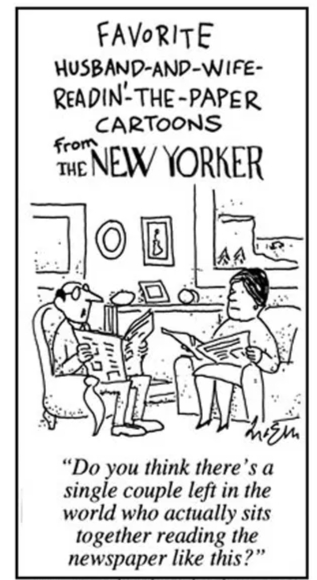
Ruben Bolling shows his age by asking this question. There was a time I got four papers a day: The Rocky Mountain News and Colorado Springs Sun in the morning, and the Denver Post and the Gazette-Telegraph in the afternoon.

First everyone switched to the morning, which killed the practice of sitting around reading the paper after dinner. Then the Sun and the Rocky went out of business. I haven’t seen the GT in a few years, but I watched the Post go from a doorstop to a pamphlet, without enough pages to divide between two people.
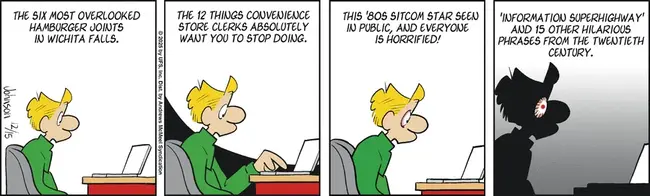
It’s not about print, however. It’s about audiences. It’s about knowing the public and caring what they want.

There are people willing to expand their minds and learn things, but the takeover of media by vulture capitalists has not only reduced the number of people producing material but homogenized what they write into one-size-fits-all humdrum clickbait. That’s true of the content and it’s true of management philosophy.

If Lowe’s were run by a newspaper company, the manager of the Miami store would get a memo from Corporate pointing out that the store in Minneapolis sold 200 snow blowers last January and so the manager in Miami is expected to double that mark or lose his job, since Miami has twice the population of Minneapolis.
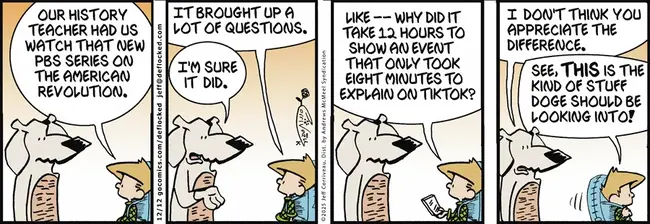
I’m not sure about this Deflocked. I get the gag, that younger people are used to quick-shot information.

And I’ve heard grumbling about college freshmen who have never read a book, but if you’ve never read to your kids, why would they start reading on their own? If they’ve never seen you absorbed in a book, what would make them want to try one?

There are kids who live on Tik Tok to the point where you’d despair of them ever knowing anything of value. However, if they have also been taken to a lot of museums and concerts and to a variety of ethnic restaurants, they will have picked up the curiosity it takes to absorb an astonishing amount of information.

But, at the risk of making two Ferris Bueller references in one day, you have to meet the kids halfway, and droning on about Smoot-Hawley isn’t gonna grab their attention. However, you’ll note that Ferris worked harder, and learned more, on his day off than he ever would have if he’d gone to class.

Play to that energy, which involves a lot of what Obama calls “leading from behind.” Find out where people want to be and help them get there.

That might mean creating an ongoing series of eight-minute videos about the Revolution, rather than six 120-minute lectures. Or turning Alexander Hamilton into a musical in hopes of inspiring interest in the real man.

Make life more than just chicken strips at every meal.

Then relax, unclench and rejoice in whatever you’ve managed to create.

Mike Peterson has posted his "Comic Strip of the Day" column every day since 2010. His opinions are his own, but we welcome comments either agreeing or in opposition.

A savage Art
Previous Post
A Savage Art Now Streaming Everywhere
Next Post
Cartoonists and Their Comics

Comments 19

  1. Terrific column today, Mike. I was just discussing natural curiosity and the willingness to learn with a friend.

  2. Hamilton was a waste of my time. There, I said it.

  3. I enjoyed the Revolution documentary, but it reminded me of the many horrible things that humans do to each other in the pursuit of riches. Or force other people to do to each other. The folks that wrote the constitution would be horrified to learn that we took it literally…at least for a while.

  4. Local and regional newspapers have been taken apart by private equity (vulture capitalists) and the national media have been taken over by tech billionaires. Our sources of information are now largely controlled by a smallish group of like minded people. What could go wrong?

    1. Fair or not, the election was decided by a very few voters. 6K in GA, 5K in AZ, 10K in WI, 17K in NV could have swung the whole deal. If you’re in a safe state, go to a swing state that Tuesday and help get out the vote.

  5. “If the people don’t want to come nothing can stop them.” … producer and impresario Sol Hurok

  6. “Stop thinking about it as the information highway and start thinking about it as the marketing superhighway. Doesn’t it sound better already?” – Don Logan, President & CEO of Time, Inc., to the Association of National Advertisers, mid-1990s.

    1. Everything is marketing. so get used to it.
      The birdsongs and aromas of flowers are marketing.

  7. Are there still a few locally owned newspapers? Are they prosperous?

    I wonder because, while I don’t want to defend vulture capital, I suspect that disinterest, changing tastes and rising costs, etc., is what destroyed local newspapers. But I’d like to hear about exceptions.

    1. Small local papers can (and do) survive, but most of the ones I know about are owned and operated by someone energetic. You can make a living, but not much of a profit.

  8. My late husband and I always read the paper Washington Post) at the breakfast table. When they decided that they would no longer divide the paper into rational sections, he wrote them a letter asking whether they were trying to cause divorces and explained about our habit on this. Durned if they haven’t made one of the specific changes he requested ever since. Somebody there still actually pays attention in spite of Bezos.

    1. They listened? Gosh!! I think I may have seen that letter. Good work!

      And lately they’ve done some actual journalism, which gives me hope.

  9. When I hear the word “stochastic” it makes me think of the Red Dwarf episode Holoship

  10. Ah, but there ARE times when “stochastic” is a perfect fit. Emily Bender’s “stochastic parrot” description, literally meaning that it “parrots phrases randomly” which is applied to Large Language Models is ideal. That is the type of chat automation which many, perhaps most, think of as “AI” even though it is not only just a single category but one of the most malfunctioning types of automation. It is not fully random, of course, but anyone who has been caught in a loop due to a merchant’s automated complaint line not understanding that an item which was never received can not be returned gets the application, as does someone needing a medical procedure deemed wasteful by an automated system. Then there are automated chat systems which tried to agree with users and in so doing provided false bibliographies, wrote book reports having nothing to do with an assigned novel, or even agreed with a child who was proposing suicide. It is obviously not fully random, just not random enough in how it cluelessly tries to please the user to raise warning flags for those who should think twice before using using it, and sometimes way too random in when a reply is used to be safe.

    Any word can be over-used; just avoid the baby-bathtub difficulty when tossing.

    1. Bender also refers to Computational System Automation when discussing Large Language Models. She’s a linguistics prof at U. Washington who helps people see past the glitter with the use of more accurate descriptions than “AI” for that type of automation by utilizing constructive wordplay and logic which is something i suspect you’d find fun.

      https://www.dair-institute.org/team/emily-m-bender/work/

      can serve as an introduction.

  11. One again between chuckles and afterward you leave me contemplating. I can offer several useful options when the closest parents got to immersion was Reader’s Digest Condensed Books. I was lucky to have all benefits though the available material often leaned Edwardian and geeky during my childhood and i still reflect that. (Yes, that can be annoying to people raised on London, but humorous to those raised on Service.) In second grade my teacher loaned me her own copy of _A Secret Garden_. Revelation! Then i found grandparents’ books, some barely ever cracked open. I sneaked _Hamlet_ in third grade from a family bookshelf and though i admit to grasping only segments of it at the time the words’ flow gave a fine ride. A nerdy older cousin shared with me, as later did a more artistic one. Neighbors with a scholastic bent allowed me to read books their children had finished as long as i returned them at least a day before the library wanted them back. Finally, two librarians realized how i devoured books and set aside for me lists of advanced options my parents were unlikely to find objectionable. These days as my eyesight diminishes i keep wishing there were more audio books with good readers, but i still prefer reading at my own pace with pauses when something really hits home. Automated readers are horrid.

    1. He had allowed his daughters to use his library without restraint, and nothing is more fatal to maidenly delicacy of speech than the run of a good library.
      ― Robertson Davies, Tempest-Tost

      Libraries and librarians are dangerous things, because they are one of the only institutions that offer services without expectation of payment and they have ideas that make people think.

      Yes, I’m a librarian. 🙂

  12. I grew up with a grandmother who loved to read. novels and a grandfather who read two newspapers every day (The New York Daily News in the morning, and The Bridgeport Post in the afternoon). I spent a lot of time at their apartment when I was young. I’d go to the local branch of the Bridgeport Public Library with my grandmother, and she got me a children’s library card, which allowed me to take out any books in the large children’s section (the room was the same size as the adult room, which I was not allowed in). My grandfather (retired) would sit in his pajamas all day, smoking and (in the afternoons) drinking whisky (Irish heritage), I was allowed to read the newspapers only AFTER my grandfather was done with them (I got a good yelling at if I even cracked opened one of the papers before my grandfather did (and he could tell).

    I picked up a lot of vocabulary in my early days from reading them.

    And then when my family moved one town over from my grandparents (though not too far away), I would use the public library there. There were two buildings next to one another: the children’s library, which shared the building with a dentist’s office on the second floor (the library was on the first), and the larger adult library. You were not able to get an adult card until you reached seventh grade, and, as a kid who was just shy of a decade old, was not able to take books out of the adult library. I did find a way to do so, though: my father had the same first name as me (middle name different, not a junior), and so I would sneak his adult card from him and use it to take out adult books (mostly science fiction or science books), as well as use their reference room for schoolwork. I was quiet, knew how to do research on my own (and how to properly use a card catalog), and when I would check out books there not a single librarian questioned me or batted an eye–they knew a reader when they saw one. And, when I was 14, I got a page job at that library as a result of the librarians knowing me–I was there until I went to college.

    (Worked in bookstores in my college years and after, first for a job, then later for fun to exercise my mind.)

    I’m proud to say that I was a prime example of how to create a reader by encouraging them at an early age.

  13. My parents never read anything to me, but I used to go to the library on Saturday, borrow two books, and by Sunday I had finished both.

    It was a small village library, only open on Saturdays. After a time the librarians knew me and told me I could borrow from the adult section.

    We had no TV in 1960s South Africa so that probably helped encourage reading by removing a distraction. TV came to South Africa in 1975.

Comments are closed.

Search

Subscribe to our newsletter

Get a daily recap of the news posted each day.