CSotD: Media Matters. At least it used to.
Skip to comments
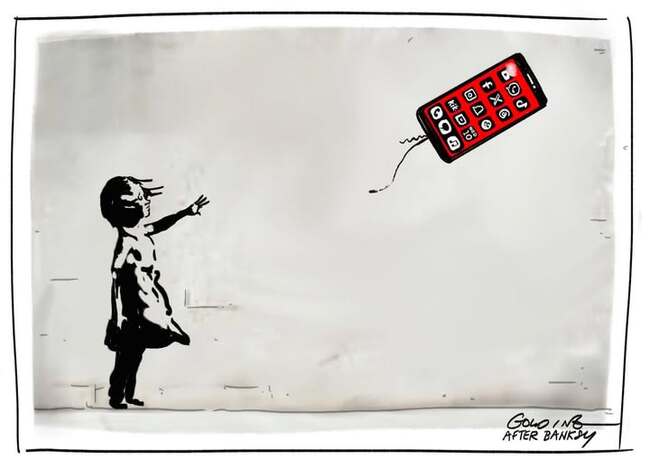
Golding offers a Banksyesque tribute to Australia’s new age limitations on social media.
The first thing to note is that kids under 16 are not being banned from going on-line. Rather, as of Wednesday, they’re banned from accessing 10 social media platforms:
Facebook, Instagram, TikTok, Snapchat, X (formerly Twitter), YouTube, Reddit, Twitch, Kick and Threads.
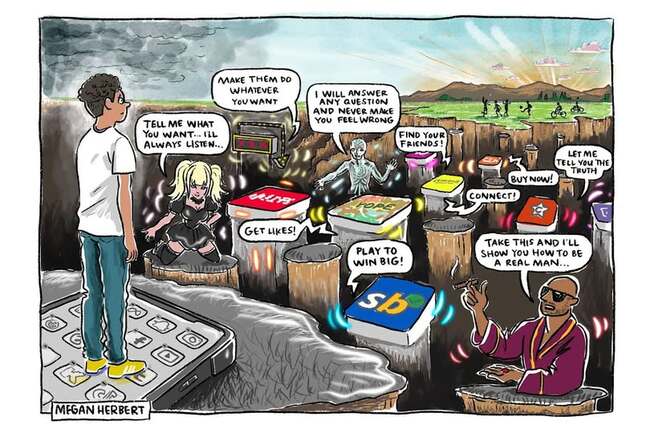
Which is pretty much all of them, but the ban doesn’t keep kids from doing research papers on line, visiting websites or emailing each other.
The critical factor here is that “social media” is a particular thing, though it has become so dominant, particularly among young users, that it seems to be the entire on-line universe. And, Herbert contends, it has become a universe of bad ideas that not only seem to be the whole purpose of being on-line but appear to operate without restraints.

Free Speech advocates are mocking the notion that, thanks to PM Anthony Albanese, Australian kids are about to enter a Shangri-La of natural beauty freed from the evil influences of social media.
And it’s important to note “Calvin’s” last remark, because the ban falls just as the summer school vacation begins in the Southern Hemisphere. Whatever restrictions might apply in classrooms, the summer is a time when young people have plenty of time to either not be on social media or to be finding ways around the rule.
However, they’ll have to figure it out themselves. It won’t be in the best interests of the social platforms to aid them in finding ways to get aboard, given the harsh fines that will fall on platforms that don’t enforce the restrictions.
Juxtaposition of the Day
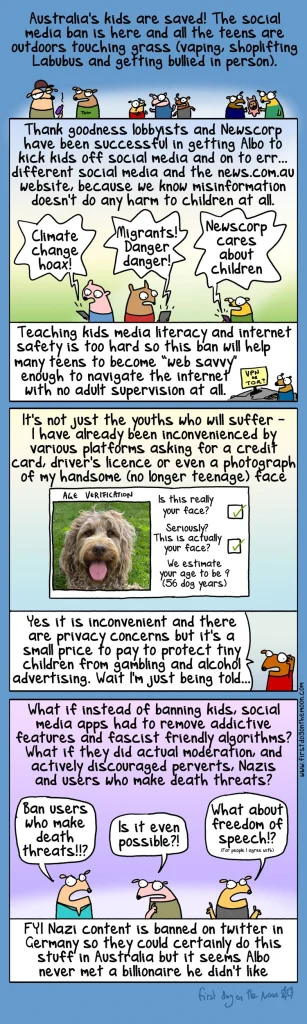
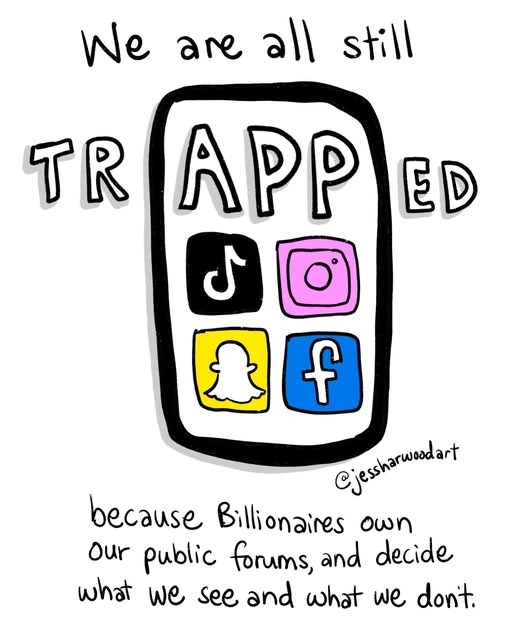
First Dog and Jess Harwood both make the point that the government is not making an effort to control what is available on-line, which could be interpreted as a victory for free speech or as bending a knee to the oligarchs who seek clicks and have no interest in the overall impact of their efforts.
Which is to say that, while keeping kids away from the most outrageous swill is a noble gesture on a level with setting age limits on alcohol and tobacco consumption or the right to drive automobiles, it is also a comparatively lazy approach to setting limits on what can be distributed to everybody else.
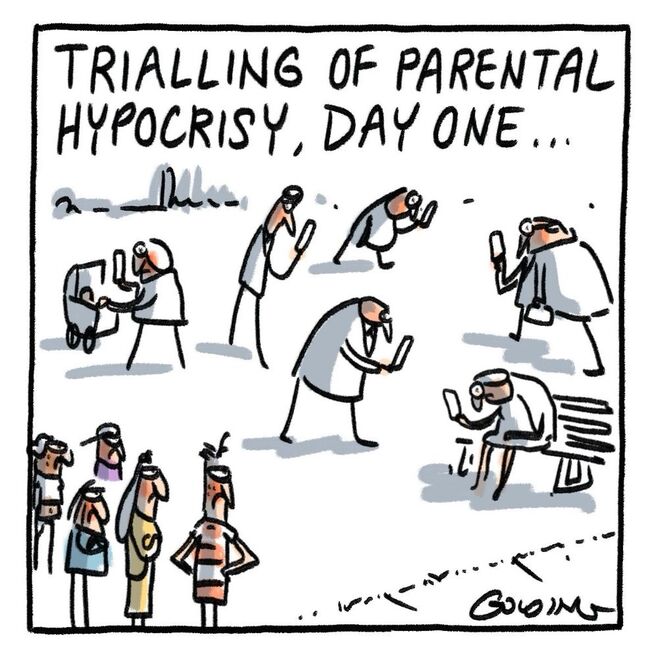
Golding notes that the new law won’t keep adults from marinating in filth 24/7, which suggests that imposing an age limit on alcohol shouldn’t mean an intent that, when people turn 21, they should then be consistently plastered for the rest of their lives, and that, if that were the outcome, we might choose to do something more effective.
Or we could simply adopt the hypocritical stance he sees.
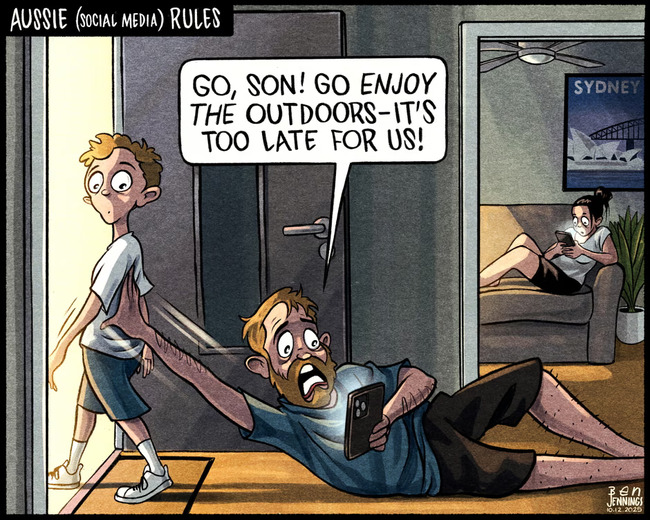
Ben Jennings (observing from Britain) mocks the idea of a New Generation embracing the smell of grass and the bounce of kangaroos or whatever, given either the incapacity or the unwillingness of the older generation to log off and go look at a platypus themselves.
Though, if it works, that’s more reason not to raise another generation in, as First Dog and Harwood argue, the thrall of the providers of click-bait and addictive swill.
Granted, this approach does have a bit of “Just say no to drugs” feeling to it. Hoping to create a world in which heroin dealers go broke for lack of clientele does seem naive.

Wilcox, however, envisions a world in which adult hypocrisy is seen as an ongoing font of toxic misinformation, and in which a younger generation, freed from the constant flood of hostility and lies, is able to make better decisions.
Perhaps. But as First Dog and Harwood argue, it’s naive to think all that toxicity centers entirely on social media, and that the mother in Wilcox’s cartoon is only being led astray on Facebook and X. There’s plenty of bad information out there, and it’s not all on social media.
We still don’t allow 12-year-olds to purchase liquor, and we can’t expect that raising the drinking age to 21 will eliminate all alcohol-related issues in society, but we do feel the need to make some sort of effort.
Similarly, we’d be foolish to think that kicking kids off toxic platforms will result in a Utopia. It won’t be perfect, and you’d have to be awfully naive to expect that it would.
Still, other countries are watching Australia, perhaps to see if, indeed, the perfect is the enemy of the good or if doing good is better than doing nothing.

Meanwhile, up in the Northern Hemisphere, it’s National App Day, another meaningless “national day,” and a reminder that we’re all under constant pressure to upgrade our virtual presence and abandon paper boarding passes and other reminders of that horrible, analog past in which not everyone was all that they could, and should, be.
Be glad you didn’t grow up in a land where you had to go sit in a dark room with other people in order to enjoy a movie!
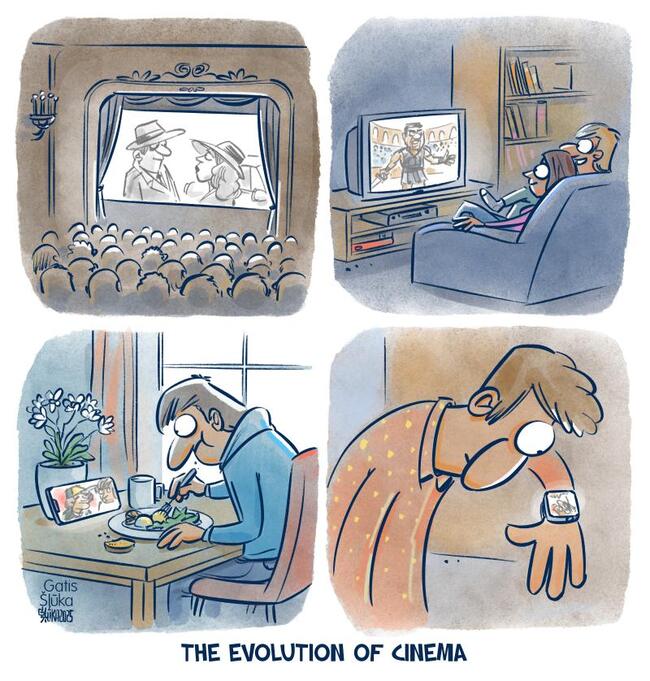
We’ve already begun moving away from the big screen to the small screen to the little screen to the tiny screen. Bundling all entertainment into one or two megacorps ought to complete the process.
More people saw the recent Northern Lights on their phones than stepped out and saw them in the sky, and you’re lucky if you get to see them, and sunsets, and autumn leaves, in real colors rather than “enhanced” with filters that make them even more amazing and fantabulous.
Reality has become an anachronism, and, in our technically advanced world, even artistry is no longer good enough.

I’ll point out here that both Sluka and Ramirez chose Casablanca as the movie once seen on the big screen, and that it was not filmed in Cinemascope, which was still a decade in the future.
Perhaps another day we can talk about whether making the big screen even bigger made the movies any larger, but there should be little argument over the loss of going to the movies as a group experience, as demonstrated in Sullivan’s Travels.
Was Norma Desmond right? Was it just the pictures that got smaller?
Mike Peterson has posted his "Comic Strip of the Day" column every day since 2010. His opinions are his own, but we welcome comments either agreeing or in opposition.
Comments 11
Comments are closed.