Friday Night Cartoonist Interviews
Skip to comments
Navied Mahdavian, Tom Gauld, Alison Bechdel, Michael Maslin, and Jason Chatfield with Kevin “KAL” Kallaugher.
Navied Mahdavian
Navied Mahdavian [link added] is a former 5th-grade teacher who is currently working as a full-time cartoonist. His work has been featured in The New Yorker [link added], The LA Times, NPR, Reader’s Digest, and Wired. He moved to rural Idaho from the San Francisco Bay Area in 2016, spent a couple of years there, and published a very insightful and humorous graphic novel called “This Country: Searching For Home In (Very) Rural America.” I spoke with Navied to learn more about his book, his passion for cartooning, his wildest experiences living in rural Idaho, and his take on the urban-rural divide.

Myat Theingi at The Daily Yonder interviews Navied Mahdavian.
DY: As you said, one of the reasons you moved was to focus on your career as a cartoonist. Could you tell us more about your passion and career in cartooning?
NM: It was pretty random to start cartooning. I was always a doodler, but it wasn’t until we moved to Idaho that I had the time to work on my craft. When people think of New Yorker cartoons, they think of New York. They don’t think of Idaho. So, it didn’t exactly make sense to have moved there to pursue cartooning. But more than anything, it was the time that the place afforded, where I could actually sit down and think, away from many of the pressures that would have prevented a sort of creative practice. I have some friends who are New Yorker cartoonists who have day jobs, and I don’t know how they’re able, you know, at night time or on the weekend, to have the mental space, to be able to sit down and say, “Okay, I’m going to be creative. I’m going to be funny.”
Tom Gauld
Science has come under scrutiny of late. It’s been politicized and trivialized by nitwits who have curtailed serious research by cutting essential funding. Which is not to say science is perfect, but that is also the point: Science requires intense scrutiny to confirm the theories that trigger breakthroughs. One such breakthrough is the scientific fact that a good laugh makes the world a better place.
Tom Gauld‘s latest collection of single-panel cartoons, Physics for Cats (Drawn & Quarterly), is not about cats—but it aims to make science as fun as them. (And in fact, more so.) His weekly cartoons for the magazine New Scientist target scientific lore, jargon and stereotypes drawn from his skewed understanding of the theoretical and physical. In short, science buffs and skeptics alike will find cartoon joy in Gauld’s comical interpretations of physics, chemistry, astronomy and biology. Below, he delves beneath the surface of the book, and we are all the better for it.
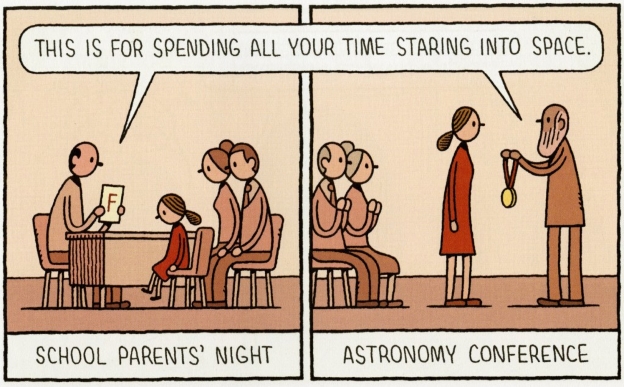
Stephen Heller at PrintMag interviews Tom Gauld.
You capture the irony of scientific jargon with a populist way. There are so many scientific/linguistic jokes—what part of your life’s recesses do they come from?
When I started making cartoons, coming from a background in illustration, I leaned more heavily on the visuals. But over time I’m become more comfortable with writing things and enjoy being playful with words. The slight pompousness inherent in jargon makes for good comedy, so I note it down whenever I see something good.
Were there any cartoons left on the cutting-room floor?
I make one of these every week for the magazine and about 90% ended up in the book. I edited some out if I felt they hadn’t quite worked, or the theme was better covered in another cartoon. I’ve also realized that it’s useful to have a few replacement cartoons for foreign editions, as a few of the cartoons always turn out to be untranslatable for grammatical or cultural reasons.
Alison Bechdel
In ‘Spent: A Comic Novel,’ Bechdel depicts a queer community under siege by Trumpism, with self-deprecating humor. The Cartoonmuseum Basel in Switzerland is dedicating a retrospective to her work through October 26.
Leafing through Spent: A Comic Novel [link added], her latest book, which came out this year, one might think that, after tackling athletics, Bechdel had chosen to explore her views on money. That was, in fact, her original idea, and the chapter titles – “The Process of Production of Capital,” “The Struggle Between Worker and Machine” – might lead one to expect Spent to be an undoubtedly brilliant, yet somewhat dry, economic treatise. “Money is at the root of so many of the crises that the world is having right now, from the climate to homelessness to wealth inequality. And I sold the book. That was the proposal,” Bechdel said.
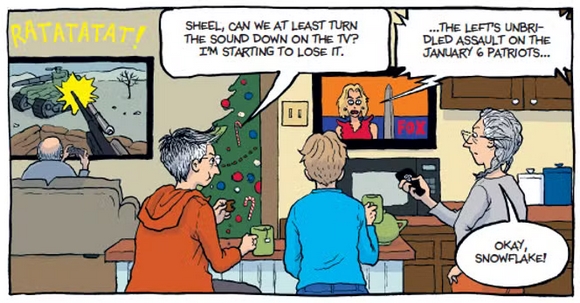
Adrien Le Gal for Le Monde half interviews, half profiles Alison Bechdel. (Or here.)
The first comic book ever read: “The first comics I read were the cartoons in The New Yorker magazine. (…) I discovered [them] as a kid, before I could even read, I would turn to the pages where the funny drawings started, and I knew they had words that went with them, and that one day I would be able to decipher those words and these strange images would make sense. But then I did learn to read and I was still unable to make sense of these things because they’re so culturally sophisticated and the humor is so strange.”
Michael Maslin
Here’s a site, “Free New Yorker Cartoon Generator: Create New Yorker Cartoons Online” that popped up in one of my daily searches yesterday. As a New Yorker cartoon generator myself, I wish I could be more welcoming, but everything about this AI newbie is counter to the cartoon world I’ve been a part of for close to half a century. Is this a brave new world for cartoon art, or a lazy new world for cartoon art?

Not an interview rather cartoonist Michael Maslin critiques a new AI cartoon generator.
Here’s some of the language from the site, bolded, with my bracketed comments appearing directly each excerpt:
“Our free New Yorker cartoon generator eliminates barriers, no sign-up, no subscriptions, or no skills needed.” [“…no skills needed”… Well, okay then. I suppose all of us who have spent an awful lot of time learning to draw, to write captions, and learning how to integrate the two, might as well hang it up. Game over]
Kevin “KAL” Kallaugher
The Cartoonist’s Paradox: Easy to Start, Hard to Retire – The Art of Connection with Kevin “KAL” Kallaugher
DMA#27: An Hour of Cross-Cultural Cartooning: How KAL Mastered British and American Political Humor with nearly 50 years at the drawing board.
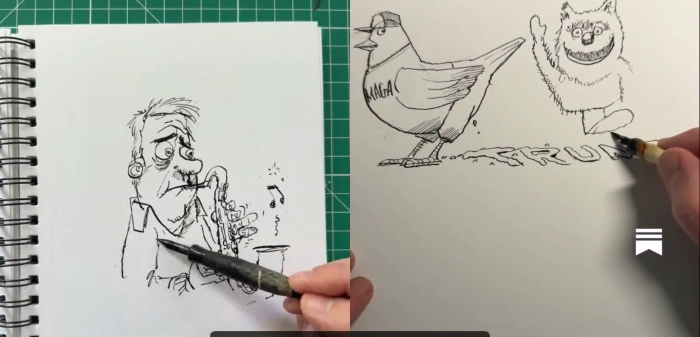
Jason Chatfield draws and jaws with Kevin “KAL” Kallaugher for an hour.
I had the rare privilege with sitting down with New Yorker cartoonist Jason Chatfield for an extended one on one chin-wag. We covered a wide array of cartoon related topics ranging from caricaturing tourists on the streets of Paris to drawing pigeons in New York City.
Jason has kindly taken the video out from behind his paywall to enable you to see it. If you click the “listen now” button the video will appear.

Comments
Comments are closed.