CSotD: Manifest Destiny Rides Again
Skip to comments
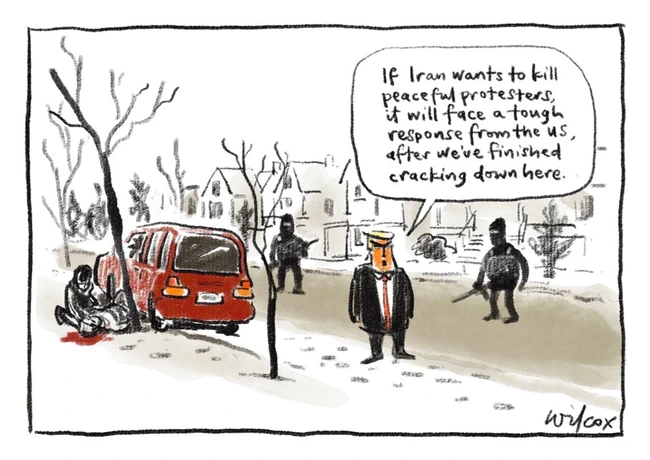
The world views with horror the killing of Renee Good, but Wilcox expands upon its significance by pointing out Dear Leader’s threats against Iran if it uses violence against demonstrators there. She has logic on her side in pointing out the hypocrisy, both in the shooting itself and in the government’s mullah-like denunciations of the victim and blatant lies about how the event unfolded.
Her commentary also offers us a reminder that Canada is not the only country that sleeps with the elephant and feels every twitch and grunt.
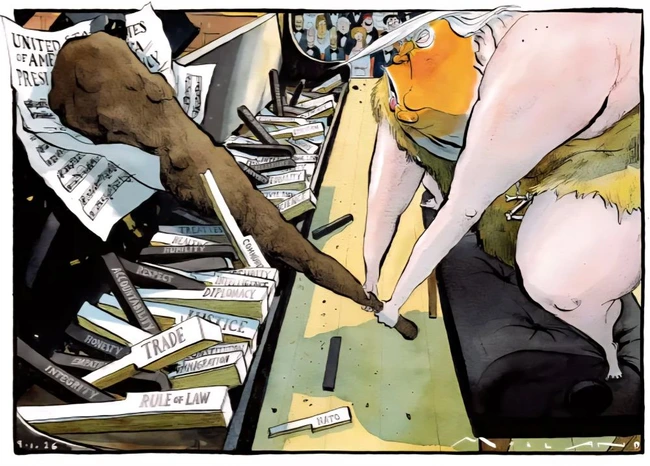
Trump’s decision to make isolation a formal policy of the United States by withdrawing from a mass of international treaties strikes Morland as primitive vandalism, and he enumerates the damage on the keys of the instrument Trump is destroying.
The accusation of his being an ignorant caveman is Morland’s opinion, but it’s hardly ungrounded. Josh Gohlke points out that Dear Leader’s admiration for William McKinley, however foolish it is to apply 19th Century imperialism to the modern world, is based on a steaming pile of historical ignorance.
It’s hardly the first time Trump has gallivanted off on a half-understood impulse, but America’s global standing makes it more than just our problem.
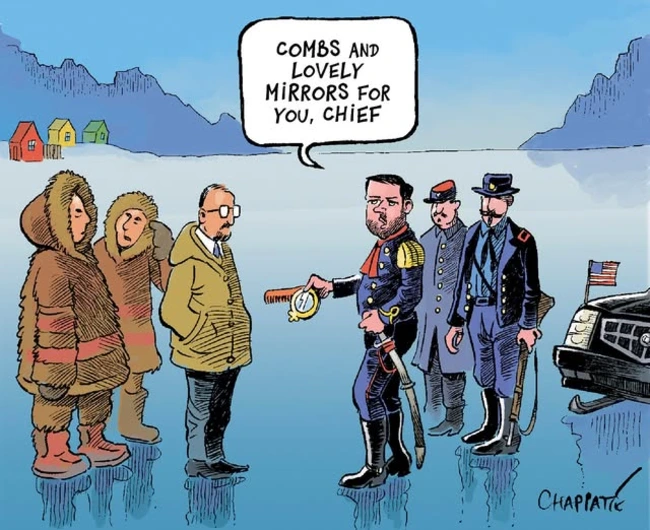
Chappatte compares our expansionist plans for Greenland to the days of cheating native people whom we considered ignorant and less than human, as we pushed them off their land. His inclusion of 19th Century cavalrymen behind Vance is a reminder of the alternative arrangements we offered those people, at Sand Creek, Wounded Knee and elsewhere, though only when, like Renee Good, they turned out to be terrorists.
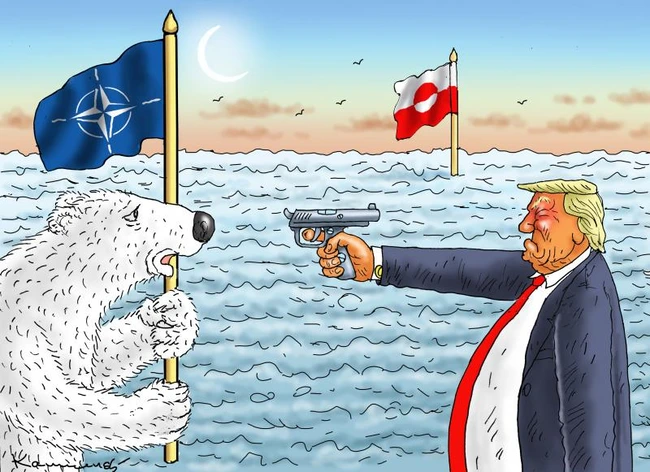
Kamensky suggests that Trump’s intentions to take over Greenland will do more damage to the United States than it will to the Greenlanders, and while he uses a violent image, it would be naive to think he’s predicting a military defeat rather than the destructive results of having Greenland’s NATO allies turn against the US through diplomatic and economic measures.
Juxtaposition of the Kiwis
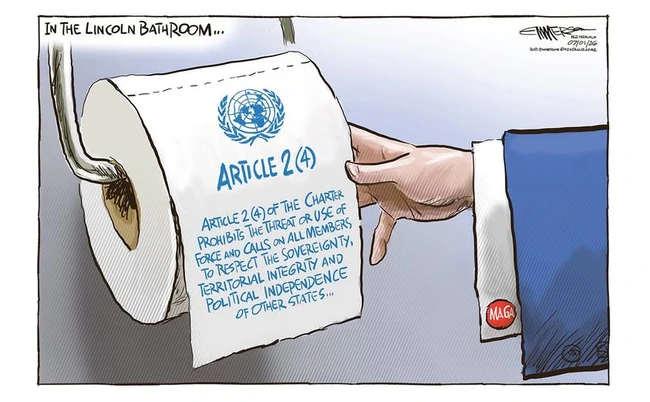
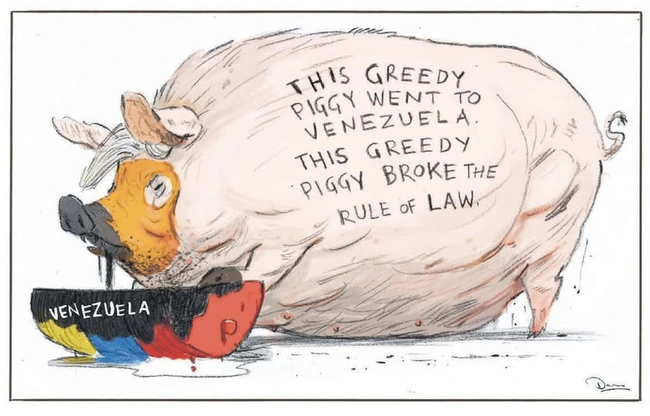
The New Zealand Herald unleashes two cartoonists on Dear Leader, with Emmerson citing his lack of respect for the United Nations Charter and Parton commenting on the gluttony with which he exhibited his lawless arrogance in going after Venezuela’s oil.
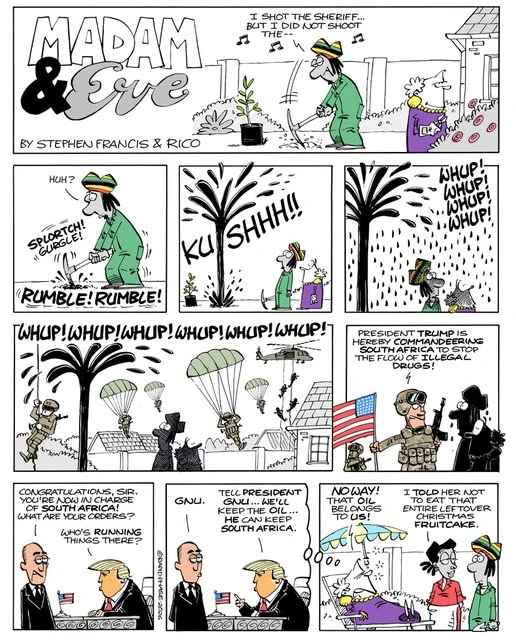
Our greed for oil was also mocked in South Africa, which isn’t oil-rich but where they haven’t forgotten Trump’s falling for foolish lies about the alleged campaign of violence against white Afrikaners and his ridiculous White House confrontation of Cyril Ramaphosa with bogus “evidence,” which — despite the flood of fact-checks that discredited it — he then employed to alter US immigration policy in favor of these non-victimized victims.
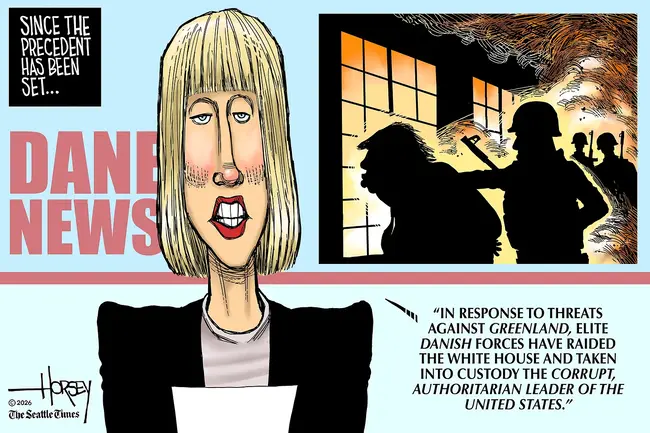
One advantage Americans possess is the ability to openly criticize their government, and, like Madam & Eve, Horsey employs mocking, cynical fantasy to suggest a logical-if-far-fetched extension of our own approach as it might be applied by others.
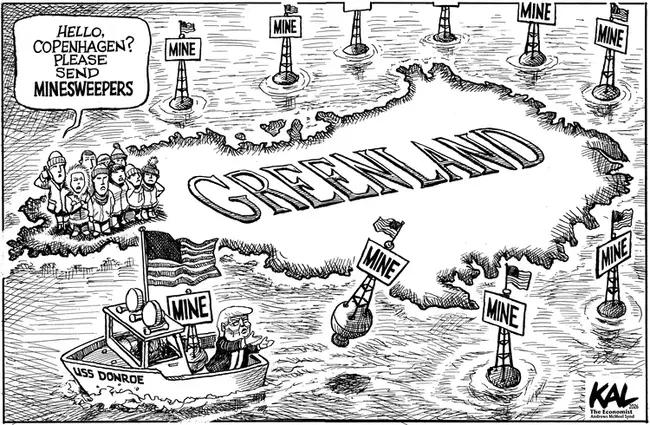
Kal makes a telling pun and a serious point with a light-hearted joke about the “Donroe Treaty” that Trump has adopted, combined with his incessant search for ways to promote and enrich himself on the public tab.
Trump might at least consult Congress and try to persuade them to change “mine” to “ours” before he blunders into either a self-destructive isolation or an actual war. Though if he doesn’t go to Congress, it’s possible that Congress will come to him.
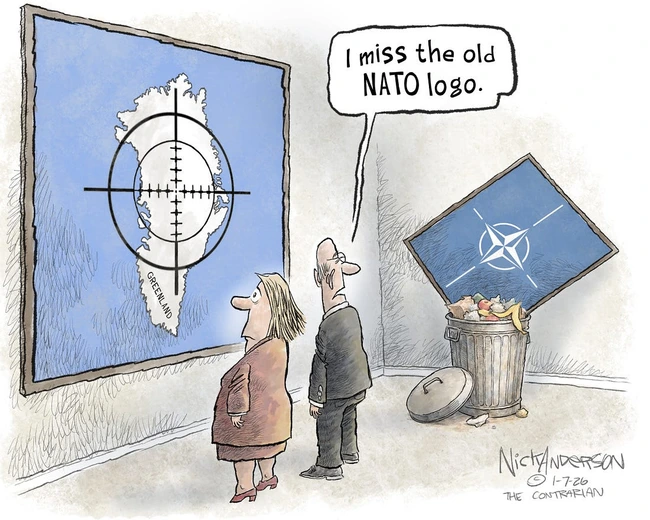
Anderson decries Dear Leader’s abandonment of our international allies in favor of imperialist, expansionist dreams. Here he uses a pair of very average-looking people to emphasize how normal it seems to be part of NATO and how jarring it is for our government — but not our people — to set America against the world.
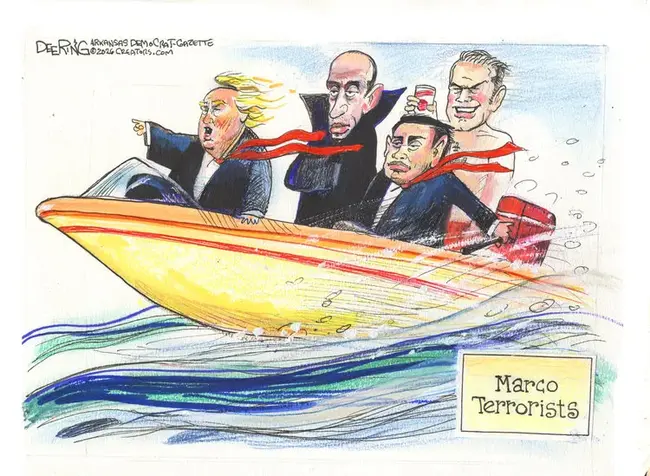
Is it our government, our people or both that wish for a policy of military adventurism?
Certainly, the MAGA crowd is open to the idea, and it’s also a frequent tendency that polls go up when the country goes on a war footing. But the polls this time show party loyalty and little else, as Americans generally don’t favor expansionist wars. The boost in Trump’s overall approval has been slight.
Deering depicts this aggressive policy as being the product of Trump’s small coterie of close, unelected associates rather than the judgment of Congress and certainly not the massive “coalition of the willing” that George HW Bush gathered to push Saddam Hussein out of Kuwait or even the much smaller group of nations that joined W for the wars against Iraq and Afghanistan.
(And a note of appreciation for the pun. If the administration can invent words like “narco-terrorism” that have no real meaning, cartoonists are free to make up terms that do.)
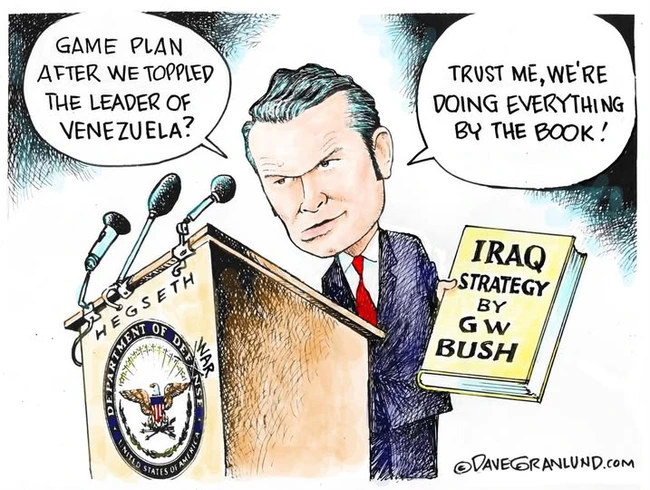
Granlund takes a more dire approach, suggesting that Hegseth’s macho approach, which no longer “defends” America but keeps it on a “war” footing, threatens to pull us again into the meat grinder that destroyed stability in the Middle East, only we’re now on the verge of applying the process to our own hemisphere instead.
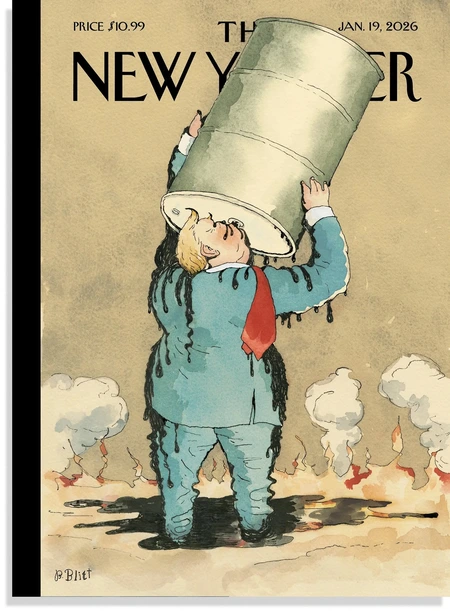
Blitt previews his next New Yorker cover, and not only does he center it on Trump’s eagerness to seize oil, but he adds a ring of fire and blood to show the price of the obsession.
I disagreed with Blitt’s famous cover depicting the Obamas as radical revolutionaries not because I didn’t get the mockery of foolish misperceptions it traded on, but because, as a magazine cover, it would be seen by passersby who, not being New Yorker readers, would fail to see the sarcasm and would accept it as straightforward commentary. I liked the art, but not the placement.
I take the opposite tack here because, as the impact of newspapers fade, a magazine cover on a news rack may be all the commentary someone sees, and this is an image that immediately conveys its intent.
It’s as good as hanging a poster, and there aren’t many posters as graphically well-executed.
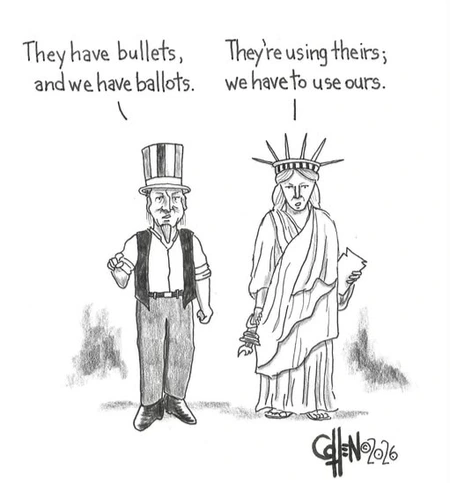
In the “What does it all mean?” segment of the day, Cohen reminds us of the balance of power in a nation that may have an arrogant, violent government but is, to adapt the phrase, “a republic if we can keep it.”
Comments 10
Comments are closed.