A Roundup of Whatnots
Skip to comments
Bookstores are rebounding, The Philosophical Implications in Calvin and Hobbes, Go with King Features’ Popeye, The Phantom, and others on a Sea Cruise, and cherished children’s book covers are transform into ecological posters. But we start with the non-anniversary of a political animal.
November 7, 1874 – First cartoon of the Republican Party elephant (Not)
While some celebrate the day as Thomas Nast’s first drawing of the Republican elephant others, like WMTV, boldly state “On this day, Nov. 7, 1874, the first cartoon of an elephant representing the Republican Party was published.”
The Daily Cartoonist covered the illustrated history of the Republican elephant last year. This year we will show that 1872 Harper’s Weekly cartoon by C. S. Reinhart “depicting the breakaway Liberal Republicans as a sham elephant” where it seems by that date elephants and Republicans are commonly matched.

Transforming Beloved Children’s Book into Climate Warnings
From Steven Heller at Print Mag:
Today, the UN Climate Conference kicks off in the Amazon rainforest—the first such event held at the epicentre of global environmental concern. In anticipation, UK-based 99designs by Vista has launched a visual campaign that transforms beloved children’s books into climate warnings.

The Daily Heller showcases seven book covers reimagined for the climate change awareness effort featuring works by Dr. Seuss, Rudyard Kipling/M&E Detmold, Hans Christian Anderson/Edmund Dulac, Kenneth Grahame/Ernest H. Shepard, A. A. Mile/Ernest H. Shepard, and Roger Hargreaves.
Won’t You Let Me Take You On A Sea Cruise
Step into the funny pages! The Beat is excited to exclusively reveal that fans can join Popeye, Olive Oyl, and friends for a one-of-a-kind fan experience: The Newstalgia Lounge, a King Features experience aboard Comic-Con: The Cruise Vol. 2, which allows cruise attendees to immerse themselves in the world of comics.

Ollie Kaplan at The Beat reports.
Inside The Newstalgia Lounge, fans will be surrounded by vibrant art and vintage details that celebrate iconic characters like Popeye the Sailor Man, who first flexed his way into hearts in E. C. Segar‘s Thimble Theatre back in 1929; Flash Gordon, Alex Raymond‘s original intergalactic hero who blasted off in 1934; and The Phantom, the masked avenger who inspired generations of costumed crusaders when Lee Falk introduced the hero in 1936.
The lounge also salutes other beloved humor strips that shaped pop culture: Blondie and Dagwood, still serving up laughs (and towering sandwiches) since 1930; the sword-swinging epic Prince Valiant; the bumbling Viking Hägar the Horrible; and the mystical Mandrake the Magician, one of comics’ very first superheroes.
The Philosophy of Calvin And Hobbes
We had The Gospel According to Peanuts, now we have The Philosophical Implications of Calvin and Hobbes.
“Calvin and Hobbes,” a widely-beloved comic strip by cartoonist Bill Watterson, ran from 1985 to 1995 and details the lives and escapades of a little boy and his stuffed tiger turned imaginary friend. Watterson’s work contains a remarkable amount of philosophical content, which we can even trace back to the name of the strip itself. I wouldn’t be surprised if you recognized the names of our titular duo, as they’re shared by two notable thinkers of the 16th and 17th centuries: John Calvin and Thomas Hobbes.
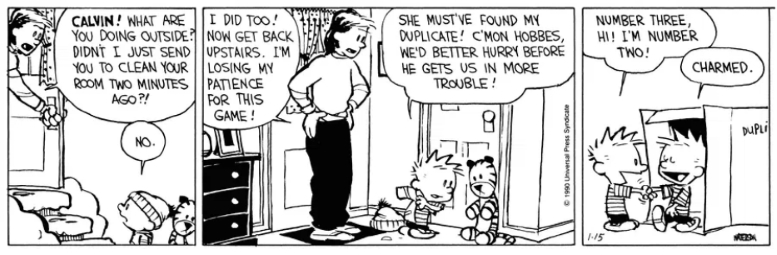
The philosophical undertones don’t end there, either. Watterson uses the absurd conceits of Calvin’s young mind to bring up meaningful questions. When Calvin clones himself with a cardboard box and then gets in trouble for the actions of his clones, the audience is asked whether one can really be held responsible for the actions of a past self no longer a reflection of the current individual. When Calvin’s unusual-looking snowmen are mocked, he defends himself by claiming that, rather than demonstrating a “soulless banality … appealing to popular nostalgia” as a standard snowman would, his creations “transcend corporeal likeness to express deeper truths about the human condition.”
The Stanford Daily publishes Olive Pacal’s analysis of wisdom in Bill Watterson’s comic strip .
The world can be a scary place, as we all know, and I was prone to being overwhelmed by it. I also read quite a bit of “Calvin and Hobbes,” and it gave me a sense of comfort that I find hard to put into words. It critiqued the seeming carelessness of the world while also reminding me that my perceived struggles were equally absurd.
The Return of the Bookstore
Books-A-Million has kept a low profile ever since the Anderson family bought back control of the Birmingham, Ala.–based bookstore chain in 2015, after a brief period when it was a publicly traded company. At the time of the purchase, BAM’s annual sales were about $475 million and the retailer, like it is today, was the country’s second-largest bookstore chain, trailing only Barnes & Noble.

Jim Milliot for Publishers Weekly interviews BAM executive chairman Clyde Anderson and CEO Terry Finley.
“We’re committing more capital to our bookstores because the bookstores have performed extremely well,” Anderson said. The retailer is in the process of opening 15 new outlets this year, which will keep the total number of outlets at over 220 spread across 32 states.


Comments 7
Comments are closed.