Comic Strip of the Day Comic strips

CSotD: Humpday’s Happy Diversions

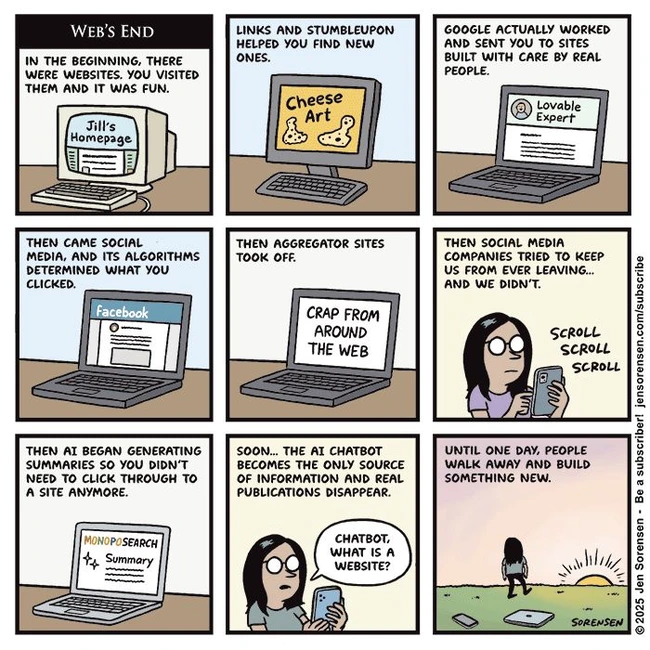
Funny you should mention it, Jen. My friend and I were discussing movies we were supposed to like but didn’t, which included a mashup of Guess Who’s Coming to Dinner and the Lion in Winter called “Guess Who’s Coming to the Crusades,” in which Henry II and Eleanor of Aquitaine exchange witty suburban repartee some 750 years before urbane dialogue existed.

But the winner was Braveheart, which created a furious, wonderful uproar on soc.history.moderated as members of that venerable old newsgroup unearthed its festival of anachronisms and impossible relationships, and added ridiculous thoughts such as why, since Braveheart was clean-shaven, he didn’t pass the razor through that tangled birds nest on his head.

In olden days, as Sorensen observes, there were a lot of happy discoveries as you wandered around on your own, picking up intriguing things by happenstance and sharing them with other curious people.

There was a particularly fun listserv called the Internet Tourbus that collected interesting sites, such as a website in which a Chinese grad student recounted his time in Antarctica.

But as Sorensen reports, the easier the Internet became to explore, the less fun and the more dumbed-down it became. And not only are the results disappointing and uninteresting, but they keep insisting that this is what you wanted, no matter how much you thought you wanted something that wasn’t all glitz and clickbait and commercial pesterware.

It’s still possible to find information, if you’re a combination of Sherlock Holmes and a safecracker, but it’s really become rare to stumble onto anything delightful.
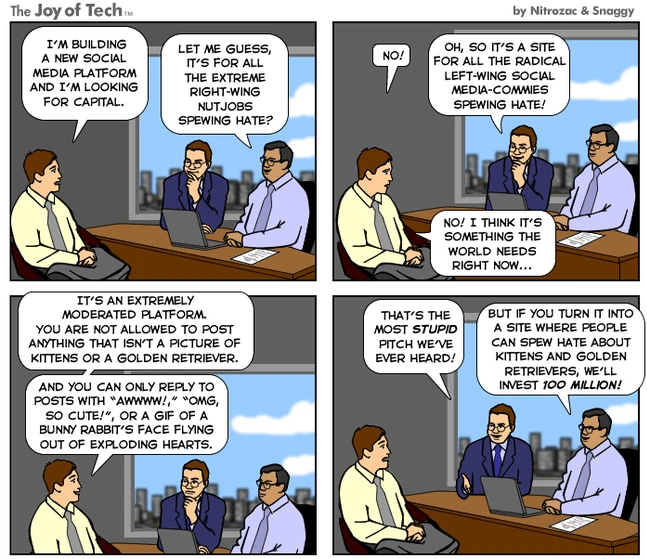
I’m not sure the Intertubes have become quite as cynical and exploitive and heartless as seen in this scenario, but I’m pretty sure the days when venture capitalists were willing to throw money at the wall to see what stuck are at least greatly diminished if not gone entirely.

In my own industry, newspapers, I had to cringe and despair as the Powers That Be made foolish, suicidal decisions about a new medium they didn’t understand, but there was a lot going on elsewhere that was fun and exciting. When Google first said “Don’t be evil,” I think they really meant it, as did a lot of other companies.

They’ve outgrown it. Google changed its motto in 2015 to “Do the right thing” but “the right thing” seems to mostly involve making a lot of money and Google certainly doesn’t have that market cornered.
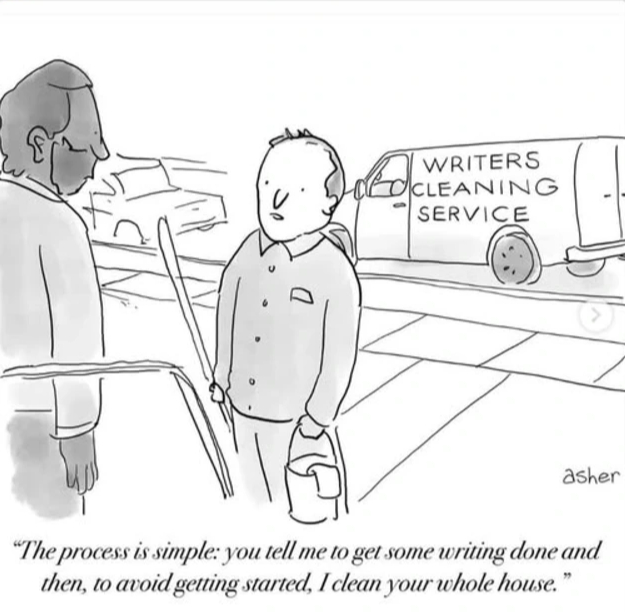
Asher Perlman seems to know how the creative process has always worked. Back when I worked on a succession of major projects, I really did clean up my office and clear my desk between gigs, but as I became more successful, I stopped fussing over such things because there wasn’t really much time between deadlines.

Or to be more honest, I started having real clients and real deadlines instead of having really good ideas that weren’t going to go anywhere. As they say, if you don’t know where you’re going, any direction will do.

And you can take as much time as you want getting there.
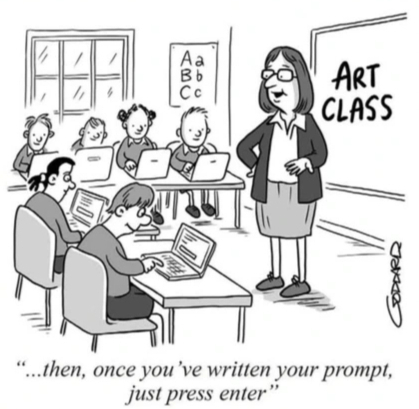
There may come a time when artists and writers are considered artisans, and like the artisans who make bread and cheese for farmer’s markets, everyone will admire their skills but without actually buying the stuff that costs three times as much as the crap on the shelf in the regular store.

This cartoon was posted on line and somebody commented of AI that “it’s just a tool.”

No, man. You’re just a tool.
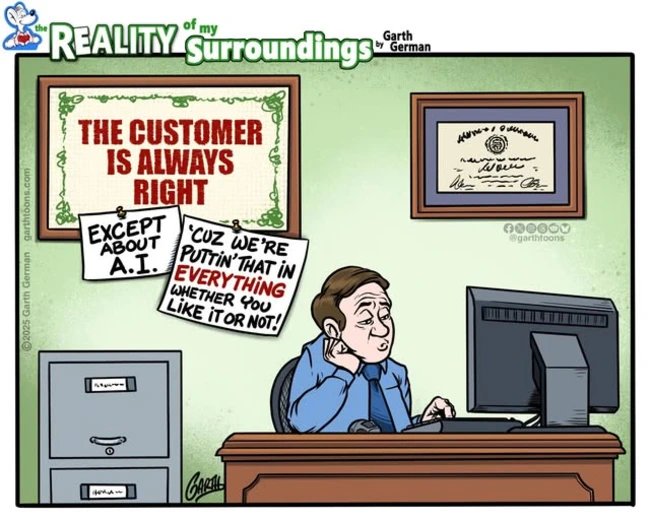
German is right: Whether we want it or not is hardly the question. Unless you plan to go back to quill pens and ink pots, you’re going to have AI because it’s being embedded in everything.

I don’t want it. But I’ll admit that, when I just want to know how hot to make the oven and how long to bake the chicken thighs, I’ll use the AI at the top of the page rather than scroll through the life story on a recipe page where keeping me there forever helps make more money for someone I have a sneaking suspicion doesn’t exist to begin with.
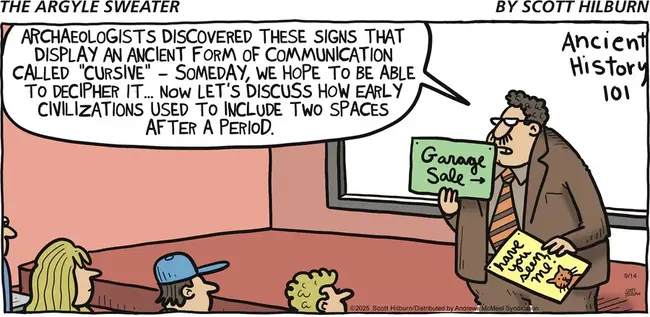
I don’t think it will quite come to this. When my brother was working on his doctorate in Spanish medieval history, he had to learn some Catalan to work through the old manuscripts, but it’s still widely spoken. I suspect that if most people aren’t able to read cursive in the future, it will be because they’re lazy and lack curiosity, not because handwriting has disappeared entirely.

Which brings us to this

Juxtaposition of the Day
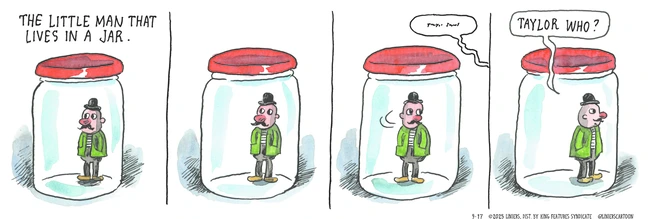
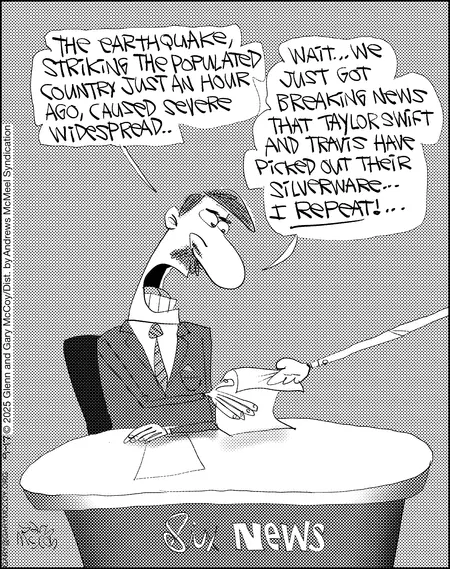
I know Liniers is kidding in Macanudo, because he’s incredibly curious about everything. Not so sure about the Flying McCoys, because they seem to be taking a slam more at the media than at Taylor and Travis.

It would be hard for any reasonably intelligent person not to know about Taylor Swift, just as it was once hard not to know about Frank Sinatra or Johnny Carson. You don’t have to like her or care about her. You just have to have an IQ in three digits and a minimal amount of curiosity.

We used to celebrate something called the Renaissance Man, a type of Jack of All Trades, admired for knowing something about a whole lot of things.

It wasn’t confined to Leonardo da Vinci, either: Samuel Johnson spoke with some awe of Elizabeth Carter, whose intellectual accomplishments are jaw-dropping, but who Doctor Johnson admired for being a down-to-Earth person, saying “My old friend Mrs. Carter could make a pudding as well as translate Epictetus from the Greek, and work a handkerchief as well as compose a poem.”

The real snobs these days are not the ones who can translate Epictetus but those who sneer at anybody who can.

For my part, I am curious and well-informed enough to know we have Cabinet members who like to cosplay as police officers, though I hope to god that, like Barney Fife, they’re permitted to wear the uniform but not to load their guns.
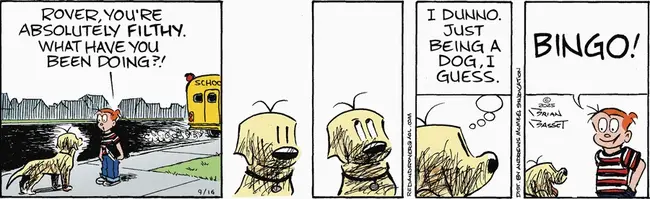

I save my admiration for Suzi, who would rather cosplay Rover than strut proudly around made up like Rin Tin Tin.
Previous Post
Cartoonist Profiles 207
Next Post
Tony D’Adamo – RIP

Comments 16

  1. I think people will stop knowing how to read cursive for the same reason we can no longer read the Elizabethan Secretary Hand: those things change. And I CAN read the Declaration of Independence and the Constitution in the original cursive, but I haven’t, at least not the whole thing. Because it’s in printed text, and that’s a LOT easier to read.

    1. In my old job, I often helped people researching their genealogies in the church records, written in Danish with quill pens. Some handwriting looked a lot like how a third grader would draw wavy water. Lower case b’s, p’s, o’s, e’s, and a’s weren’t closed off, because that would have made the ink fill in the circle and drag across the next letter or two. If you’ve ever seen the meme arguing that millennials won’t be able to decipher the word “minimum” in cursive, that’s what a lot of those old records looked like.

      Ah, well. Someday, nobody will be able to read the cloud, either. And all our USBs, CDs, and floppy disks will have gone the way of the hollerith card.

      1. Back in the days of Windows 3.1, a TrueType font for the German “Sütterlin” script was developed, expressly for the purpose of training archivists how to read handwritten documents that had been recorded in that script. See:
        https://en.wikipedia.org/wiki/Sütterlin

  2. I do miss the Google “I’m feeling lucky” button for searches. Could lead to some interesting places.

    1. Why “miss” it? The “Lucky” button is still there, at least on this side of the Atlantic.

  3. two things about cursive (or three):

    First, look at the money. When Jack Lew (Secretary of the Treasury 2013–2017) was asked for a sample signature to put on paper money, they noticed that it was spelled: OooooOooo. So when President Obama found out about this, he asked Lew to take a couple of hours re-learning cursive so that his signature wouldn’t look embarrassing.

    Second, Trump’s first Treasury Secretary, Steven Mnuchin can’t write cursive. His signature is in print. Don’t believe me? Look in your wallet and examine some bills. Series 2017.

    Third: Cursive, especially Copperplate (the kind used in wedding invitations and the like), is used surprisingly frequently for logos and signs in shops. If a place wants to look fancy schmancy, they use that. I’m fairly certain that the kids would figure it out, or at least ask a parent or teacher.

  4. I think what I admire about Taylor Swift is that, no matter how hard people try, she seems to be incredibly successful without having to resort to nefarious tactics or behavior. She seems like an intelligent, thoughtful, kind person. That could be entirely wrong, I know, but it’s hard to hide anything about yourself anymore.

    I don’t much care about the music she produces, as my music files were full by about 1980 and nothing has resonated since then. That’s a me problem, but I don’t care.

    1. My initial exposure was one of my 10-year-old reporters who wrote up what was her first concert, and it sounded like Taylor really went out of her way to provide a fun, good-natured experience, including several quick costume-changes, talking to the crowd and popping up in the middle of the audience after her break. My only negative was that this kid was never ever gonna have that much fun at another concert.

  5. “A.I. is just a tool”
    “No, you are”

    lol ouch

    Anyway, A.I. was a lot more fun when it mostly just gave us images of Sonic with three arms and six noses.

    And yeah, I often recall a time when I actually enjoyed going on the internet. Such happy days…

  6. Mike,
    I was a bit surprised by your comment above: “No, man. You’re just a tool.”
    I taught middle and high school (music) for a total of about 43 years and watched and experienced the music and art programs evolve to include technology. In my last years, there was an innovative art teacher, Helen K and a technology teacher, Bryan W. (it used to be drafting) who both used AI as a tool to enhance student learning after they learned the basics. Helen now owns ZazzCorp out on the west coast doing graphic posters for major performing groups and Bryan has also retired (as have I).
    It’s all good – depending on how its used.

    1. The value of a tool is subjective. I remember young artists who made album covers and how some of those covers were fabulous and the artists went on to good careers that rewarded their talent. But now people have found a way to mechanically crank out computer-based art and circumvent creativity and talent. There are all sorts of ways to make money. Not all of them are honorable.

      In this case, consider the difference between crafts and arts. The original Luddites objected to machine-made cloth, but cloth is somewhat generic, and whether it’s hand-spun and hand-woven or machine processed is somewhat irrelevant. Art is different. Machine-made art is not art. You might use a mechanical means to create art, but it still begins within the artist, and providing a prompt is no more “art” than when a client says “This is what I want.”

      Clients are not artists. That’s why they hire artists.

  7. I’m old enough to remember when digital clocks were stuck on everything.
    Fridge magnets/ clip boards/ rulers/ pencil holders/ clips for your shoe laces/ you name it. AI feels like that a little.
    Speaking of digital clocks, weren’t we supposed to forget how to tell time on a clock face with hands because of it?

    1. My grandson (who is 13) either doesn’t know how to read those or pretends he doesn’t. It’s hard to tell with him.

  8. There are still ways to find interesting tidbits on the internet, but it involves avoiding anything that smacks in the least of an “algorithm”.

  9. My serendipitous joy comes from used books anymore. I know I’m a dinosaur, I just can’t decide whether I’m a stegosaurus or an ankylosaurus.

Comments are closed.

Search

Subscribe to our newsletter

Get a daily recap of the news posted each day.