CSotD: What Are Little Girls Made Of?
Skip to comments
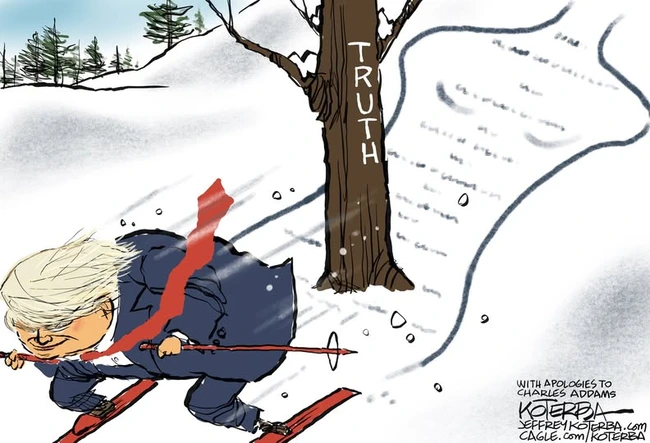
Political cartoonists have been having a field day with the message Donald Trump allegedly submitted as part of a birthday book assembled for Jeffrey Epstein’s 50th birthday.
That “allegedly” part is beginning to fray a bit, given that Trump sued the Wall Street Journal for publishing it and denied that it was his signature on the piece. However, handwriting experts have confirmed the signature and Trump has dropped his lawsuit, so make of that what you will.
I like Koterba’s take because he managed to get a chuckle from the classic Charles Addams homage while labeling the tree as “truth.” The original joke was that it would be impossible for the skier to get around the tree like that, and Koterba suggests an equally impossible avoidance for Trump.
The comment becomes more pointed when you consider the number of times Dear Leader has passed through what appeared to be an insurmountable barrier.
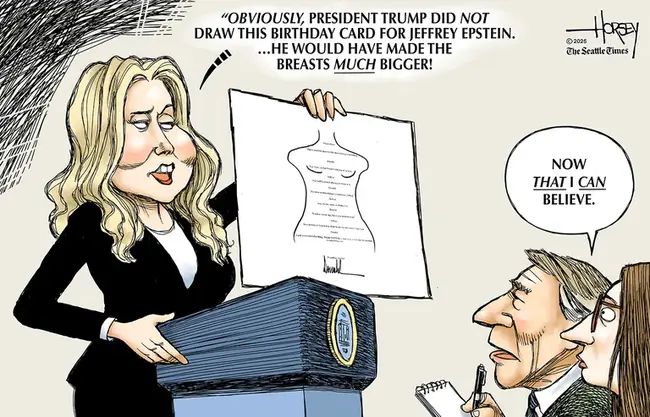
Horsey takes the opportunity to mock Karoline Leavitt’s pattern of defending the indefensible and denying the undeniable. It’s a bit unkind, because she’s a very bright woman and a graduate of a college that only accepts 78% of the people who apply, but I can’t find any record of her actually saying the words he suggests.
On the other hand, I have heard wiser voices suggest that the small breasts in the drawing indicate the very young age of the girls involved, and we do have an oft-sited record of Trump saying that Epstein “likes beautiful women as much as I do, and many of them are on the younger side.”
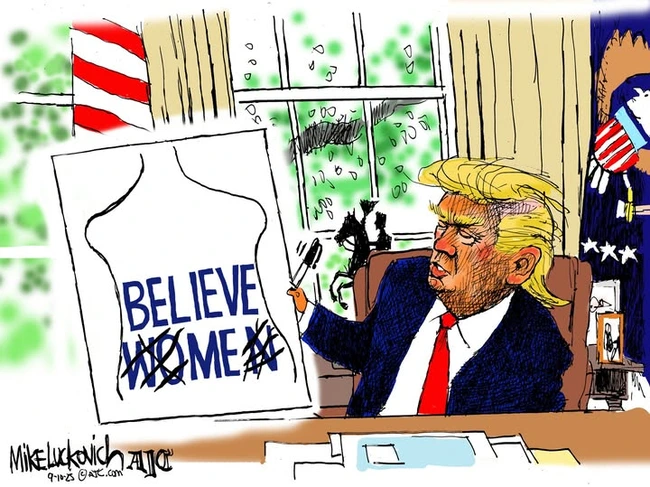
Whether Trump indulged himself with Epstein’s collection of underage girls is not clear and falls into the “he said she said” category of uncertain accusations, though Luckovich suggests that a powerful man can try putting a heavy thumb on the scales.
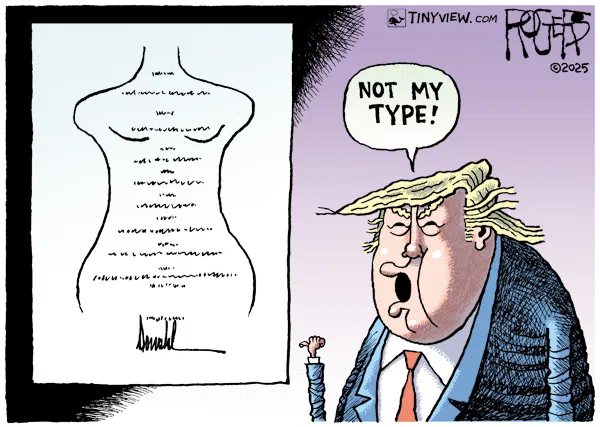
Rogers ratchets up the skepticism, casting Trump’s denial in the words he used when he denied sexually assaulting E. Jean Carroll. In that case, and under oath, he insisted she was not his type, but then accidentally identified a photo as being her when it was, in fact, a picture of his ex-wife, Marla Maples.
In that case, Trump was found guilty of the assault, a verdict which was just confirmed by an appellate court this past week, while, in an example of things you can’t make up, Woody Allen has confirmed that Epstein seemed like a nice fellow when he and his wife, who used to be his girlfriend’s stepdaughter, went to a party at Epstein’s house after he was released from prison for raping an underage girl.
Epstein, that is. One has to be specific in this case.
Allen also reportedly contributed to the birthday book. There’s a character reference for you.
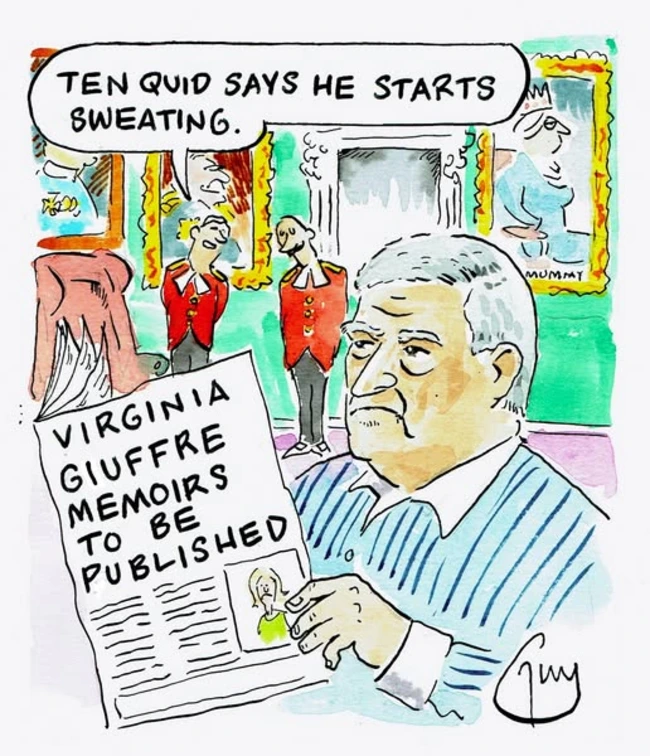
Prince Andrew was also at the party Allen and his wife went to, and has been more specifically, though not yet legally, linked to Epstein and the young girls, as Venables noted when the late Virginia Guiffre’s autobiography was about to be published.
Andrew has gone from being nicknamed “Randy Andy” to being the Royal Who Isn’t There, but the more the Epstein case unfolds, the more the royal connection resurfaces, and now Andy’s found himself smack in the middle of this
Juxtaposition of the Day
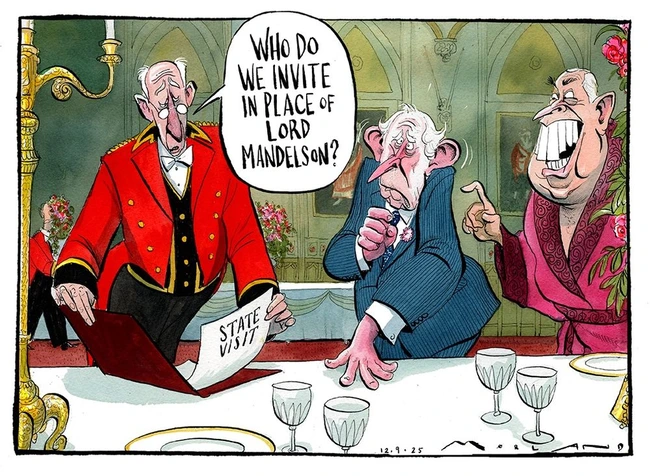
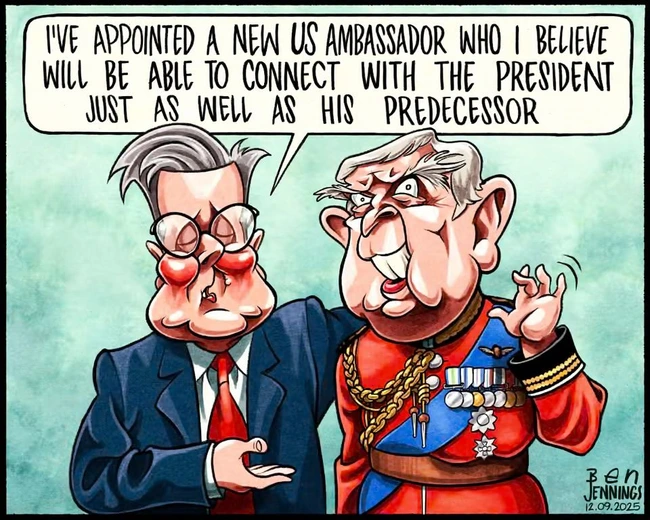
Britain recalled its US ambassador when it was discovered that he had been chummy with Epstein, and cartoonists there cheerfully nominated the now-idle prince as a logical replacement.
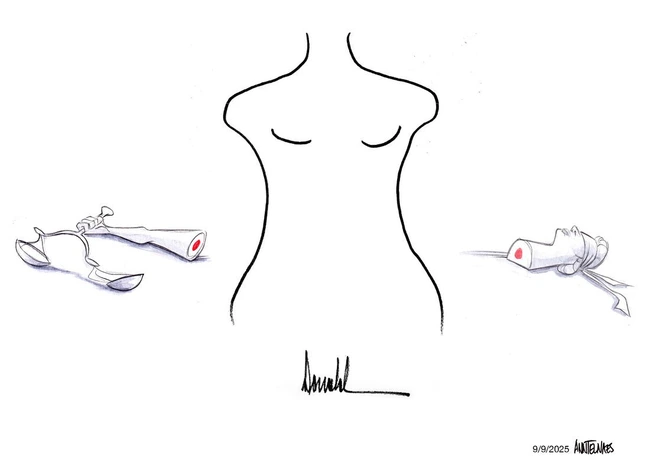
However, not everyone is finding humor — even dark humor — in the situation, and Telnaes points out that the drawing does not include a head, suggesting a disdain for women’s intelligence and personality, nor does the figure have arms, which indicates a lack of agency and a contempt for justice.
It is, overall, an insult to women, she contends, while the term “women” must be applied advisedly, given that the people involved were still little girls.
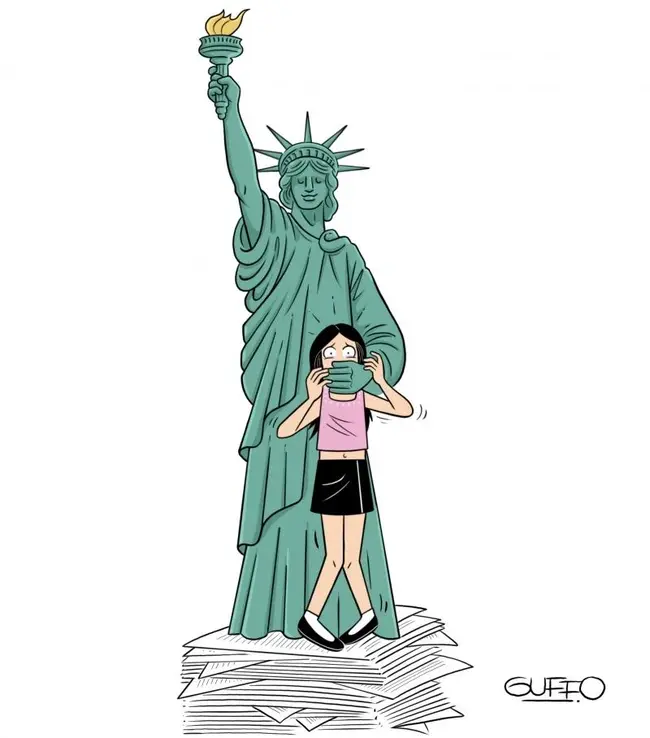
Mexican cartoonist Guffo emphasizes the latter point, depicting a victim in bobby socks, but also notes the stack of evidence underlying the assaults and accuses the US system of suppressing the victims and keeping their stories from becoming public.
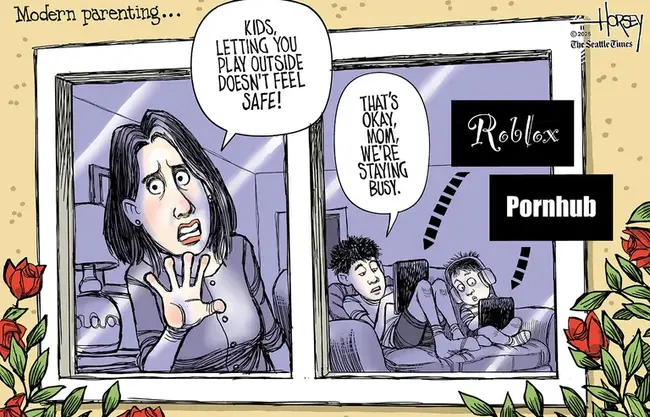
Meanwhile, Horsey notes the atmosphere in which American children grow up, in which they may not be legally permitted to walk to the store on their own but may explore inappropriate virtual worlds unsupervised in what ought to be the safety of their homes.
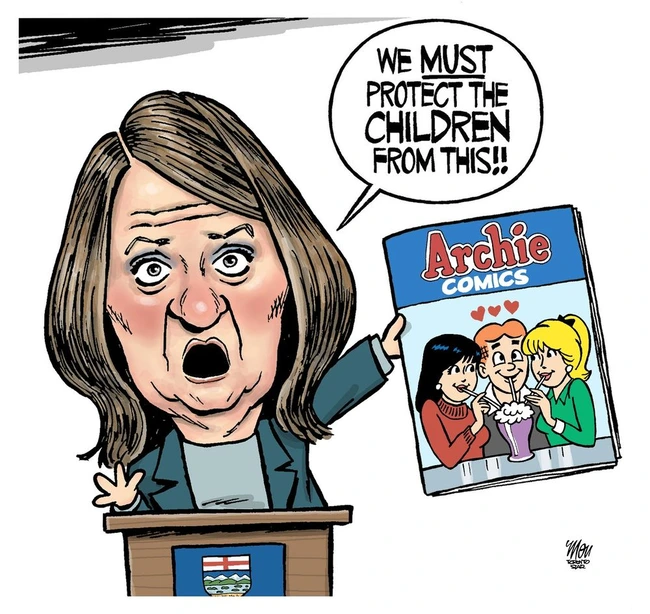
As was reported here earlier, a rightwing website criticized Moudakis for his mockery of an attempt to remove adult-content books from school libraries in Alberta.
Well-run libraries already have ways of making intelligent, appropriate acquisitions, but even I will admit sometimes something sneaks through the net.
Specifically, the dust-up reminded me of a time in my senior year when the Virgin Soldiers appeared on the shelf of our school library, but was, in fact, rarely on the shelf because it was in constant circulation among my classmates.
It was intelligent and funny, but, indeed, racy. Then again, we were 17 and 18 and while we weren’t all experienced, we got more laughs than lessons from the novel.
And besides, it sure did encourage reading among our peer group.
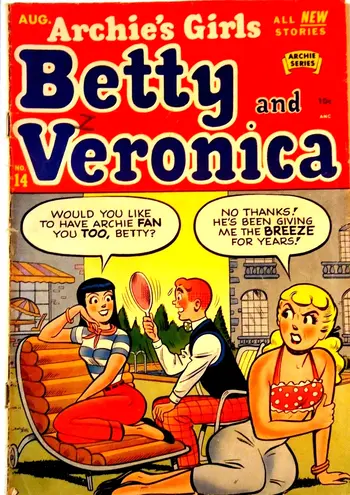
However, Moudakis offered an intriguing example of poor role modeling. I’m not that crazy about immersing young kids in the weird world of Riverdale High.
I don’t know how you recover from growing up thinking this is how it all works, on either end of the equation. It’s like Riverdale is a magnet school for dysfunctional dating.
As a kid, I might have wanted to be Archie, but when I got older, I wanted to be the fellow somebody took up with after she’d given up on guys like him.

Comments 7
Comments are closed.