CSotD: Call of Pooty Orange Ops 2
Skip to comments
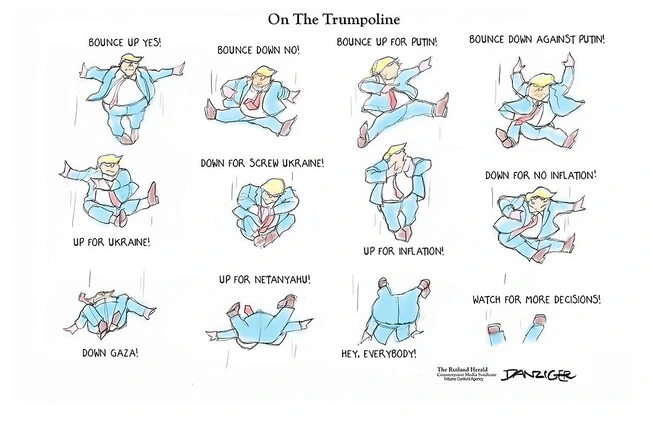
Understanding Trump’s complex relationship with Vladimir Putin begins with understanding Trump in general, and, as Danziger suggests, he’s not complex. He’s chaotic.
Trying to oppose Trump is like fighting a drunk: It’s difficult not because he is any stronger or any more skilled than average, but because you have no idea what he’s going to do.
There are certain threads you can expect: He’s particularly susceptible to flattery and especially resistant to criticism.
And he’s clever, but not smart, which is to say that he has excellent basic survival skills but it’s all reptilian reflex rather than intellectual insight and planning. You’d do well to assume that he wasn’t very good in school and, early on, adopted a stubborn refusal to learn, since it would open him up to trying and failing.
Significantly, if you believe that “the child is father of the man,” you should bear in mind that, while his siblings were raised at home, little Donald was so stubborn, ungovernable and resistant to training that his mother gave up and made the decision to ship him off to a military boarding school.
He remains a stubborn, undisciplined narcissist. That’s not an accusation. It’s an observation.
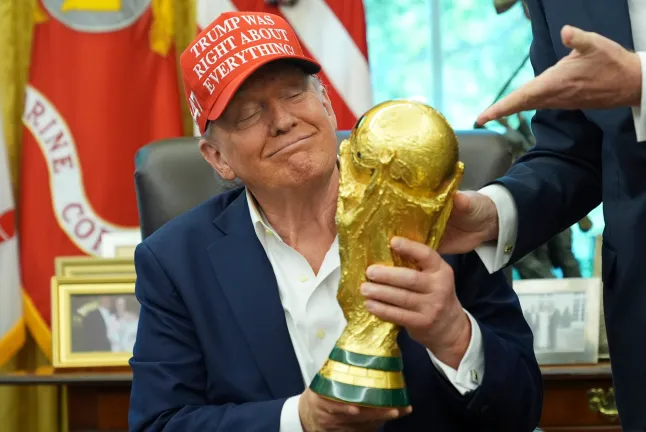
Case in point: When the FIFA President visited the White House Friday to announce that the draw for next year’s men’s World Cup tournament would happen at the Kennedy Center, Trump not only wore his baseball cap in the Oval Office during the meeting — one more bit of basic etiquette his mother was unable to teach him — but asked if he could keep the World Cup trophy.
Was he kidding? Probably not. This is the same person who, when the Chelsea football team came to the White House to celebrate their win in the Club World Cup, insisted on keeping their trophy, which remains in the Oval Office.
And despite having used a dubious letter from a doctor to gain a IV-F deferment from the draft during the Vietnam War, he declared himself a war hero the other day for having ordered the bombing of Iran’s nuclear facilities.
Well, why not? After all, he did receive a Purple Heart.
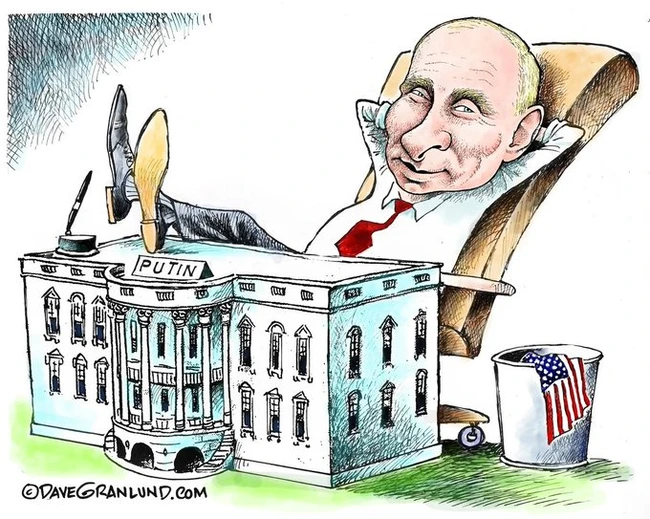
Granlund’s cartoon of Putin resting his feet on the White House, with the American flag in his wastebasket, seems to overstate the Russian leader’s overall dominance, but is right-on in summarizing the confidence with which he manipulates the president.
He still has to deal with Trump’s mercurial attention span and compulsive tendency to launch out into new ideas and to undertake odd, unfinished missions, but he seems as unbothered as a snake-charmer as he is hailed as a colleague one day and then denounced the next.
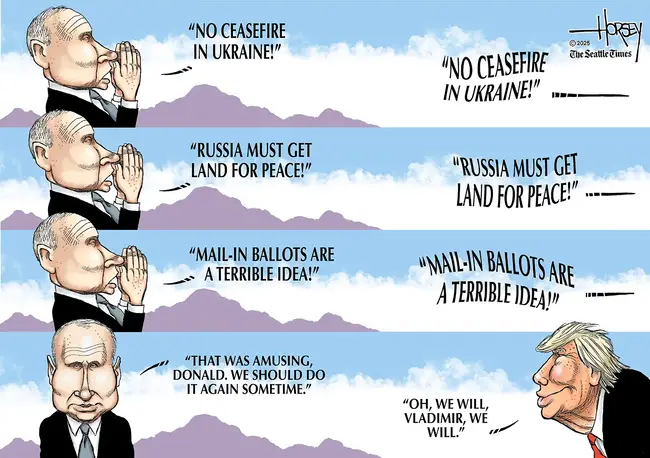
As Horsey suggests, Putin has had great success in giving Dear Leader ideas and seems content to let Trump take credit for them, so long as they are put into practice.
It’s just one more way of letting Trump keep the trophy, even if you were the one who actually played the game.
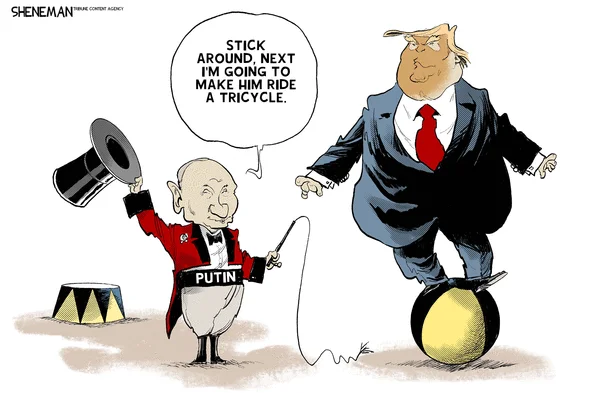
Sheneman may be right about the degree of control Putin exercises over his hero-worshipping colleague, but the humor of the cartoon is in the graphic overstatement, because the ex-KGB official would never be so blatant in declaring his domination.
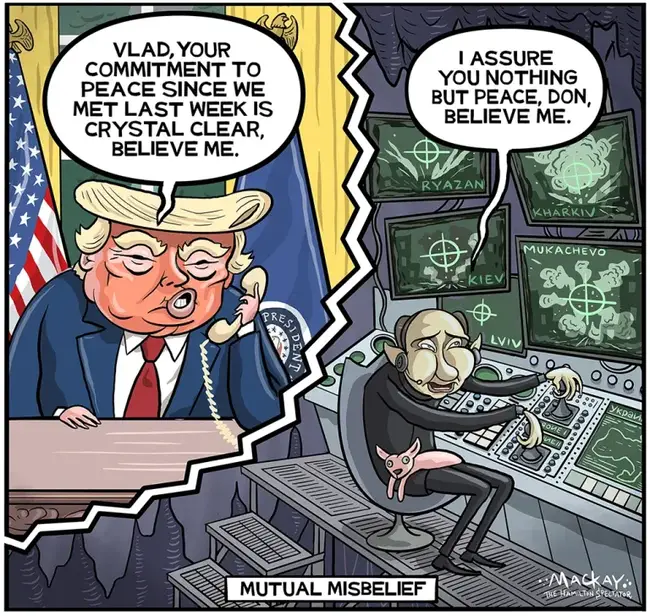
The reality may be more as MacKay portrays it, with Trump thinking he’s speaking friend-to-friend while Putin is engaged in an intense program not only of continuing his attacks in Ukraine but in keeping Dear Leader under the impression that he’s being heard.
The payoff for this is that, by launching attacks immediately following another of Trump’s upbeat comments about progress towards peace, Putin sends a message to the rest of the world that couldn’t be any clearer if he really did dress up as a ringmaster and show them Trump balancing on a ball.
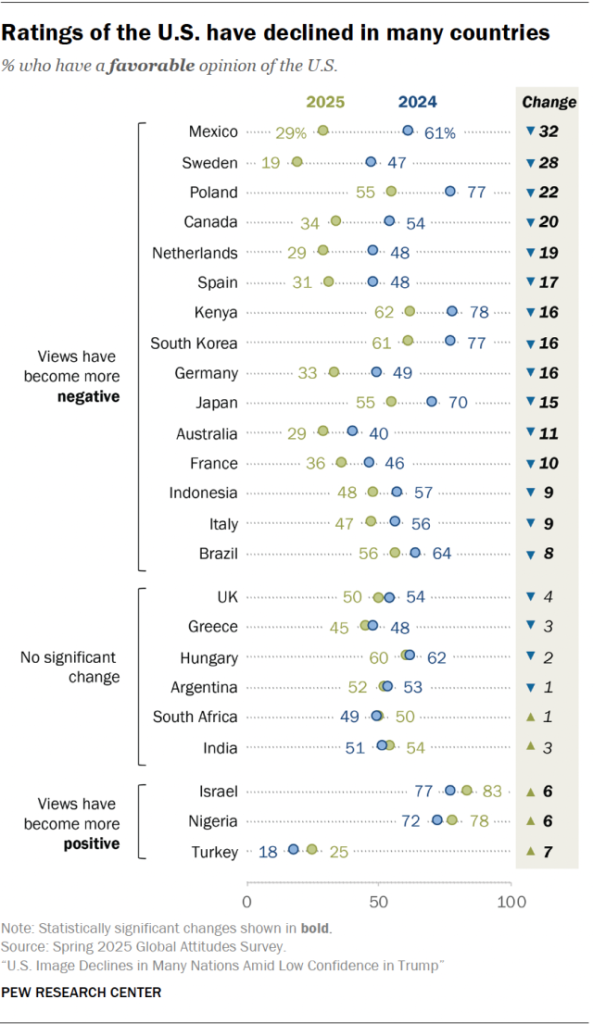
Message received, according to the Pew Research Center, which surveyed 28,333 people in 24 countries.
It’s not just based on Putin’s dominance or just on the war in Ukraine, but since Trump returned to power, America’s image in other countries has taken a blow. The three nations in which people now feel better about us are not likely to win many popularity contests themselves.
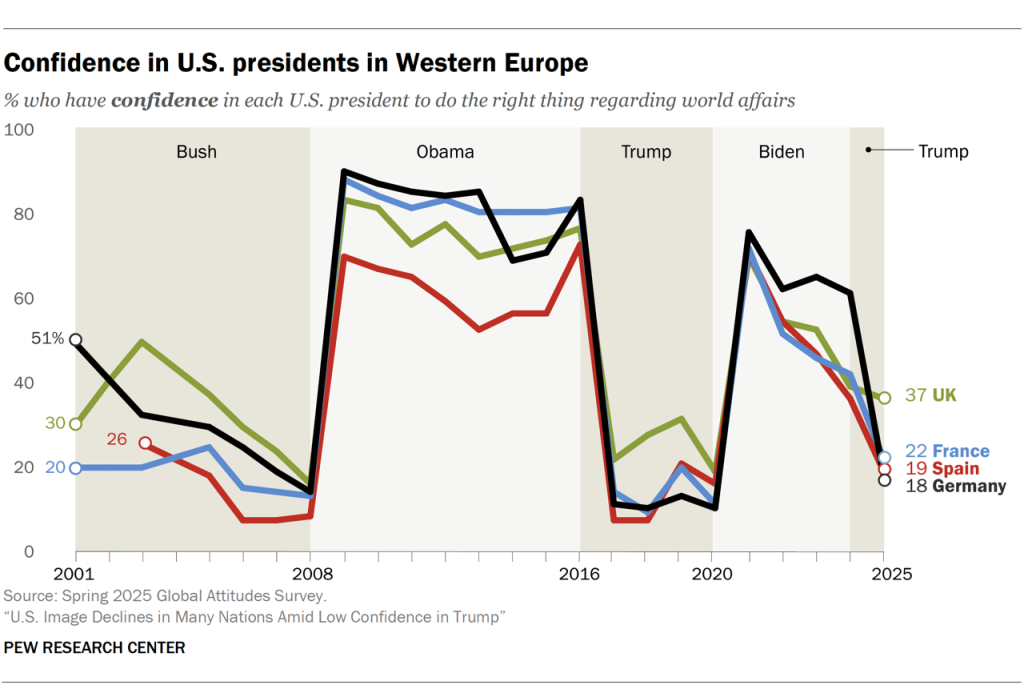
And it seems part of a consistent pattern.
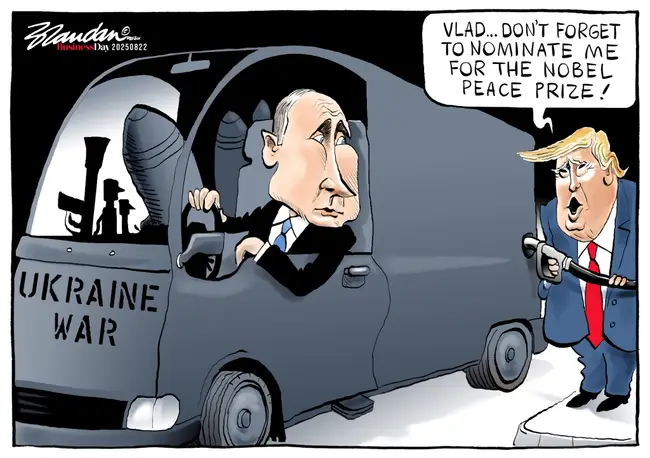
If Dear Leader’s policies in Ukraine are not the sole reason for the low expectations in other countries, they are certainly a factor, while his openly-expressed desire for the Nobel Peace Prize exposes him, and therefore the nation, to ridicule.
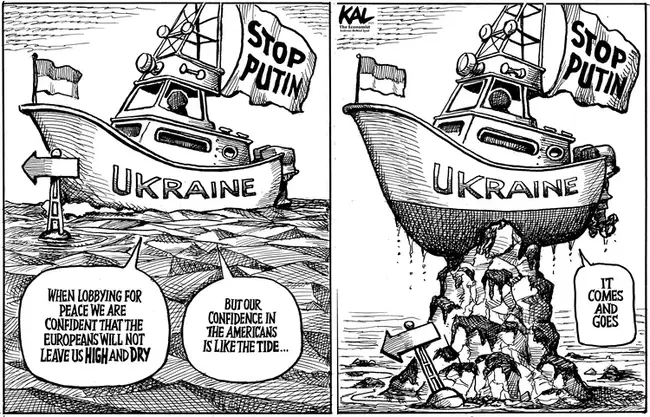
None of that is meant to say that Ukraine isn’t a factor, including, as Kal depicts it, our fickle approach to the issue, which seems supportive overall except when it suddenly isn’t. That doesn’t go unnoticed in Kyiv, but the rest of the world is hardly blind, either.
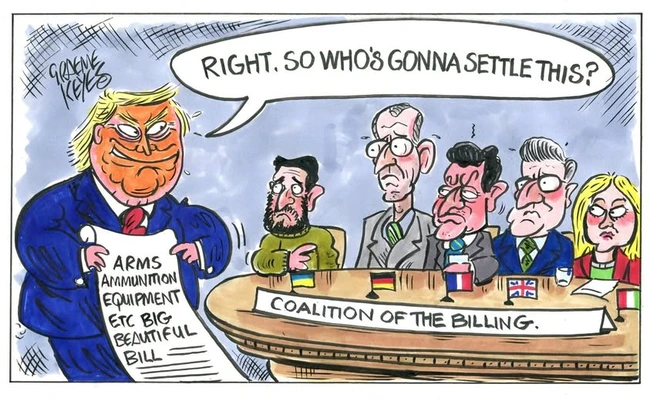
Keyes notes that even this past week’s unscheduled summit meeting leaves things unanswered, and that having Western Europe declare their support for Ukraine leaves the devil in the details, with the details largely still vulnerable to the whims of America’s mercurial president.
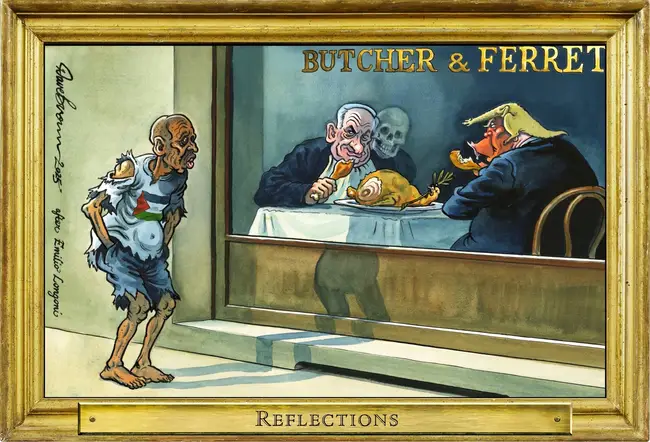
Then there is that other war with which the world is rapidly becoming weary, and Brown points out how, despite the recently-confirmed famine in Gaza and growing antiwar demonstrations in the streets of Jerusalem, American foreign policy remains strongly aligned with Netanyahu’s aggressive attitude.
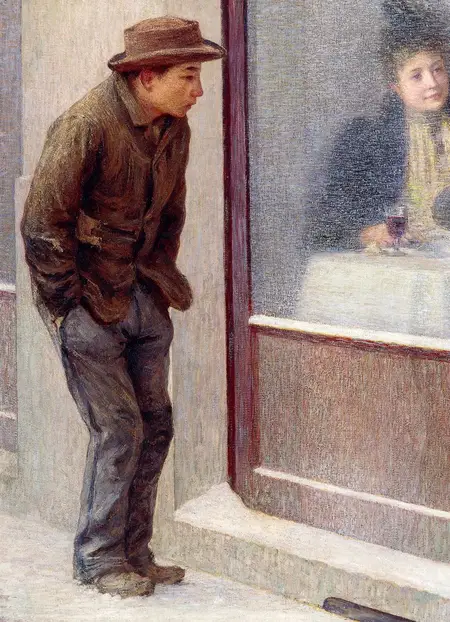
Brown, as he often does, mirrors a well-known painting, in this case Emilio Longoni‘s “Reflections of a Hungry Man or Social Contrasts.” But note the name of the restaurant, one reflecting Netanyahu and the other reflecting Brown’s established way of depicting Trump’s hair style.
Together, his overall message is not simply of pity for dying Gazans but a scornful condemnation of those who created and have sustained the crisis.
He’s not alone: That Pew Center poll shows that 29% of people in the 24 countries have faith in Trump’s handling of Gaza, while 68 express no confidence.
Of course, none of them get to vote, which leaves things in the hands of those who do.
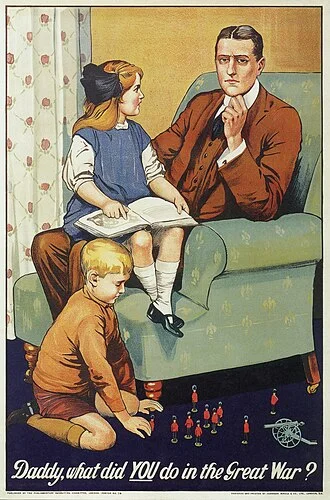
The question never changes. The answers rarely do, either.


Comments 14
Comments are closed.