Cartoon Conflicts: Controversies and Precedents – A Book
Skip to comments
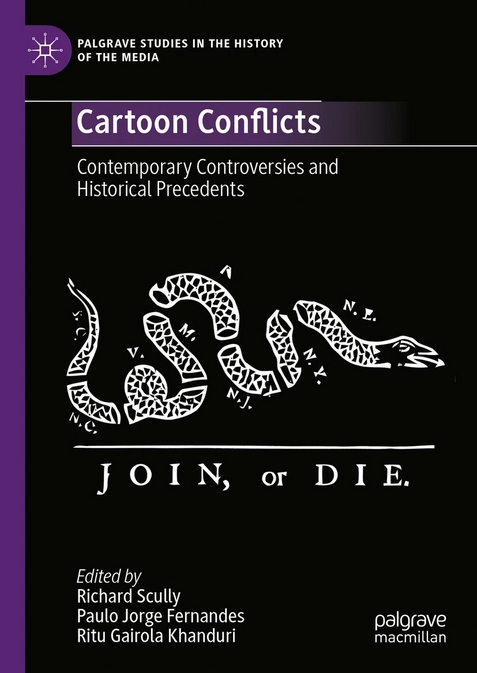
From Palgrave Macmillan comes Cartoon Conflicts: Contemporary Controversies and Historical Precedents Edited by Ritu Gairola Khanduri, Richard Scully, and Paulo Jorge Fernandes.
This edited collection of new research highlights the way in which the cartoon – long regarded as a staple of journalism and freedom of expression – faces new challenges in the twenty-first century that can be far better understood and appreciated if one takes an historical perspective. Current debates over the limits of freedom of expression, ‘political correctness’, and ‘cancel culture’ all have their precedents in past controversies over cartoons and caricature; indeed there is a definite continuum between these past instances of debate and their present manifestations.
The chapters consist of
Introduction
- Ritu Gairola Khanduri, Paulo Jorge Fernandes, Richard Scully, Pages 1-15
The Political Cartoon: History and Historiography
- Richard Scully, Pages 17-86 Open Access
Striking Weapons: Cartoons During the American Civil War, 1861–1865
- Alentieva Tatiana Victorovna, Pages 87-122
Culture Wars Within a “United” Kingdom: Irish Cartoons in a British Empire, 1870–1872
- Chris Williams, Pages 123-154
Caricature and Identity Crisis: On the Satirical War Between Punch and Pontos nos ii (1889–1890)
- Maria Virgílio Cambraia Lopes, Pages 155-215
“Why should public men be held up to ridicule?”: The George Reid Caricature Controversy of 1904—Echoes, Continuities and Discontinuities in Australia in 2012
- Paul Kiem, Pages 217-249
The Conspiracy of Cartoons in India
- Ritu Gairola Khanduri, Pages 251-280
Brazilian Disputed Imaginaries: Graphic Humour in the Black and Indigenous Press in the 1970s–1980s
- Mélanie Toulhoat, Carlos Benítez Trinidad, Pages 281-317
The Contested Ethics of Charlie Hebdo’s Editorial Cartooning: 10 Years on from #jesuischarlie
- Jane Weston Vauclair, Pages 319-354
Mark Knight Versus Serena Williams: Game, Set, and Match for Political Correctness?
- Richard Scully, Pages 355-390 Open Access
A Blind Man and a Dog Walk into a Cartoon: The Limits of Humour, Antisemitism and Racism and Informal Censorship in the Contemporary Liberal Press
- Paulo Jorge Fernandes, Pages 391-423
Zapiro as Zorro: Political Cartooning During the South African HIV/AIDS Crisis
- Paul Sendziuk, Pages 425-448
Conclusion
- Paulo Jorge Fernandes, Richard Scully, Ritu Gairola Khanduri, Pages 449-456
Back Matter
Pages 457-471
Chapters 2 and 10 are available open access under a Creative Commons Attribution 4.0 International License via link.springer.com.
Chapter Two (“The Political Cartoon: History and Historiography”) gives us a history of political cartoons and an overview of previous books on the subject.

From the Chapter Two abstract:
There are countless histories of the comic strip available—from David Kunzle’s two-volume foundational study through Thierry Smolderen’s more recent work … Yet there exists only a handful of dedicated studies in English that purport to cover the cartoon in all its aspects, across national and other boundaries, including John Geipel’s The Cartoon (1972), Syd Hoff’s Editorial and Political Cartooning: From Earliest Times to the Present (1976), and Charles Press’s The Political Cartoon (1981). These are still useful primers, but with their modern Anglo-American point-of-view, they are showing their age, particularly given new research into past eras, as well as the technological and socio-cultural developments of the past few decades.
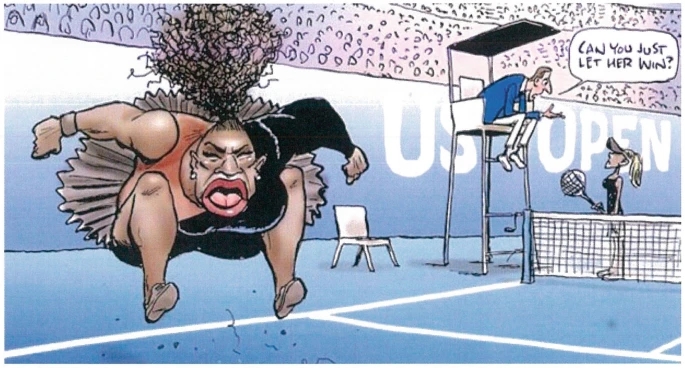
Chapter Ten (“Mark Knight Versus Serena Williams: Game, Set, and Match for Political Correctness ?”) is more specific relating to the squabble over Mark Knight’s cartoon of Serena Williams.
From the Chapter Ten abstract:
This chapter updates research undertaken at the height of the 2018 controversy between Australian cartoonist Mark Knight and American tennis player Serena Williams. Knight’s cartoon for the Melbourne-based tabloid the Herald Sun occasioned little comment when it first appeared in print, but Knight’s own use of social media platform Twitter to publicise his work prompted a huge international backlash from commentators and authors of all manner of backgrounds. Harry Potter creator J. K. Rowling in the United Kingdom, the US-based National Association of Black Journalists, and media outlets in the Middle East, China, and South Africa provided a global response to a very localised cartoon, illustrating many of the realities of twenty-first-century cartooning.
Knight himself was forced to close his Twitter account and retreat from the spotlight owing to a campaign of outrage that became threatening. This chapter assesses the various responses in the light of recent and historical developments, seeking neither to defend Knight nor to condemn him (or, indeed, Serena Williams).


Comments
Comments are closed.