CSotD: Unfortunate Complexities
Skip to comments

There’s not much to add to or analyze in Jennings’ cartoon. Children are living as grotesque skeletons and dying in unconscionable numbers. The obvious, simple solution would be to give them food, but instead they have to die. It’s all rather complicated.
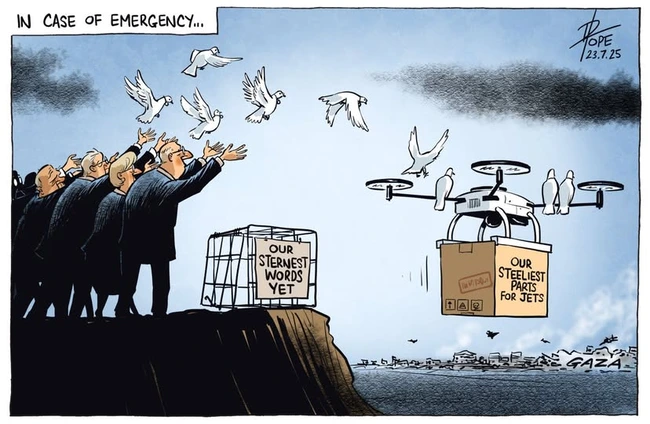
The whole world is watching, and, as Pope says, putting together their sternest words, but what they’re sending over is weaponry. As an Australian, he cites airplane parts. An American cartoonist could add more fearsome armaments, but either way, it surely offsets the thoughts and prayers that may go with it.

The US had been sending food, but, as de Adder notes, we couldn’t afford to feed starving people and also give tax cuts to our most wealthy. As it is, we had to add several trillion dollars to our deficit just to take care of our upper crust.
You’d have to be a forensic accountant to understand the need to cut back on foreign aid, but, after all, it was 1.2% of our federal budget in 2023, and you can’t let that kind of wasteful spending go on forever, because we have a deficit to think of.
And you can’t distribute the food we already paid for and shipped to the region, though why that needed to be wasted while children are dying is one of those complicated things we can’t expect anyone to understand.
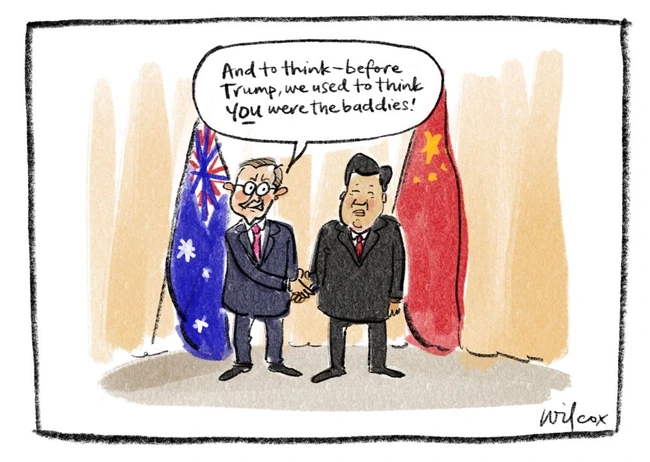
Anyway, the whole world is watching, and our inability to feed the starving, provide medical care, help them get clean water or, for both poor and more developed countries, to offer trade without massive tariffs is all rather complicated.
But it has a lot to do with the deficit, and you’d think other countries would understand our policies.
Perhaps they do.

It could be worse, after all. At least it’s not genocide, because, if it were anything at all like what the Hutu had done to the Tutsi in Rwanda, or what the Serbs did to the Bosnians, we’d condemn it right away.
But although Amnesty International has called it genocide, and hundreds of groups and individuals have signed letters saying it is, and members of the Knesset have called for the total destruction of Gaza and the expulsion of its population, it’s not.
It is all rather complicated.

Far too complicated to discuss.

And, anyway, calls for an end to the war have a lot less impact than bullets and bombs, so what’s the point?
As Sen. Joni Ernst (R-IA) said in a discussion of cuts to Medicaid, “we all are going to die.” The details of how and when are hardly relevant.
Are We Done With These Yet?

I like Zapiro’s Coldplay cartoon because he brings in the factor of how the couple was mocked from the stage, though by the time it ran in South Africa earlier this week, Musk’s revelation was a bit stale.
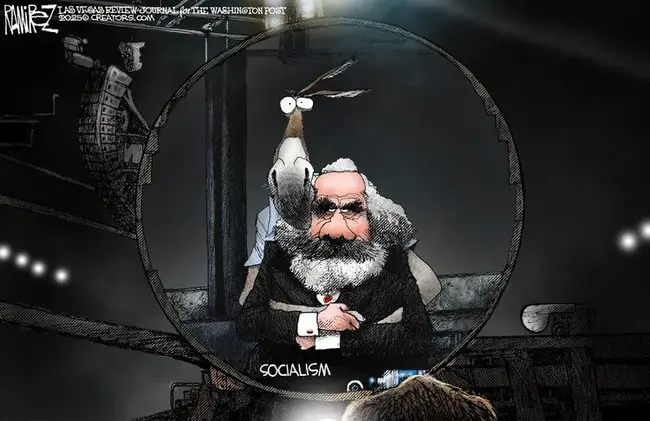
This variation is problematic because anybody who recognizes Karl Marx knows he wrote Das Kapital and likely knows the differences between socialism and communism. And it’s wasted on anyone who doesn’t recognize him.
Socialism is, in Marx’s phrase, “From each according to his ability, to each according to his needs,” and while Marx advocated communism, the phrase applies to sharing in general. Conservatives have complained about “Socialism!” ever since the New Deal brought in Social Security and the minimum wage.
Communism, by contrast, consists of the central government controlling the means of production, such as if the federal government were to take a “golden share” giving it control of a major steel company.
Which could never happen here, because we hate communism.
Juxtaposition of Its Ownself


It happens, though a good way to keep it from happening is not to jump on the cliché of the day. Obviously, there’s a substantial tradition in political cartooning of trading on popular themes, but, for instance, you can draw Ozzie Osbourne at the Pearly Gates without referring to the bat incident.
In this case, the Coldplay kiss-cam reference is somewhat worn out, but the real problematic element is using Dear Leader’s own term, “hoax,” to declare the truth of something unproven.
We know that the final reports — even the Mueller Report — said the Russians had attempted to influence the election, that they were unable to hack into voting machines, and that there was no proven communication between Trump and the Russians. The reports all agreed, as well, that the attempted interference did not change the results, in which Trump defeated Clinton.
I’d chalk up the duplication as a routine matter of chance, and the labeling as a case of Obama Derangement Syndrome.
But that’s enough Coldplay cartoons. Arwa Mahdawi has an excellent opinion piece on why we should all be ashamed of ourselves for laughing at it in the first place, writing that “we should all work a little harder at minding our own business” and reminds us that “We clicked ‘accept’ on 90,000-word privacy agreements that we didn’t read, signing away all our data in exchange for convenience and dopamine hits,” while the billionaires we sold our privacy to solidly protect their own.
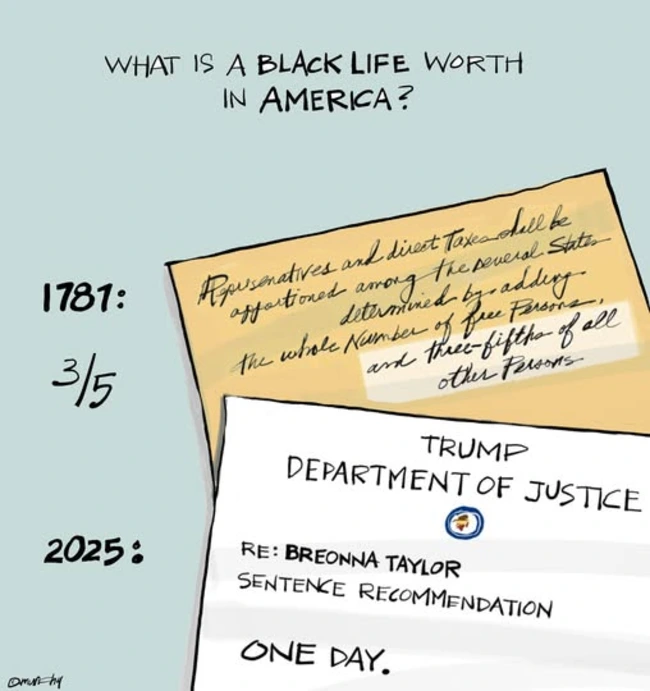
I’m not only picky when it comes to conservative viewpoints, and, while I generally agree wholeheartedly with Murphy, I’m surprised he fell for this common misinterpretation of the 3/5’s compromise.
If slaves could vote, it would indeed be true that counting them at a rate of 3/5 would be racist and unfair.
But what was racist and unfair was counting them at all. The Southern States wanted to count them entirely, in order to increase Southern seats in Congress, so the Northern States came up with the compromise in order to preserve the union.
However, like sovereign native tribes, who remained uncounted, slaves had no voice in government, and even counting 60% of them gave the South an advantage in Congress.
It was, as they say, all rather complicated.
Without it, however, the South might have rejected the new Constitution and formed its own nation, which would make a really good alternative history novel: There’d have been no Civil War and no resulting emancipation.
Though they were whole people and I doubt they’d have let things stand.


Comments 13
Comments are closed.