Comic strips

The All-New Blondie Title Panel

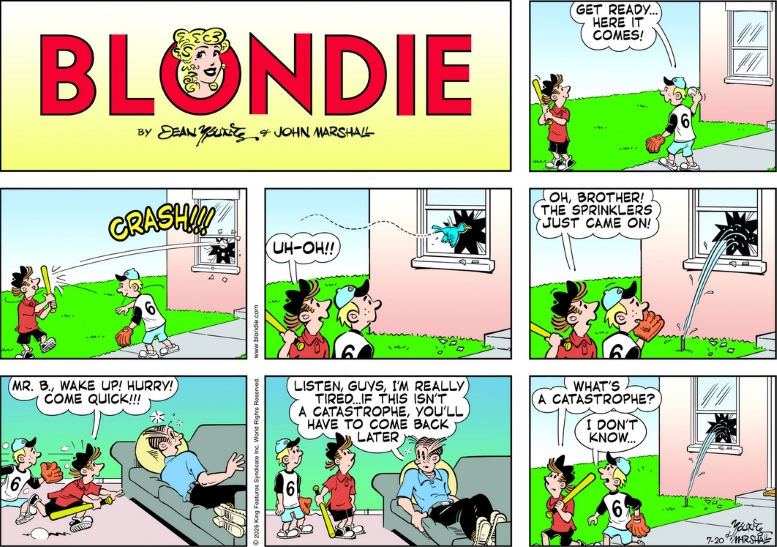
By now regular readers of The Daily Cartoonist are aware of my obsession with comic strip title panels. So it should come as no surprise that my biggest note about today’s Sunday comics pages is the new look Blondie!

Blondie comic strip title panel as of July 20, 2025

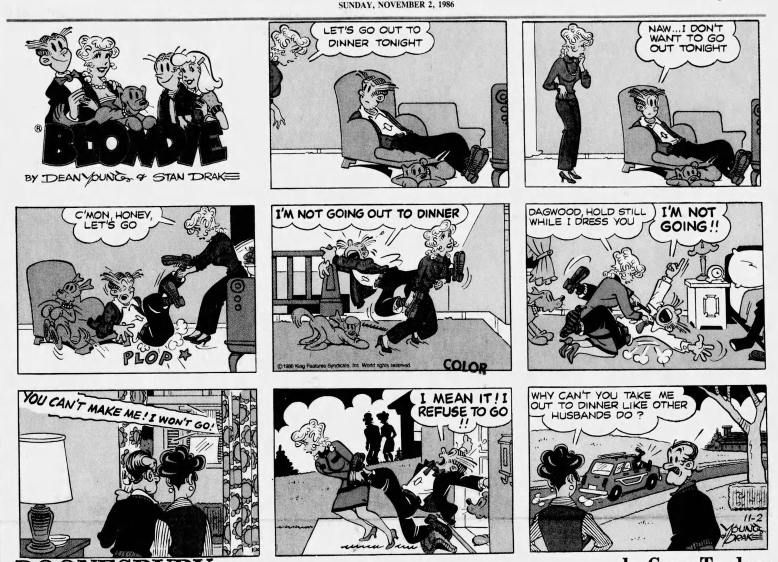
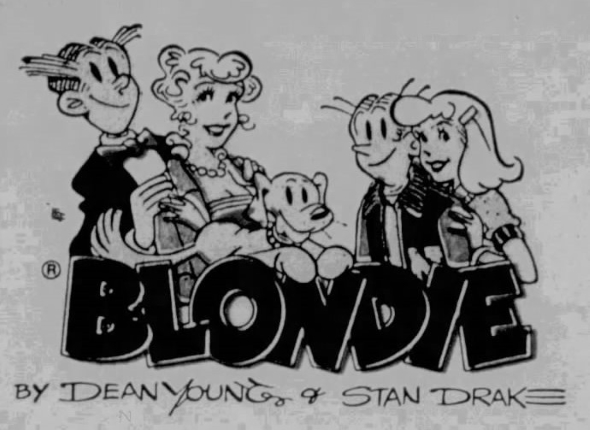
This is a major change in the look of the Blondie Sunday strip since its change from a twelve panel (actually thirteen panel for the full half page) grid to a nine panel grid with the November 2, 1986 issue.
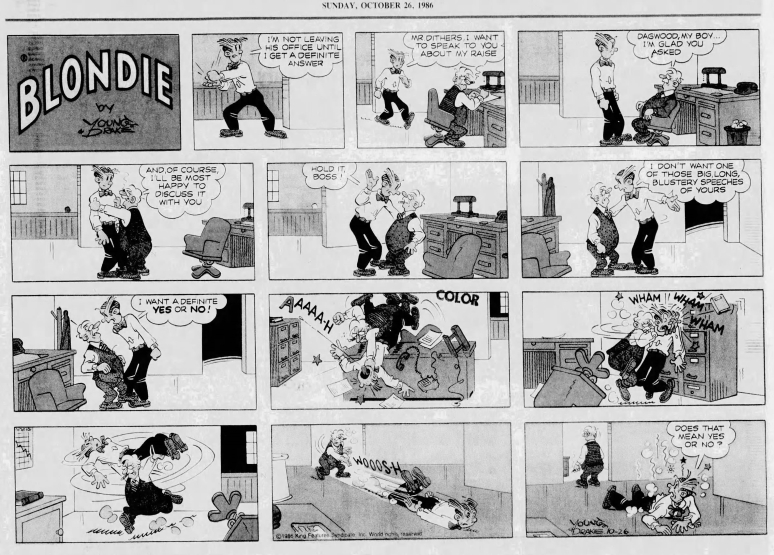
Half page Blondie by Dean Young and Stan Drake – October 26, 1986
Half page Blondie by Dean Young and Stan Drake – November 2, 1986

That November 2, 1986 also introduced a new illustrated title panel which has, with very occasional minor adjustments over the years with new Blondie cartoonists, remained the same for the almost 39 years since.
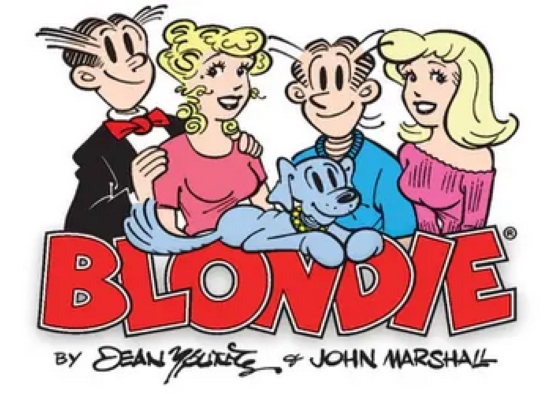
Until today.

Half page format Blondie by Dean Young and John Marshall – July 20, 2025
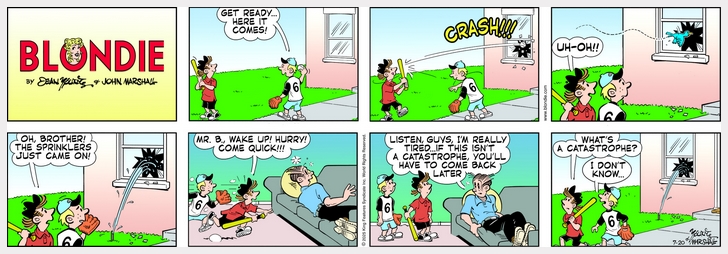
Quarter page format Blondie by Dean Young and John Marshall – July 20, 2025

As seen above, when necessary, the two-panel title panel can be squeezed into a single panel.

And they (King Features? Dean Young?) have even created a different title panel for promo purposes:
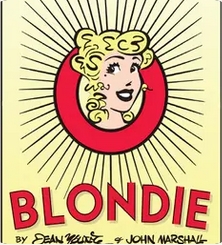
new Blondie nameplate

Still more!

Back in the day it wasn’t uncommon for comic strip syndicates to provided stylized titles and credits for newspapers that ran their comic strips in third page format which, unlike half page and quarter page formats, didn’t include title and credit panels. For instance:
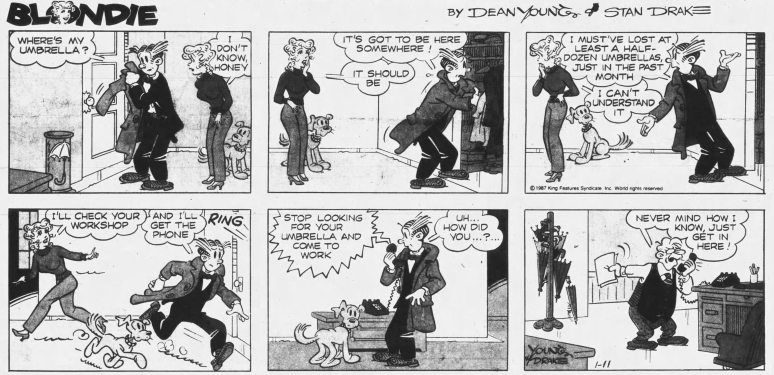
third page Blondie by Dean Young and Stan Drake – January 11, 1987

So that was the Blondie nameplate of the past. A completely different, but more stylish, font than the new one, though still with Blondie’s face filling in the letter “O.”


Blondie nameplate 1987
Blondie nameplate 2025

So…

Blondie joins Dennis the Menace, Curtis, Marvin, Popeye, and Mary Worth in the two panel sized comic strip titles, leaving behind the one panel titles as seen with Beetle Bailey, Barney Google and Snuffy Smith, Hagar the Horrible, and Mark Trail.

Previous Post
Wayback Weekend Anniversaries – Endings: Pogo, Scopes, Bodé
Next Post
CSotD: How the Other 45.5% Live

Comments 15

  1. I didn’t know, so I checked, and that Blondie title panel that was replaced in 1986 was first used at the beginning of March 1955. What is the oldest static title panel still being used now? I think the current B.C. title panel is the original from 1958 with the only change being the credit.

  2. Which reminds me, Dean Young is either dead or 110 years old by now. (Okay, 87) Who’s writing the strip as of now? Is it just John Marshall, leaving Young as a legacy? (then they should have Chic’s name up there)

    they should credit more of the team.

    1. The thing with comics made in the old “assembly-line” fashion of the early-mid 20th century (contrary to the more artisanal approach of most modern strips) is that they are often made by several ghost artists, which makes it hard to make comprehensive credits of the team. Other examples include Garfield, Hagar and the relatively recent Dustin, all of which are handled by several artists who often overlap (such as Eric Reaves, who in addition to draw Hi and Lois, does occasional work on both Blondie and Garfield). Dick Tracy gets around this with the Mint Mystery storylines.

    2. Dean’s daughters, Dana and Dianne, are heavily involved in the creative direction of the strip these days. I don’t know if they’re actually scripting it or just coming up with the ideas, but they’re both active members of the creative team.

      1. That’s nice. But if Mr. Young isn’t doing the actual writing, then the people who do should have their names on the thing.

      2. Eric you know comics history well enough to know that the behind the scenes “assistants” seldom get their names on the strips. Dan Barry had literally scores of people helping him get the Flash Gordon comic into newspapers and none until Bob Fujitani ever got their name on the strip. Roy Thomas wrote The Amazing Spider-Man newspaper strip for decades without getting public credit. Most of the public thought that Walt Disney himself turned out those dozen comic strips signed with only his name.

      3. Of course I do. I know all about the Al Capp-Ham Fisher war over JOE PALOOKA. i just think that once the original artist is gone and his replacement is credited, then THEIR replacement should be credited as well.

        Jim Scancarelli was the fourth guy to be credited for GASOLINE ALLEY and he hasn’t done most of the strips for years.

  3. Useless factoid only hardcore comics enthusiasts might find remotely interesting:

    Blondie had been the sole strip still running on the old King Features 12-panel two-thirds format for almost 30 years after Toots and Casper ended in December 1956. This format had been around since 1926 when Hearst’s syndicate added topper strips to the Sunday full-pages, with some variations throughout the years.

    1. I find that a fascinating bit of comic strip trivia.

  4. The fundamental weakness of zombie strips is that they are not owned by the artist; the syndicate is boss and has total control of the content. If the owners don’t like what the current artist is producing, they can fire him and hire someone else. As far as the syndicate is concerned, the old zombies who still read newsprint only want whatever they had in the past. In the long run, the strip percolates down to a tired collection of running gags, devoid of any brilliance or controversy.

    1. I don’t know which strips you’re referring to, but Blondie is absolutely owned by the Young family.

      1. Are there even any syndicate-owned strips running anymore aside from Barney Google, Gasoline Alley and Popeye? It was something more of earlier comic strips created back when cartoonists were employed by major newspapers, which in turn sold the comics to other papers.

        Also, while associated with titles whose creators have long passed, the term “zombie strip” tends to be applied to those comics that are created by more people than the credited artists (opposite to the artisanal approach preferred by modern comics). Garfield and Dustin are often referred as “zombie strips” in spite of their creators being still much alive and involved in the creative process.

      2. Alley Oop, Dick Tracy, Heart of the City(?), Nancy, Flash Gordon, The Phantom, Gil Thorp, Animal Crackers(?), Mary Worth, Judge Parker, Rex Morgan, Prince Valiant, Mark Trail. Oh, Sally Forth.

      3. I stand corrected on the ownership issue, but there is often only a very fine line between the “legacy” strips that have been “inherited”, versus the “zombies” that have been “assigned”. Continuing popularity notwithstanding, I think Schulz and Watterson made better decisions than Young, Hart, Walker, and Browne.

Comments are closed.

Search

Subscribe to our newsletter

Get a daily recap of the news posted each day.