CSotD: It’s True Because It’s Funny
Skip to comments

This morning’s Duplex reminded me of a news story I was sure I’d clipped, but can’t find. A business professor at the University of Denver wanted to make a point about ethics, so announced to his class that he was going to award a certain number of A, B, C and D grades and that they could bid on them.
To his horror, the students didn’t recognize the sarcasm and, rather than having sparked an ethical debate, he’d unleashed a flood of genuine bids.
Moreover, when he explained his purpose and that the offer had not been real, the students were furious and complained to the administration.
Juxtaposition of the Day
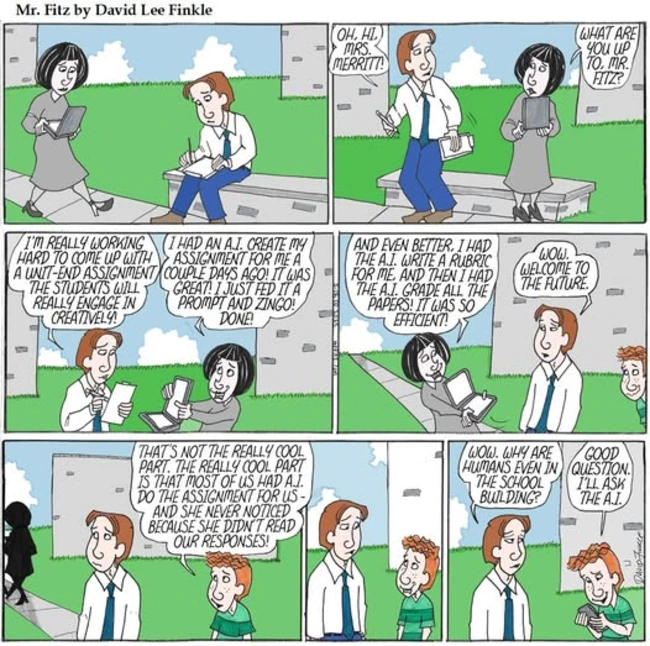
Still on the topic of ethics: I don’t envy teachers having to deal with AI these days, but having spent a few decades working with schools, I have no doubt that teachers are embracing it, too. Nor do I disagree with Mr. Fitz that it makes the presence of human beings in the school somewhat unnecessary.
Buying, rather than writing, essays is nothing new. There used to be ads in the classifieds of underground papers and Rolling Stone offering pre-written papers for sale, and frat houses often kept files of previous papers that members could copy and submit.
In recent years, there emerged software that could detect plagiarism, but, when I was editing kids’ work, I found it just as easy to Google a suspected passage, and, in 10 years doing that, I had two hits, which wasn’t much among some 2600 or 2800 pieces of work, though granted I was working with highly motivated writers.
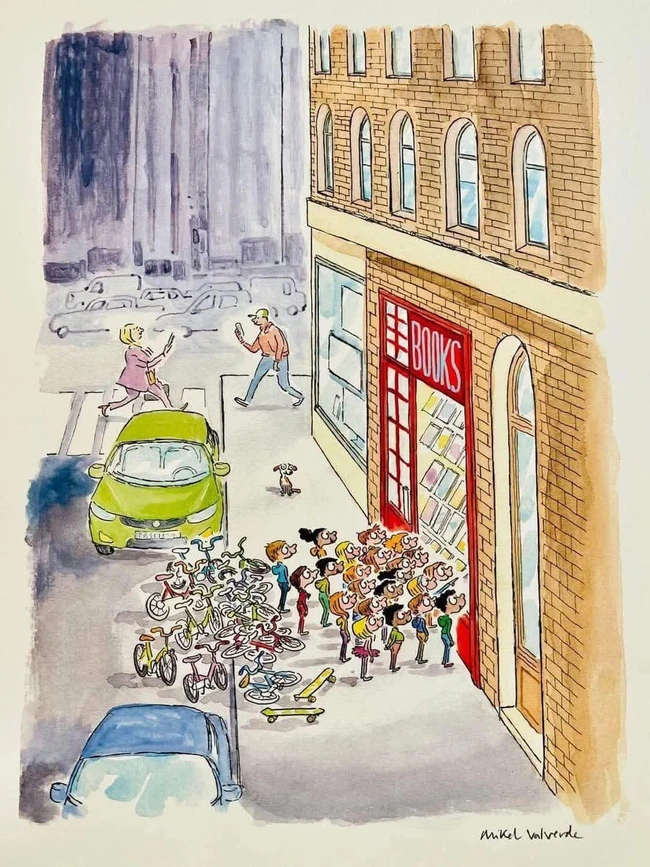
However, the AI issue reflects a sad inability to inspire love of reading, and writing. As noted recently, the popularity of Captain Underpants and other kid-oriented work shows that kids will read, as long as they’re not being force-fed the literary equivalent of Brussels sprouts.
Valverde is right: Kids will joyfully read, and if they’re chugging down insipid James Patterson books today, that doesn’t mean they won’t progress to more substantive things later. I’ve read Tolstoy and Joyce, but I started out on Humpty Dumpty magazine, which is still around, and is still not apt to be mistaken for Anna Karenina or Ulysses.

Not that I don’t have limits in what I can take, and Stahler’s gag reminds me of when one of my granddaughters took dance and I got to attend what her father referred to as an Estrogen Festival.
BYOB would have been excellent advice, but as an old marketing type, I was impressed with the teacher’s formatting, which included a grand finale with all the kids from all her classes on stage at once.
It still wasn’t Swan Lake, but it was an excellent way of preventing parents from ducking out after their little cherub had strutted her place upon the stage.
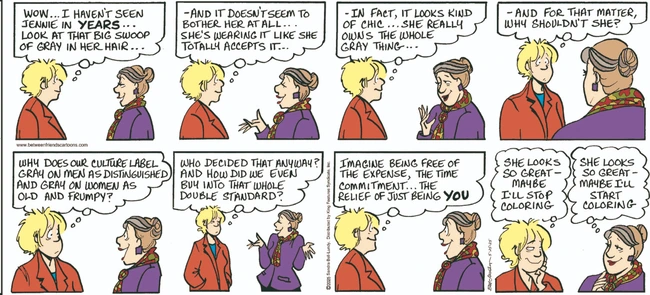
I was going along with Sunday’s Between Friends until it came to the end. The fact that my generation has cheerfully gone gray is a major consolation for our growing older, and I’ve noted in particular an attendant lack of fuss among those who embrace their gray.
It’s not often piled up or sculpted or shellacked into place, adding to a charming impression of low maintenance and calm self-assurance, though if that final bit of unspoken dialogue is realistic, perhaps my imagined conclusions are not.
Which would be a pity.
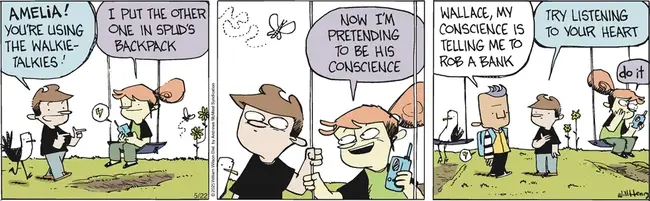
I’ll bet Amelia isn’t going to pile up, sculpt or shellack her hair as she goes through life. For that matter, I suspect she’ll hand out as many gray hairs as she acquires herself.
One of the major strengths of this strip is that the characters don’t fall into rigid, predictable types. Sometimes Wallace and Amelia are co-conspirators, but other times, as here, he’s something of a sea-anchor, not trying to stop her but perhaps to slow her down a bit.
He doesn’t spoil her prank, but he tries to counsel Spud through it. That’s what friends are for, all around.
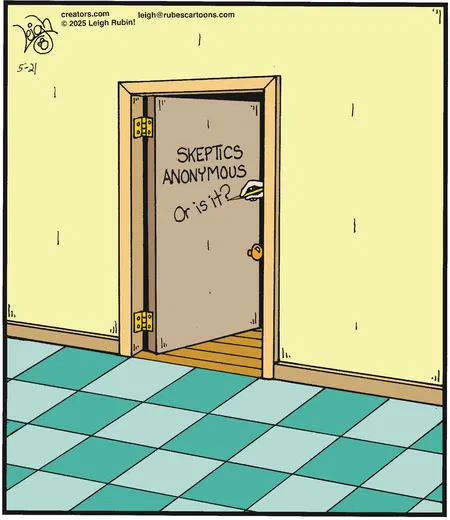
I wish more skeptics were as self-aware and flexible as the unseen person here. Unfortunately, a lot of people who call themselves skeptics are, in fact, cynics. They don’t come into things with curiosity, trying to see what’s behind the well-packaged surface, but rather approach it with absolute certainty that it’s dishonest.
Shades of the Argument Clinic: That’s not an argument but “just the automatic gainsaying of anything the other person says.” I once had an exchange with James Randi in which he resolved the dilemma presented by declaring that I was lying. That’s not skeptical but, rather, dogmatic.
Not to be confused with Diogenes, whose nickname “the dog” gave us the term “cynic” from the Greek, but whose philosophy of Cynicism was a building block of Stoicism, which is more skeptical than cynical.
In modern usage, a cynic is like an atheist — “Prove it is.” — while a true skeptic is agnostic — “Prove it is not.”
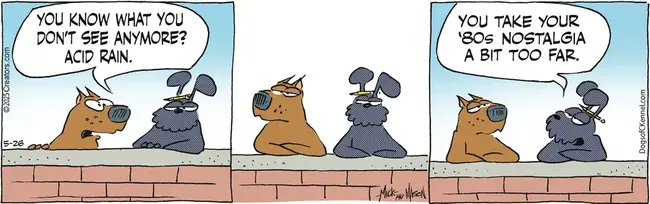
I sure don’t get nostalgic for acid rain, since being downwind of the Midwest in a place with igneous rocks was a particularly deadly combination for fish. The acid wasn’t neutralized as it might have been by sedimentary stone, while, in addition to lowering the Ph level, it also leached metals out of the rocks to help destroy life in the lakes and ponds.
But hang in there, Will, because I’ve little doubt but that Dear Leader’s combination of love for coal and hatred of regulations will Make Acid Great Again.
At least the whales won’t be getting cancer from windmills.
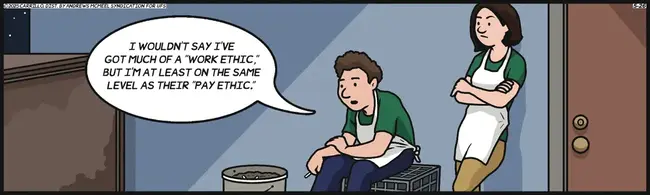
Speaking of remembrance of things past, this reminds me of working food prep at a pseudo-Mexican restaurant, where I spent much of my time folding canned chili peppers and American cheese slices into eggroll wrappers to make what was sold as chili rellenos.
I didn’t last long, since I was working at a speed of $1.50 an hour, which apparently wasn’t fast enough.
I can’t tell what’s in this guy’s hand, but it does remind me of a time the hostess brought something excellent back to the kitchen, which had the ghastly effect of slowing an already interminable shift down even more.


Comments 19
Comments are closed.