CSotD: The Fire Next Time
Skip to comments
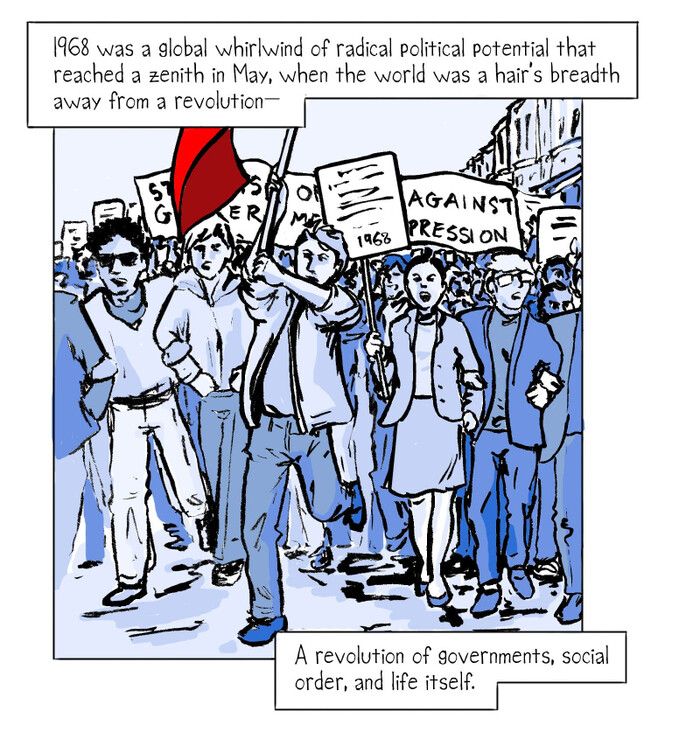 I've criticized — perhaps even "railed against" — young cartoonists for either misinterpreting history or presenting it as some new discovery when it's always been there for anyone who wanted to know it.
It's only fair, then, to praise this piece from the Nib, "1968: The Revolution That Almost Was," by Julia Aleksayeva, who looks at 1968 and gets it right. You should go read the whole thing.
As I was carrying it around in my mind and thinking about what I might say here, and before I looked into her bona fides, I began by thinking of an almost-comic event in which a fellow I knew in college was picked up by the Soviets in the crushing of the Prague Spring because he and his friends — on break from their sophomore year abroad in Austria — were taking pictures of the tanks.
They were held for a few hours because George wouldn't sign a form in languages he couldn't read, but things turned out all right, though they never got their film back.
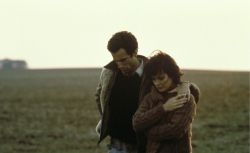 That made me think of Philip Kaufman's film adaptation of "The Unbearable Lightness of Being," and the chilling scene — spoiler alert — in which Tomas, having fled Prague, decides to come back.
He hands over his passport at the checkpoint, but, when he reaches to get it back, a faceless hand enters the frame and simply finger-wags a "No."
But Prague is home, and Tomas needs to be there with the thoughtful, determined young photographer, Tereza, in contrast to the joyously libertine artist, Sabina, who winds up free but rootless in the wide world beyond the Iron Curtain.
When I went back and looked into the cartoonist's background, I found that she is a Soviet ex-pat whose family left Ukraine when she was a very small child. Though she was born two decades after 1968, she has solid roots, and a perspective that allows her to bring some grit and reality to her analysis of a tough but critical year.
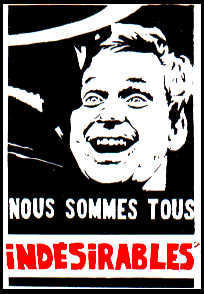 And, yes, the revolt came up a little short, but, as she notes, it planted a lot of seeds.
It reminds me, too, of an interview I did with Arlo Guthrie back in 1989, in which he talked about playing "Alice's Restaurant" for an audience that wasn't born when the song debuted.
"I think it was a fabulous time to be alive and it was a fabulous time to be a teen-ager. It was great; there's no doubt about it."
But that doesn't mean that there is nothing interesting going on right now, he noted: "It just isn't going on in the United States. For other young people, in other places, this may be the generation their children wax romantic over.
"I think what's going on in the Soviet Union right now, and what's going on in China right now, and what's going on in Poland, for those young people, this is that time," he said. "It's not like it's dead, and it's not like it only belonged here."
Moreover, Guthrie said, the various movements towards freedom and democracy will continue to inspire young people in other places, just as they always have. "There were people in other countries in the world who, 20 years ago, were looking this way. Younger people, I think, shortly, will begin to look elsewhere and see that they can participate in what's going on."
It's up to people like Julia Alekseyeva to make sure the stories — of 68 or of Tiennamen Square or of the Arab Spring — are told right, and that new generations are inspired to build upon those revolutions that almost were — including ones that came before that.
Yes, I've added another book to the stack on my nightstand.
Coffee break's over; back on your heads
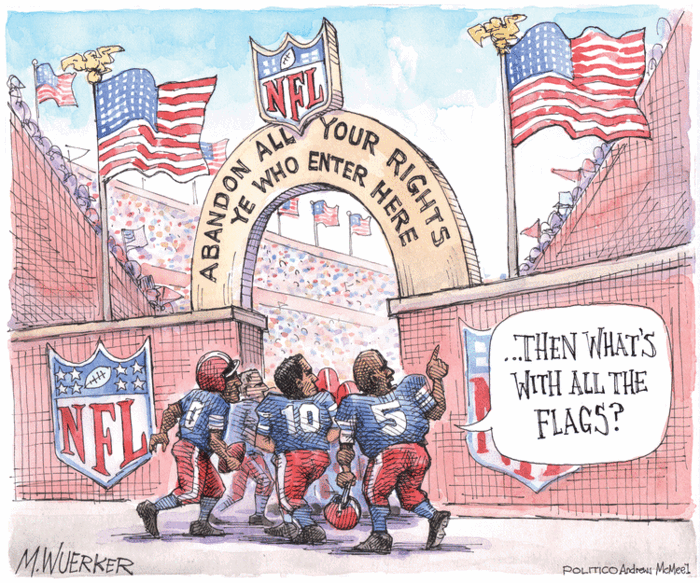
Meanwhile, back in the here and now, things have become bad enough that we could use a little revolution.
Matt Wuerker comments on the NFL crackdown, which seems trivial in the grand scheme, but is one of those things that is so trivial that it illuminates the larger issues, becoming another straw on the camel's back.
Fascisti are now blatting about how players are employees and must obey their employers' rules, but players are hired to play football, not to participate in political demonstrations.
If you demand that they make an overt political statement of any sort, as Wuerker suggests, you have opened the door and challenged their First Amendment rights.
You want to take politics out of the game?
Take politics out of the game.
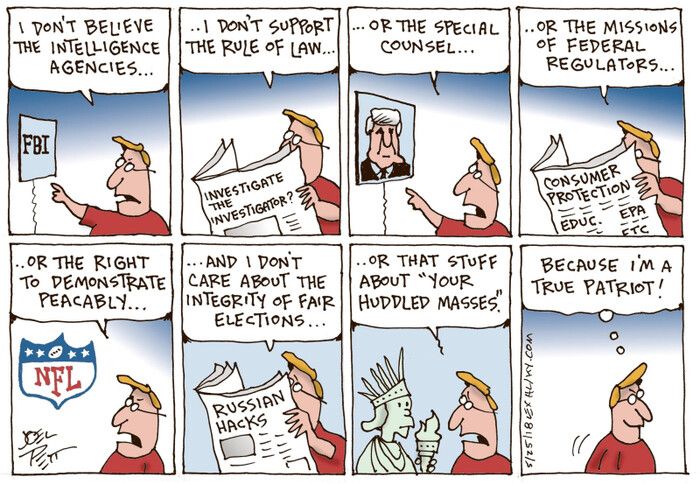
But, as Joel Pett suggests, maybe we've come too far to do that, because everything is political and political in the literally iconic sense in which statues and flags and slogans are worshipped while their meanings and origins are forgotten.
This weekend, there will be millions of little plastic flags handed out, and there will be flags on napkins and paper plates and t-shirts, and in advertisements, and I'm betting that, when Tuesday comes around, those flags will not be respectfully burned in a solemn ceremony.
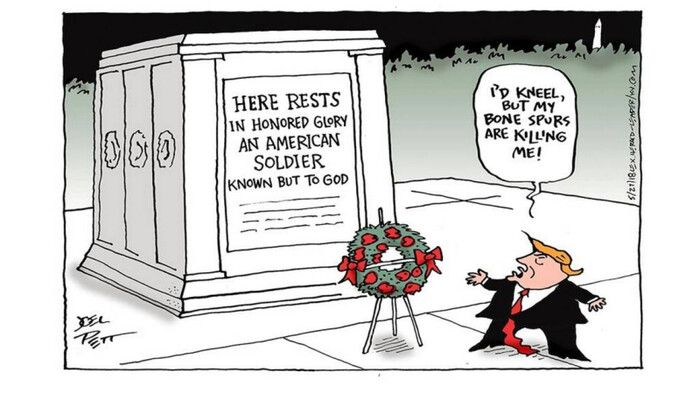 And, to give Pett his own private juxtaposition of the day, the chief celebrant will be Cadet Bone Spurs, who last year gave a stirring speech to the Coast Guard Academy graduates in which he revealed that he thinks they have aircraft carriers.
You do not have to have served, though it's better to have simply not served than to have taken active, dubious steps to avoid service.
However, you do have to be willing to acquire some knowledge of the service before you open your mouth, and, certainly, before you make decisions about those who do serve.
And before you make assumptions about who they are.
Here's something else: The fascisti and the ammosexuals may be loud, but they aren't a majority.
And the new majority — those you ignore and marginalize — may spark another 1968.
For instance, because you didn't make it stop at Parkland, it won't stop at Parkland.
They're smart, they're motivated and they're getting organized.

Comments 3
Comments are closed.