CSotD: Sequel! Dr Jekyll Meets The Blob of Stupidity!
Skip to comments
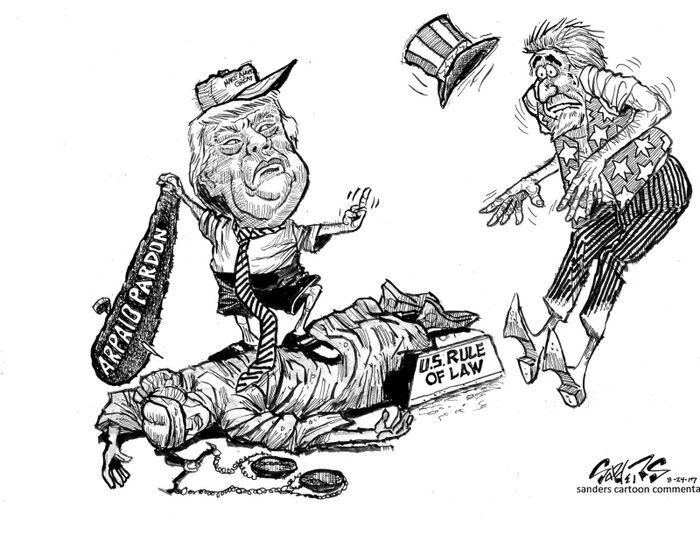 Bill Sanders makes the point graphically that has been under discussion here: Trump is not a baby ignorantly blundering into trouble but, rather, a defiant brat.
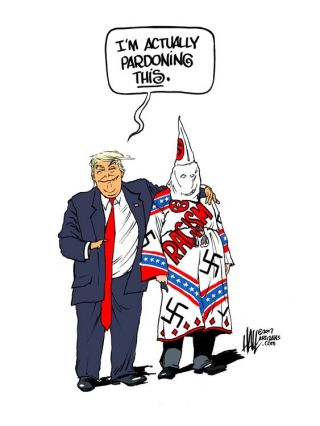 And Ed Hall makes the further point that Trump is once more playing to his white supremacist base.
I'm a little disappointed that the major coverage of the pardon simply states that Arpaio indulged in "racial profiling" without going into the outrageous level of abuse he had his officers engage in.
I had an on-line discussion yesterday about this, and I still don't think the Arpaio pardon is illegal, but this Washington Post piece convinced me that it is unprecedented in a way that is troubling.
The Constitution has a flexibility that has preserved its relevance and efficacy down the years, but it was written with the assumption that responsible, intelligent people would head the government.
Granted, even the Founders anticipated a certain amount of bad faith, which required one of the few specific, nit-picky clauses, reducing representation in slave states by only allowing slaves to count as 3/5s of a "person."
Yes, they might have outlawed slavery entirely, but the world wasn't there yet. They were at least wise enough to recognize that we'd never get there if the South were able to pack Congress in its favor.
And they initially set things up so that the presidential runner-up would be vice president, which made sense at least to those who assumed so much intelligent responsibility that we wouldn't have political parties and partisan divides. The 12th Amendment was a quick fix after the troublesome elections of 1796 and 1800; any hopes that we'd move forward free of partisanship had disappeared at the end of Washington's second term in office.
However, while the disastrous failure of militias in the War of 1812 led to a revamping of the army, nobody apparently felt it was necessary to alter the Second and Third Amendments just because the former was no longer relevant, while the latter was preventing an abuse nobody would ever propose anyway.
And, likewise, it wasn't necessary to put a lot of specifics on the President's power of pardoning:
1: The President shall be Commander in Chief of the Army and Navy of the United States, and of the Militia of the several States, when called into the actual Service of the United States; he may require the Opinion, in writing, of the principal Officer in each of the executive Departments, upon any Subject relating to the Duties of their respective Offices, and he shall have Power to grant Reprieves and Pardons for Offences against the United States, except in Cases of Impeachment.
Though it seems rather specific that he can't pardon himself if he's impeached.
Which makes me question the worries of those who have argued that Trump will be able to pardon his various cohorts and frustrate Mueller's investigation, because, first of all, pardoning them for their own involvement would remove their Fifth Amendment rights against self-incrimination, while I suspect a reasonable court could rule that Mueller's investigation is tied to impeachment and so they couldn't be pardoned for contempt in refusing to testify.
The key phrase being "reasonable court," but Nixon certainly found that the Supremes take their independence rather seriously.
Also, I'm not a lawyer.
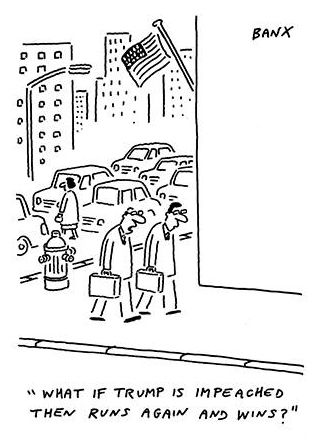
Also, Jeremy Banx notes an even bigger threat and, no, the Founders never considered this one, though we can hope the GOP would at least grow enough spine to keep him from getting their nomination.
Again.
Maybe they could hire Debbie Wasserman Schultz this time.
By the way, I like Banx's flag, which, if he ran it upside down would, of course, be a signal of distress, but instead he's simply running it bass-ackwards which pretty much sums things up as far as I'm concerned.
Things are distressing all right, but it's hard to separate the ignorance from the genuine ill-will, the overt hatred from the thoughtlessness.
With regard to those Jim Crow statues, there are people who believe in the romance of the Old South and they aren't all toothless hillbillies in tumbledown shacks.
"Gone With The Wind" gets a good audience wherever it's shown, and viewers don't all wince at the depictions of happy slavery.
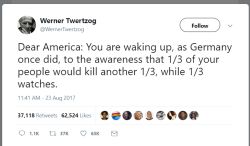 And Facebook remains full of postings from people who have apparently missed the flood of information about who put those statues up, and when, and why, and what history they represent.
When even Fox is beginning to criticize Trump for his backing of white supremacists, you have to wonder how these people manage to miss the point, but there's little doubt that they do.
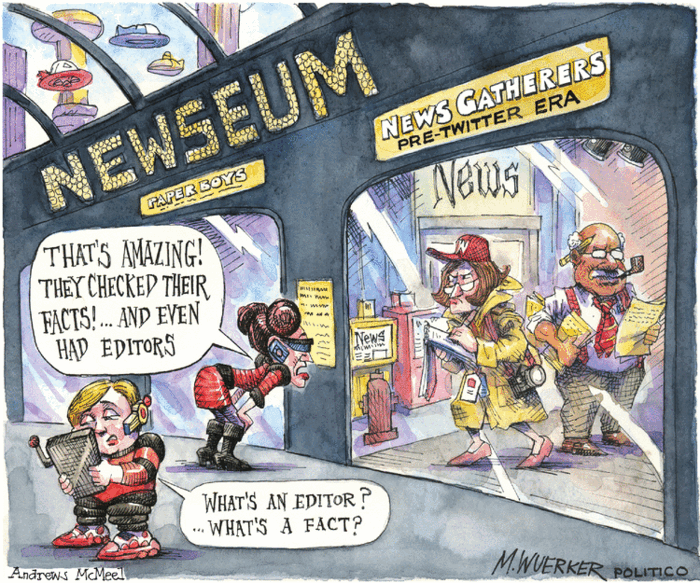
Matt Wuerker worries about the future of journalism, and the willingness of people to ignore the news is as frightening as the eagerness of Trump to turn the media into enemies.
I saw something the other day in which the writer dismissed some nonsense, comparing it to the Discovery Channel, and doing so without any discussion of that channel, simply understanding that we all know and accept it as an endless font of misinformation.
Which it didn't used to be, but, yes, it certainly is today.
Only we don't all know and accept that.
Meanwhile, the Wall Street firms who now own newspapers are saving money by laying off editors, firing reporters and getting rid of editorial cartoonists.
Sunday papers in major metros are now smaller than small-town dailies were 20 years ago, in page size, in page count and in the information they contain.
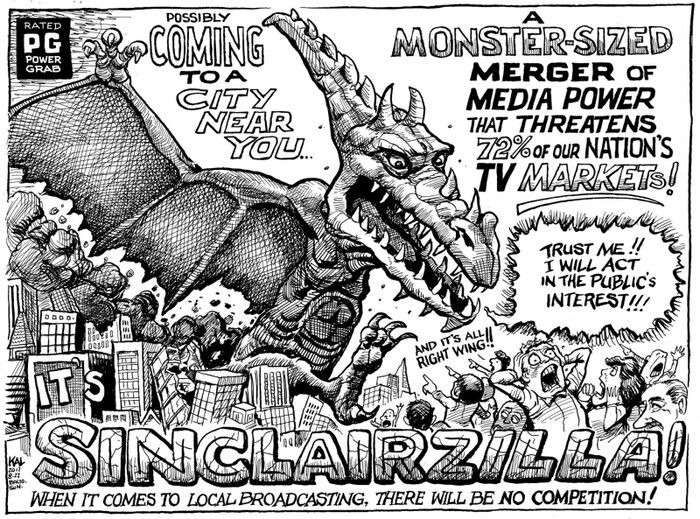
And if those changes are due to simple, non-partisan greed, Kal Kallaugher warns of the spectre of Sinclair Broadcast Group, which is about to capture a huge chunk of local stations, and which actively, deliberately tailors its news to spread a rightwing view of reality that would embarrass Rupert Murdoch and Roger Ailes.
More than a moment of zen:
But it's important and hilarious, and your Sunday paper doesn't
take up a third of the time it used to anyway.
Comments 3
Comments are closed.