CSotD: Judging Stories By Their Covers
Skip to comments
This was an odd morning of collection and collation, because for some reason not all the strips were updated, so I had to scramble around to back-up sites trying to assemble the day’s offerings. (It may be resolved by now, of course.)
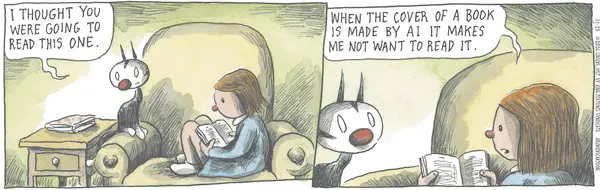
But Henrietta and Fillini offer an exchange that fits just such a day.
On the surface, you have to assume that if the company doesn’t want to invest in quality, the shortcuts you notice are probably also present in ways you don’t. If the candy label looks bogus, you’d better check the ingredients before you bite in.
True in candy bars, true in books. Why wouldn’t it be? You only have to look at the work of Garth Williams to see how the quality of his work was matched with the quality of the books he illustrated.
In fact, you could have a reasonable discussion of how much of a factor his covers were in establishing those titles as classics: As soon as Henrietta said that, I thought of Stuart Little canoeing down the river, and immediately went to Charlotte’s Web and then to the Little House series.
The publishers of those books knew they had something special in hand and so they found someone special to illustrate them.
Granted, Henrietta is a particularly perceptive child. But somebody has to set the standards that upcoming generations live by, and it’s a combination of conscious choices and subconscious recognition.
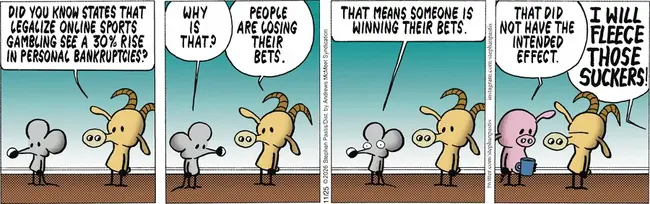
Henrietta represents a Fool in the theological sense of an innocent who sees beyond the obvious.
By contrast, Pig is a bumbler, a clown who mistakes what he sees, while Rat is a clown who doesn’t realize he’s a clown. Together, they make a pair like Ralph Kramden and Ed Norton, misperceiving one thing after another and we laugh because we know they’re going to blunder into yet another disaster.
In this case, of course, Rat’s cunning plan is answered by “How do you think they build those fabulous casinos?” but if everyone could see the obvious flaws in their insights, there would be no Las Vegas.
And yet there is.
Juxtaposition of the Holiday
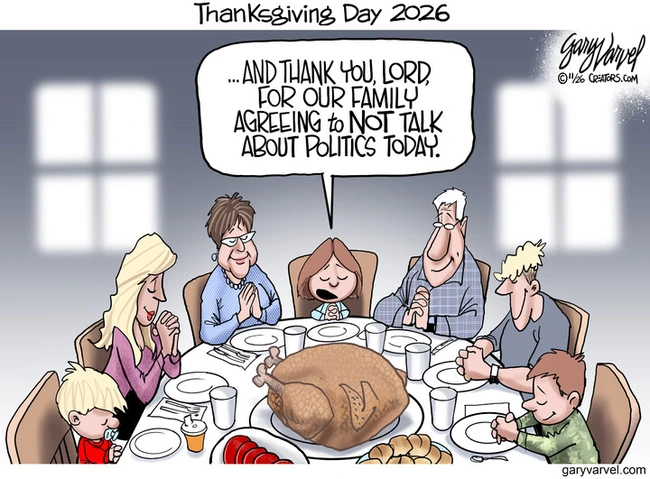
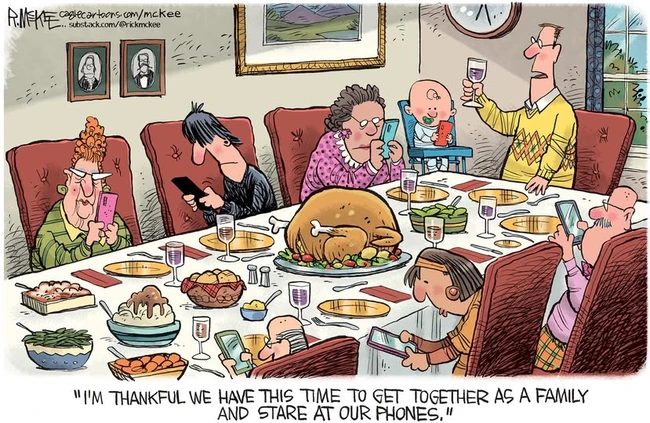
Tomorrow will offer a lot of insights to people who may or may not figure out what they’re seeing, but the tensions around the Thanksgiving table are something we all recognize.
If the family gathered regularly, there would be far less tension, and Varvel’s family wouldn’t need the father’s reminder not to talk politics, because they’d have long since learned not to, or, at least, they’d know the ground rules.
Similarly, McKee’s family clearly has no rules and no expectations of how “family” works. Even if the family is just three or four people who eat together regularly, they should already recognize the difference between grabbing lunch on the way out the door and gathering for dinner as a time to talk to each other. One or two people might have to be reminded, but McKee’s joke is that we have lost the habit of just being together.
It’s not necessarily “religious” to have such purposeful gatherings, but anyone who has lived in the Rocky Mountain West is aware that observant Mormons have a family night, and even if you’re not Mormon, if you’re in a strongly LDS community, you learn you can’t schedule meetings or sports or other events for that night and expect a crowd.
Similarly, one of my favorite movies is Ang Lee’s Eat Drink Man Woman, about a Chinese widower and his three adult daughters who gather for dinner every Sunday. Dad is a fabulous chef and it’s a command performance, but the three girls are branching out in their lives and the interplay of their needs, ambitions and love — as well as his — make up the point of the movie.
In their case, it’s time for a conversation, but if you can’t get through Thanksgiving dinner once a year without issues, maybe it’s past time for your family to have that discussion, as well.
Juxtaposition of the Holiday #2
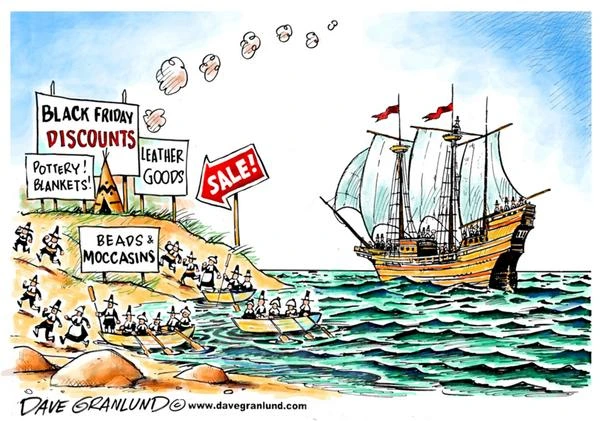
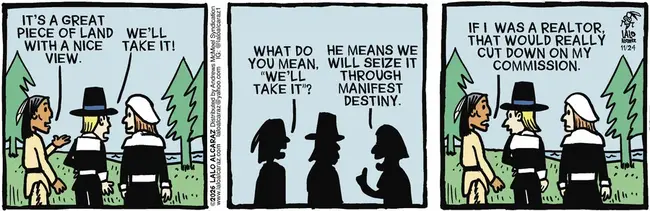
Put on your sarcasm glasses for this pair. Granlund gave me a jolt because, at first glance, it seemed he was blaming the Indians for selling out. Alcaraz is more quietly ironic in his brand of sarcasm, and they make a nice juxtaposition because Granlund goes too far and Alcaraz leaves too much unsaid.
As noted here before, Thanksgiving wasn’t a thing until we completed the Transcontinental Railroad and began recruiting an immigrant farming and labor force, using the story as a welcoming myth.
It is a myth, even in that corner of the New World. But that’s a part of the country with a lot of mythology. For my part, I don’t take much responsibility for anything that happened east of the Hudson, not to the Narraganset, not to Ann Hutchinson. As Tolstoy said, each unhappy family is unhappy in its own way.
But west of the Hudson, the approaches of the Dutch, English and French into Iroquois country is interesting history, as four cultures clashed, not over beaded moccasins as in Granlund’s fantasy or modern mortgages as Alcaraz jokes, but over metal and over pelts.
The three European groups had their own wars going on at home; for the natives, the clash was largely technological. To oversimplify, as the beaver fad in Europe drove exploitive trade for pelts, the tribes in the region were becoming increasingly dependent on metal tools.
By the time the pelts began running out, the natives no longer knew how to cook as their great-grandparents had, without metal pots, or how to hunt and work without metal weapons and tools. Economically dependent on their European trading partners, they began raiding each other’s communities for pelts in the ghastly, tragic Beaver Wars and to make real estate deals that benefited major tribes while impoverishing smaller ones.
The Thanksgiving Story is simple and the food is great, but if you want to know how we all got to where we are today, start by thinking not about Indians and White People and a clash between primitive and modern folks.
Think, instead, of a clash of several distinct peoples, each with different goals, and offer each of them respect.
That’s where thanksgiving really begins.
Mike Peterson has posted his "Comic Strip of the Day" column every day since 2010. His opinions are his own, but we welcome comments either agreeing or in opposition.
Comments 2