CSotD: Goodbye, Columbus Day
Skip to comments
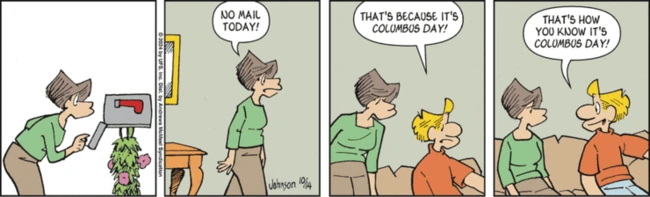
That is indeed how you know it’s Columbus Day, or Indigenous Day, or Discovery Day. The new names have caught on about as well as “the Gulf of America,” though they came from the other side of the political spectrum and had some genuine reason for existing.
But if there’s any major hoo-ha to be had today, it’s likely in cities with a strong Italian-American presence, since it’s essentially their holiday. The rest of us don’t even get green beer.
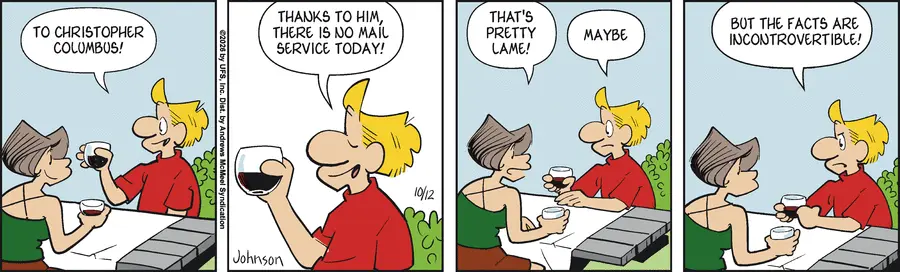
Jimmy Johnson revisited the point today, but he was one of the few cartoonists to mention the matter at all, which indicates that while nobody seems to have taken the re-naming seriously, they have largely abandoned the holiday. Columbus Day is still on the books, but it’s one of those American holidays where only letter carriers, bank tellers and teachers get the day off.
For my part, with all the horrendous news happening, I was planning to ignore it, but Mondays are often quiet on the political cartooning front and, true enough, there wasn’t much fresh fodder this morning, so I’ve dug into the vaults and here’s a look at the holiday that mostly isn’t anymore.
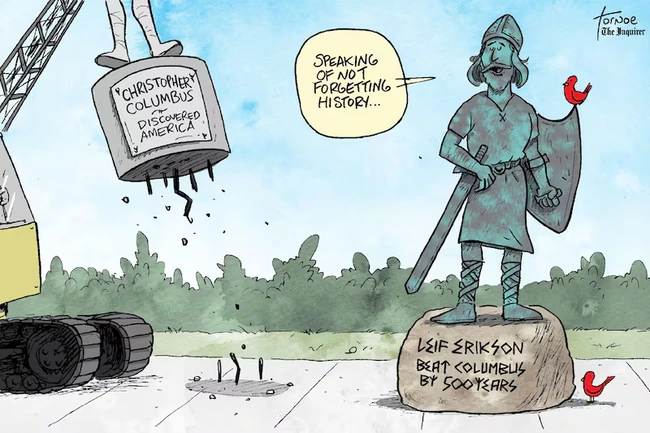
I can be neutral in the whole “Who discovered America?” issue, because my paternal grandmother was Italian, my paternal grandfather was Danish and my mother’s family was Irish, so I can argue in favor of Leif Erikson or St. Brendan or Columbus, then, though each of them with an asterisk.
It all may be history, but it’s not very good history.
The Irish claim goes in the bin with a whole lot of other people who may have blundered onto the place but didn’t do much about it, though the Irish built some fun but outrageous mythology around Brendan’s voyage. Supposedly he landed on an island and started to say mass when it turned out to be a giant fish that woke up and cast them all back into the water. There are scholars who suggest a link between St. Brendan and Sinbad, largely based on their imbalance of storytelling vs. history.
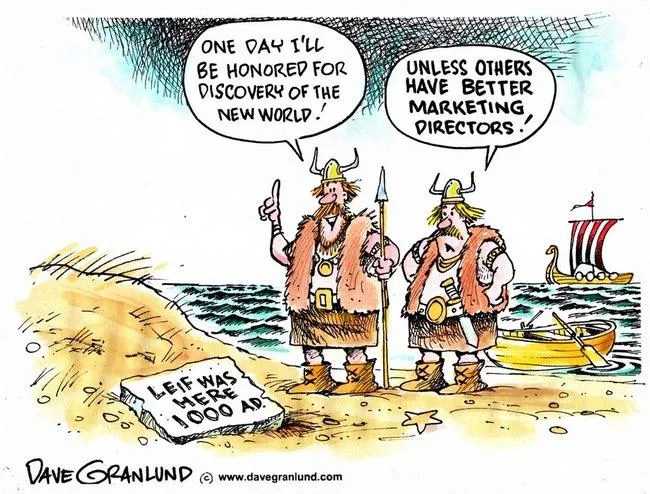
The Norse claim has some genuine history behind it, but Granlund nails the fact that, while they recorded it in their own sagas, they didn’t do much to spread the word.
And Erikson didn’t actually make the discovery. A fellow named Barney Haroldsen spotted the land first, and Erikson then tried to market it as a place where settlers could make a living selling lumber and grapes to the folks back home. This real estate project, however, apparently failed because the Norse weren’t all that much better armed than the local skraelings, and they were very much outnumbered.
Whatever the details, you can go see the site of one of their settlements, and, sorry, Virginia Dare, but the first European kid born in the New World was a Norse boy named Snorri.
In any case, as Granlund puts it, the Norse failed to promote their discovery and, as public relations people will tell you, when you don’t promote, something terrible happens: Nothing.
It didn’t stop them from settling in other lands, by the way, and I’m not sure of the timing between the Vinland and Markland attempts here and their more successful expansion into Ireland, but if your family tree includes any McIvors or MacAuliffes, you’ve got some Ivors and Olafs mixed in with your Celtic forebears.
Juxtaposition of the Day
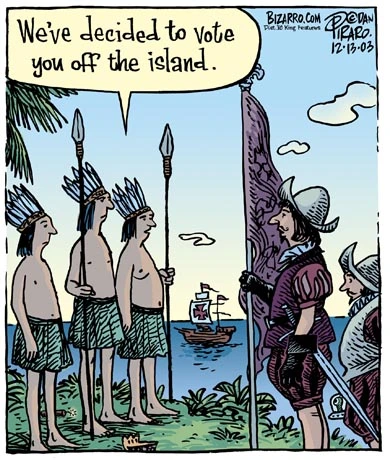
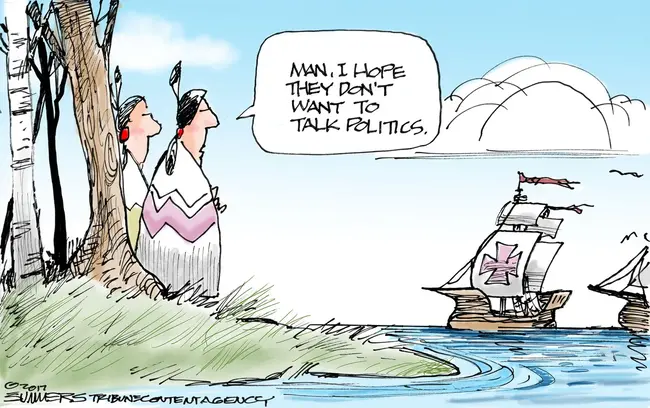
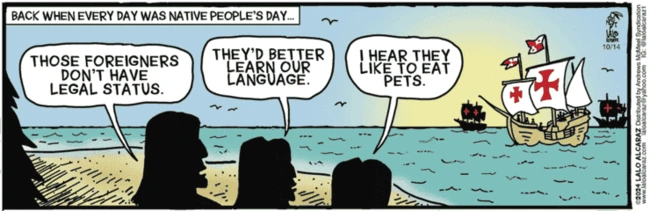
I could do an entire book of cartoons about the natives wanting to build walls to keep out the aliens, or demanding that they assimilate. It’s not a bad way to criticize the America Firsters who seem to think their ancestors were the last deserving people to arrive, and who don’t acknowledge those who had shown up far earlier, never mind the ones who were here in the first place.
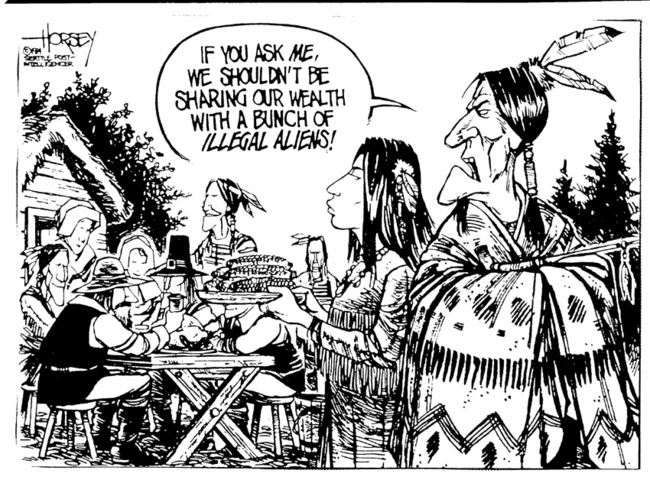
This is a Thanksgiving cartoon, not a Columbus Day cartoon, but it was a favorite among my students because it so well flips the myth of the first Thanksgiving.
Every society in a temperate zone has some sort of festival to mark the harvest season (and, BTW, today is Canadian Thanksgiving), but the Pilgrim’s small celebration was expanded and exalted at a time when we were trying to draw in immigrants to work in our factories and farm our prairies.
As such, Horsey’s cartoon is a more pointed commentary on our current xenophobia than Columbus Day gags about natives trying to exclude the newcomers, because it doesn’t just point out exclusion and bigotry but specifically notes the hypocrisy between our self-image and our actual behavior.
Juxtaposition of the Day #2
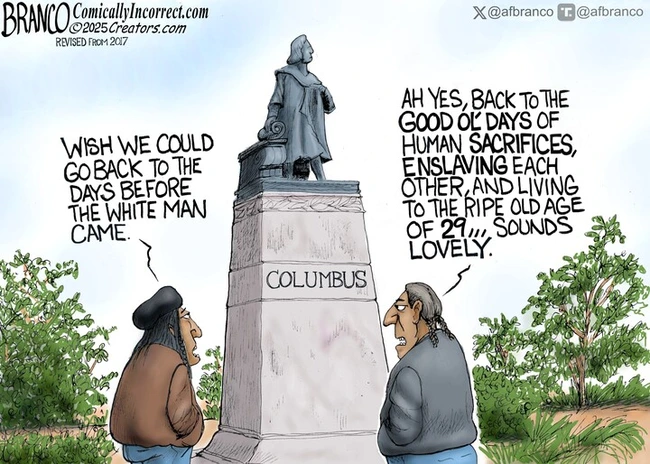
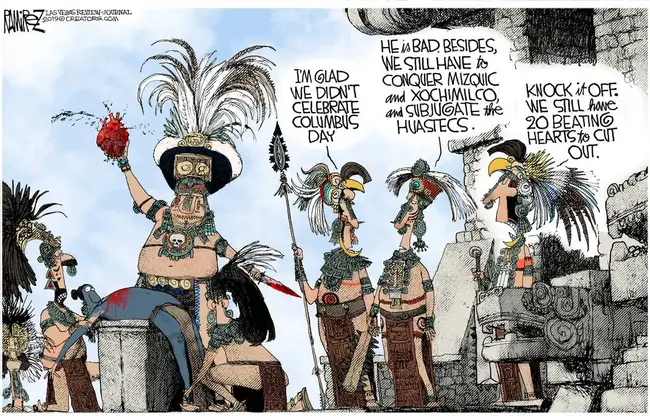
As criticism of Columbus’s brutality began to emerge, the response from the right was to point out the brutality of native people, and, while you can criticize the spirit in which it is offered, the fact is that life seemed cheap in preindustrial days, and not just in PreColumbian times. Read a little about the 100 Years War and you’ll find that Europeans weren’t much nicer to each other than they were to native people on other continents.
Nor, to address Branco’s criticism, were lifespans in Europe all that much greater that they were in the Americas before the introduction of foreign diseases. That’s not a door you want to open if your point is that the white man brought benefits to the people of the New World.
In any case, good parenting limits how much bad behavior is justified by “all the kids were doing it,” and the fact that the Aztecs and Incas may have ruled harshly is a dubious excuse for how Cortez and Pizarro in turn treated them.
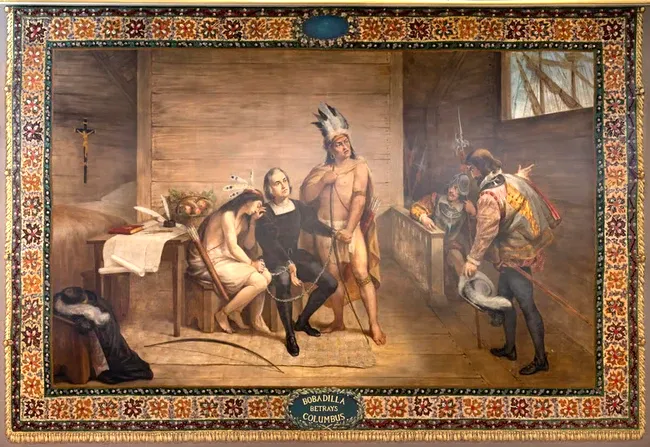
It’s an even more lame excuse for Columbus, portrayed in a now-covered-up series of paintings on the walls of the University of Notre Dame’s administration building.
We walked by this particular mural regularly, but were never taught how Bobadilla had betrayed Columbus, and we were left to feel that he must have been quite a cad to betray the great hero. But what emerged later, and why the university has covered up the murals, was that Bobadilla was a good guy and had busted Columbus for his incredibly brutal treatment of the native people of Hispaniola.
That’s not an issue of how we feel about it looking back. It’s a matter of behavior so outrageous that it horrified people even in the midst of the Spanish Inquisition and Ferdinand and Isabella’s expulsion of Jews and Muslims from Spain. Bobadilla’s report laid out both the horrific way in which Columbus mistreated, tortured and enslaved the Taínos and how he dished out much the same treatment to Spaniards in the colony.
It could be argued that, had he only treated native people that way and spared the white folks, the crown might not have condemned him. But it doesn’t change the question of whether he is worth holding up as a great hero worthy of statues and of a national holiday.
Not does it change the answer.
I see that I’ve gone well over my usual word count today, so I’ll finish by letting Stan Freberg puncture the mythology in a far more entertaining manner:
Mike Peterson has posted his "Comic Strip of the Day" column every day since 2010. His opinions are his own, but we welcome comments either agreeing or in opposition.

Comments 1