CSotD: Canada Goes Elbows Up
Skip to comments
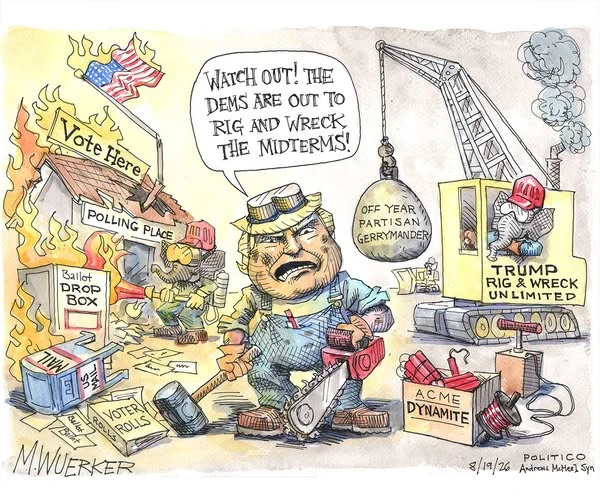
Wuerker points out the many ways Dear Leader is interfering with the upcoming midterm elections, whining about alleged cheating in 2020 that only he can see, and insisting that it’s going to happen again. This time there may actually be cheating in the elections, but it will come from Trump ignoring the well-established Republican belief in states’ rights and imposing federal interference on elections.
There is a long tradition of photos in the newspapers of presidents casting their ballots on Election Day, but Dear Leader votes by mail. This puts him in with a significant percent of voters who do the same, but he’s trying to eliminate the practice and, in the meantime, is making it as difficult as he can.
He’s now got the USPS poised to interfere as soon as they find a way around court orders forbidding them from doing so. There seems to be enough resistance to the plan not only among Democrats but among state and local Republicans, who are not as easily led as their colleagues in Congress, and if he doesn’t get his nefarious plots in place before the elections, he may not have the power to impose them later.
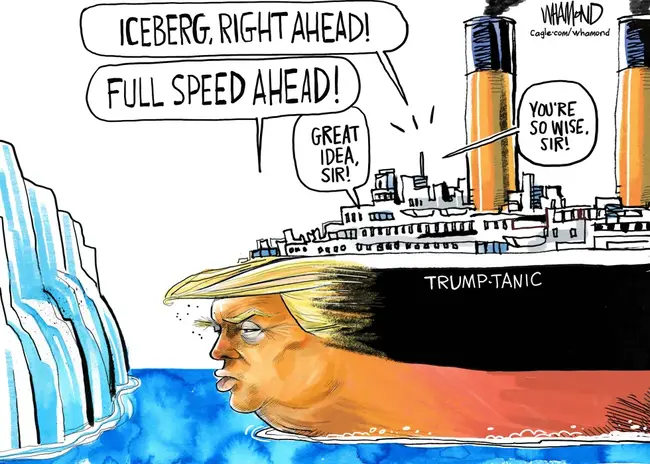
Meanwhile, he’s practicing how to alienate people by trying to pick on Canadians, who have a well-earned reputation for being polite, but also have a well-earned reputation for what they call going “elbows up” and fighting back when challenged on the hockey rink, or any ice.
One thing Dear Leader does not lack is hubris, that element of arrogance that makes a man think he can defy the gods and that invariably leads to his destruction. As the old song goes, relevant to Whamond’s cartoon, “They built the ship Titanic to sail the ocean blue, and they thought they had a ship that the sea could not get through.”
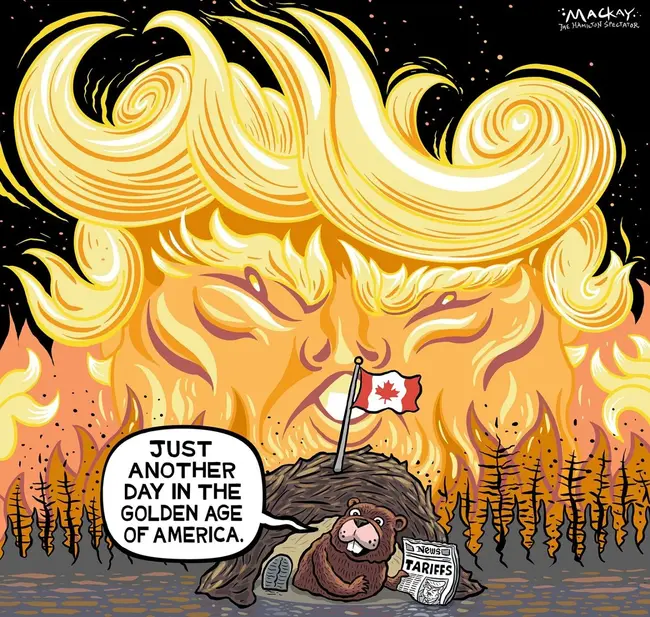
It started out normally enough, by Trumpian terms. Canada was targeted with much the same tariffs that Dear Leader imposed on other countries, which were a response to his not understanding how trade deficits and trade balances and international business in general works.
Canada being one of our largest trading partners, the tariffs hit hard, but, then again, the same ignorance that inspired him to impose them also led him to do so in a manner that the courts struck down.
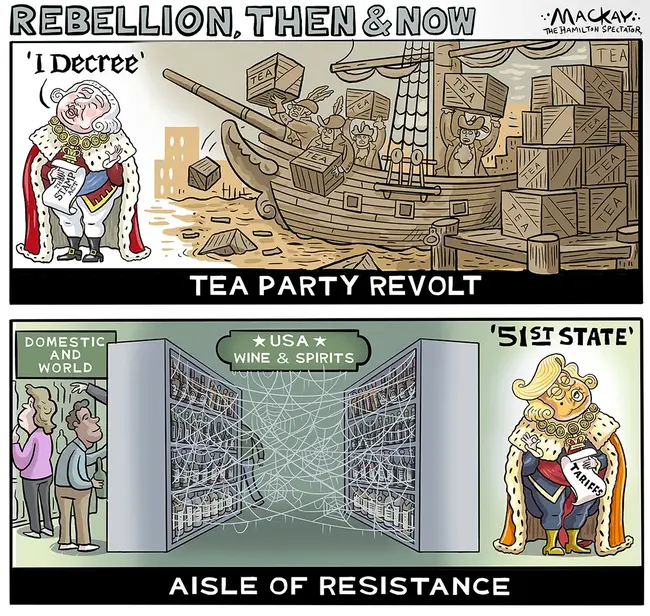
The tariffs were only part of the mix, as MacKay noted, and he compares Trump to George III, who imposed a set of what the Americans called the “Intolerable Acts,” which included a tax on tea that the Yanks opposed by tossing a shipload of the stuff into Boston Harbor.
MacKay compares King George’s arrogance with Trump’s repeated, ridiculous plan to make Canada the 51st state of the union, an insult that, combined with his defiance of his own trade agreement, caused provincial governments to ban American liquor from store shelves.
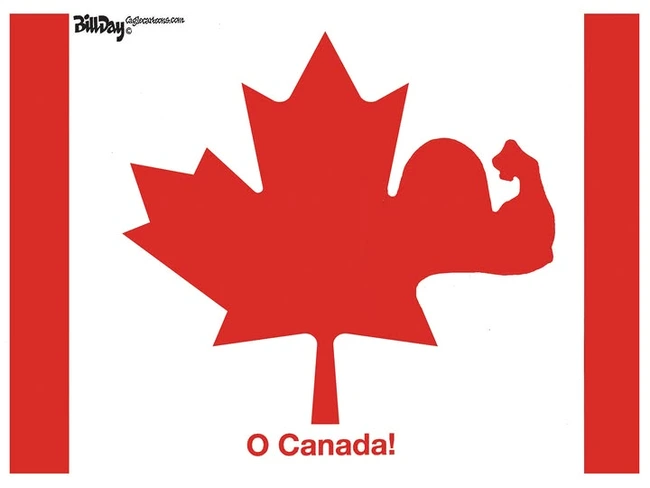
And at the same time this was costing American liquor company revenues, Canadian tourists began staying home, which did serious damage to economies in several states. Part of this boycott was a response to horror stories of people being hassled and even arrested at border crossings.
But as Day points out, a large part of it was national pride and a reluctance to be pushed around, even by a larger bully.
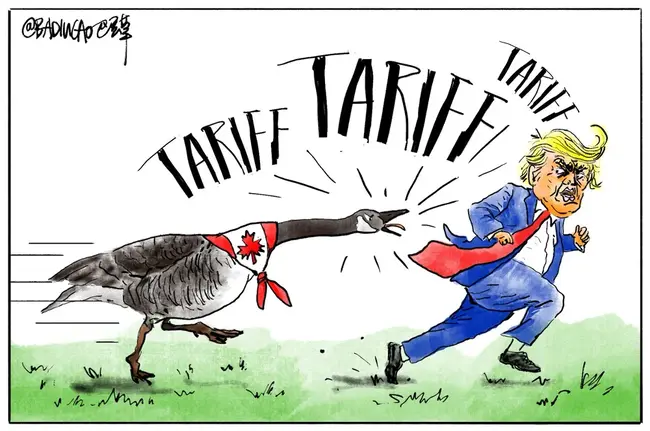
The latest development was a series of stalled trade negotiations in which the Americans made outrageous demands, including that Canada seek permission for agreements with other nations and that it back off from bilingual labeling requirements, despite French being the language of nearly a third of Canadians. If Canada didn’t bow to these demands, the Americans threatened tariffs of 50% on a variety of imports.
Badiucao indicates the Canadian response. Their negotiators walked out of the meetings and Canadian Prime Minister Mark Carney issued a televised response that left no doubt as to the nation’s refusal to surrender to the demands.
Canada is America’s second leading trade partner, behind only Mexico. When I moved East in 1987, my main reporting assignment was to follow Canadian trade, both the cross-border shopping that was a local phenomenon and negotiations for the Free Trade Agreement, which later included Mexico and became the North American Free Trade Agreement or NAFTA.
There were bumps in the road over specific items, notably softwood lumber, potash, and dairy goods, chiefly because of subsidies the Americans considered unfair advantages.
But even when such disagreements were referred to international courts for resolution, things were friendly and positive, and life went on, until Trump came to power and insisted on renegotiating the agreement. Even that went well enough and he was proud of the resulting United States-Mexico-Canada Agreement (USMCA).
Until he wasn’t, which is how we got to where we are now.

Trump may have thought he could bully his way through but ran into not only national pride but into someone who actually understands how this stuff works, which put the self-proclaimed valedictorian at a distinct disadvantage.
As Wikipedia notes, Carney “graduated with a bachelor’s degree in economics from Harvard University in 1987, and earned a master’s degree in 1993 and a doctorate in 1995 from the University of Oxford, both in economics. Carney worked at Goldman Sachs before joining the Bank of Canada in 2003 as a deputy governor. In 2004, he joined the Department of Finance Canada as a senior associate deputy minister. Carney served as the eighth governor of the Bank of Canada from 2008 to 2013.”
By comparison, Trump has bankrupted six businesses, and has an overall approval rating of 39% while 60% of Canadians are in favor of Carney’s tough response to the US/Canada trade issues, which is very high in a parliamentary system with multiple parties.
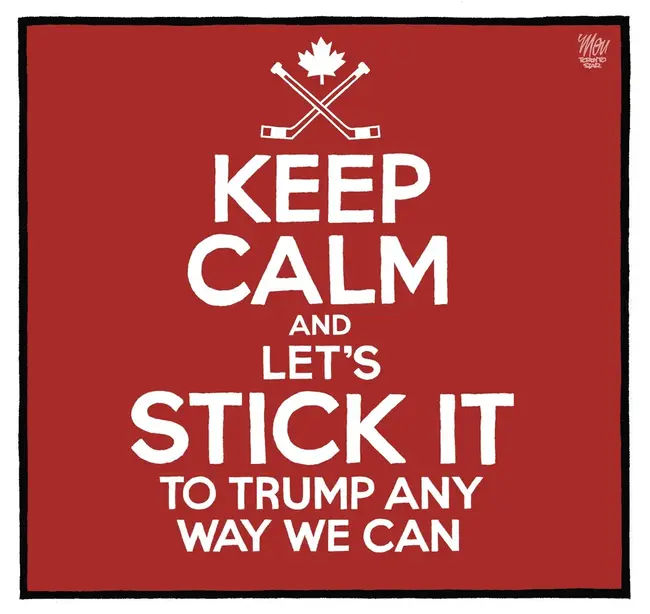
As Moudakis points out, Canadians aren’t happy. You can dig deeper with this analysis by Meidas, or try a more amusing and definitely NSFW analysis from this Australian blog.
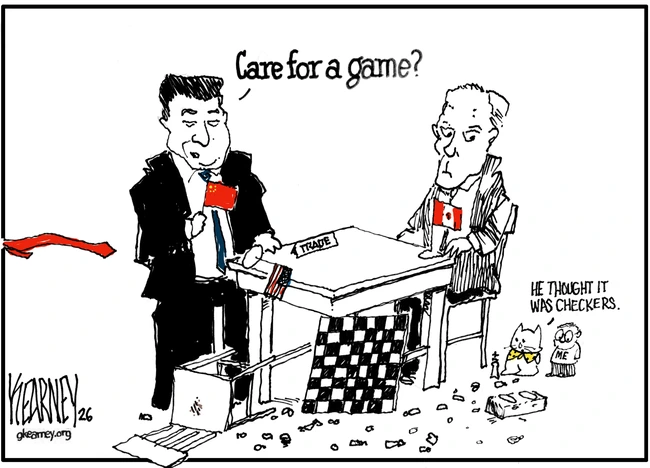
The first example of international trade I remember came when Canada sold wheat to “Red China,” in 1961, when few countries recognized Mao’s government, and more than a decade before Nixon visited Beijing.
Today, Canada has plenty of trading partners and, as Kearney suggests, it shouldn’t be hard for them to find someone more cooperative to work with.
Elbows up, mes voisins.
Mike Peterson has posted his "Comic Strip of the Day" column every day since 2010. His opinions are his own, but we welcome comments either agreeing or in opposition.

Comments 14
Comments are closed.