Comic Strip Credits for 2026 Eisner Hall of Fame Nominees
Skip to comments
The San Diego Comic-Con is next week and while we have noted the Eisner Awards Hall of Fame inductees for 2026 with comic strip credits we never got around to give the comic strip bona fides for the nominees.
The Eisner Awards Hall of Fame judges have chosen 16 nominees from whom voters will select 4 to be inducted into the Hall of Fame this summer. These 4 will be joining the 19 individuals that the judges have already chosen for the Hall of Fame.
The 16 nominees are Kate Carew, Colleen Doran, George Evans, Crockett Johnson, Peter Kuper, George McManus, Kevin Nowlan, Mimi Pond, Posy Simmonds, Jeff Smith, Paul Smith, Leonard Starr, Akira Toriyama, Mark Waid, Chris Ware, and S. Clay Wilson.
Over half have comic strip credits in their resumes, they are…
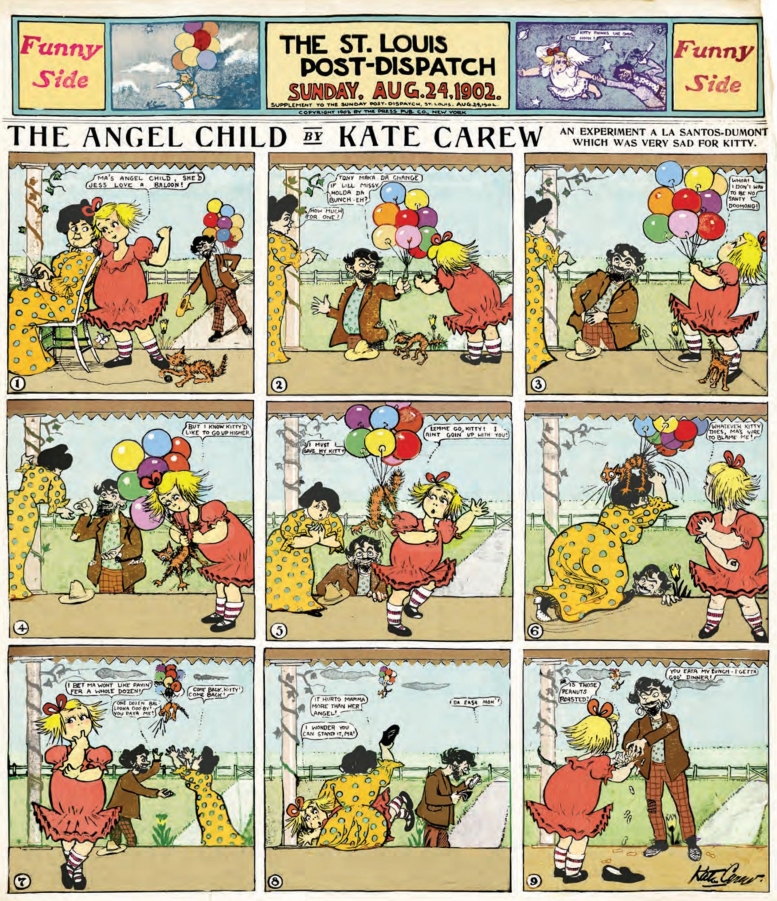
Kate Carew (1869–1961)
Mary Williams, who used the pseudonym Kate Carew, studied at the San Francisco School of Design and started her career in illustrating in 1889, when she was employed by the San Francisco Examiner. A year later, she moved to New York to work for The New York Globe, where she created several comics, including “The Angel Child.” Her caricatures and interviews became so popular that she was sent to Europe to make the series “Kate Carew Abroad.” In 1911, she settled in London and did work for The Patrician and Tatler. At the start of World War I she moved back to the States and continued working for newspapers such as The New York Tribune.
Kate Carew no doubt has Eddie Campbell and Fantagraphics to thank for her nomination this year.
George Evans (1920–2001)
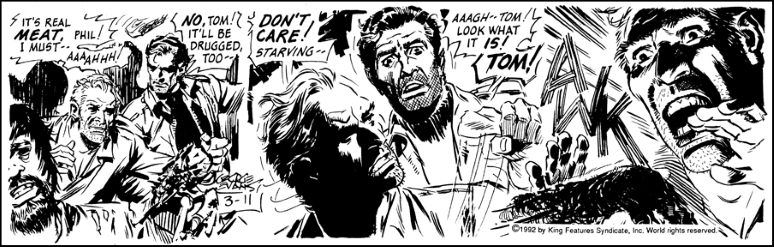
After working for Fiction House and Fawcett in the late 1940s, artist George Evans joined EC Comics in 1953, working for Harvey Kurtzman on Two Fisted Tales and Frontline Combat and with Al Feldstein on The Haunt of Fear and Weird Science. When EC collapsed in 1956, he went to Gilberton’s Classics Illustrated line and did “Space Conquerors” for Boy’s Life magazine. In the early 1960s he worked for DC (Blackhawk) and Gold Key (Twilight Zone, Hercules Unchained), and then Warren’s Eerie and Creepy. In 1980, he succeeded Archie Goodwin and Al Williamson on Secret Agent Corrigan, a syndicated comic strip he continued until 1996. During the 1980s and 1990s, he also drew for such publishers as Pacific (Vanguard Illustrated), Eclipse (Airboy), Marvel (The Nam) and Dark Horse (Classic Star Wars).
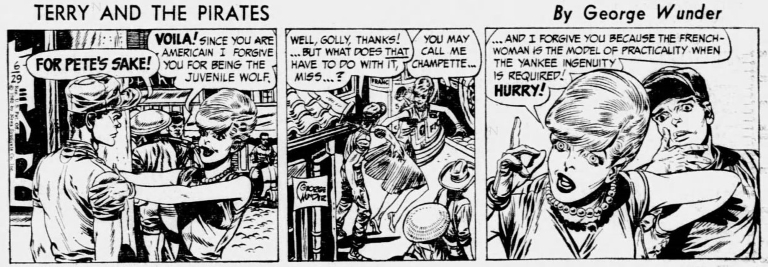
Beside the above mentioned Secret Agent Corrigan Evans was a longtime ghost for the daily Terry and the Pirates during the 1960s and into the 1970s. He was also briefly one of the ghost artists on the Dan Flagg comic strip and ghost wrote a couple Rip Kirby episodes in the first half of the 1980s. He was given credit for a Flash Gordon Sunday.
Crockett Johnson (1906–1975)
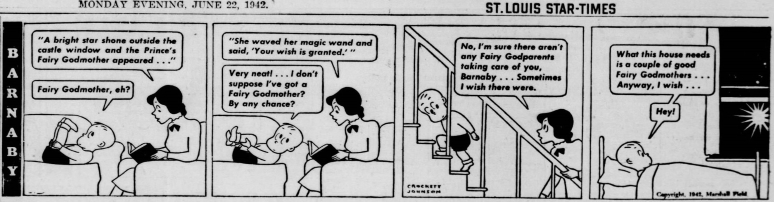
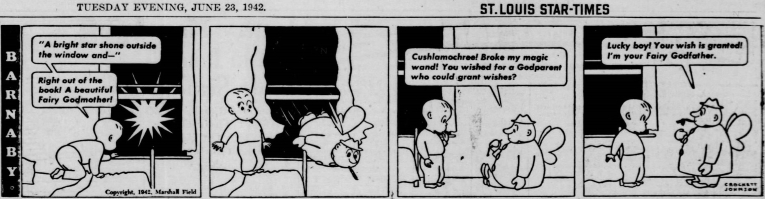
Crockett Johnson achieved lasting comic strip industry fame when he created the enormously popular syndicated strip “Barnaby” in 1941. It lasted 21 years and was adapted for a book, a play, television, and radio. In 1940 Johnson married children’s author Ruth Krauss, with whom he would collaborate on four children’s books. He wrote and illustrated Harold and the Purple Crayon, a critically acclaimed story of an imaginative boy who draws fantastic landscapes with his crayon, in 1955. Harold enjoyed further adventures in six sequels between 1956 and 1963, as well as being adapted for animated films and television.
Johnson would also do Barkis and Family, a daily panel, in 1955.
Crockett Johnson’s Barnaby is, at least for the first few years, universally recognized as comic strip genius.


Peter Kuper (1958– )
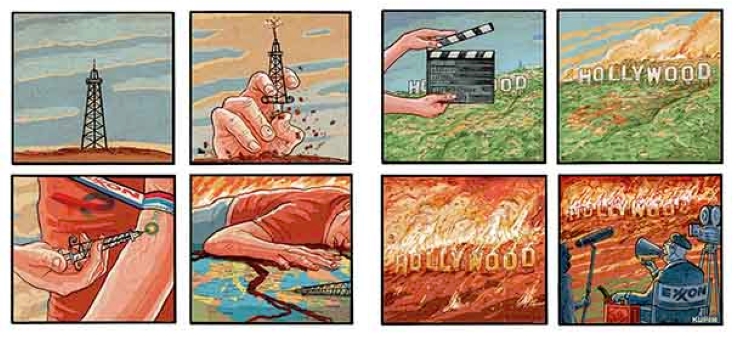
Peter Kuper has been a regular contributor to The New Yorker, The Nation, and MAD magazine, where he wrote and drew “SPY vs. SPY” every issue from 1997 to 2022. His “Eye of the Beholder” was the first comic strip to ever regularly appear in the New York Times. He is the co-founder and editor of World War 3 Illustrated, a political graphics magazine that has given a forum to political artists for over 40 years. He has produced over two dozen books, including The System, Diario de Oaxaca, Ruins, and adaptations of many of Franz Kafka’s works into comics. His latest graphic novel is Insectopolis, a graphic novel on the history of insects.

George McManus (1884–1954)
George McManus dropped out of school at age 15 and started working at the St. Louis Republic. This newspaper published his first comic, “Alma and Oliver.” In 1904, he moved to New York and was employed by the New York World, where he worked on several strips, including “The Newlyweds,” about an elegant young couple and their baby, Snookums. This series, the first family strip in an American newspaper, became quite popular and caused rival newspaper The New York American to invite McManus to work for them, which he did from 1912 on. He continued “The Newlyweds” and started up several other daily comics, most notably “Bringing Up Father.” This comic about an Irish immigrant worker, Jiggs, and his wife Maggie, inspired several movies—in four of them, McManus himself played the role of Jiggs. McManus influenced a great number of artists, including Herge and Joost Swarte.
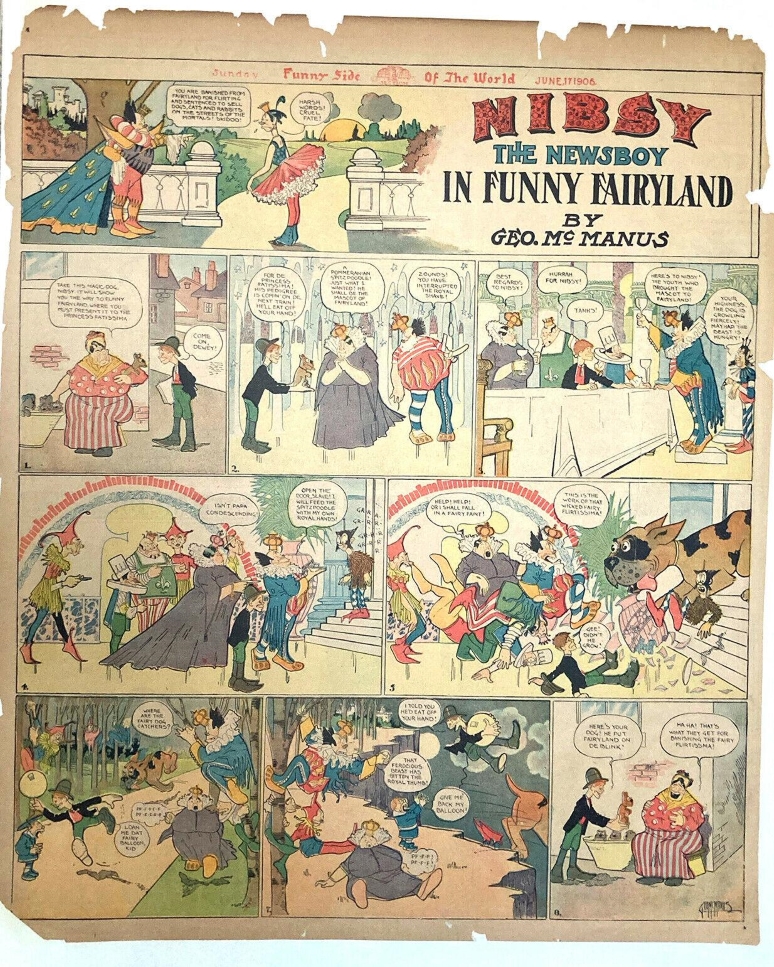
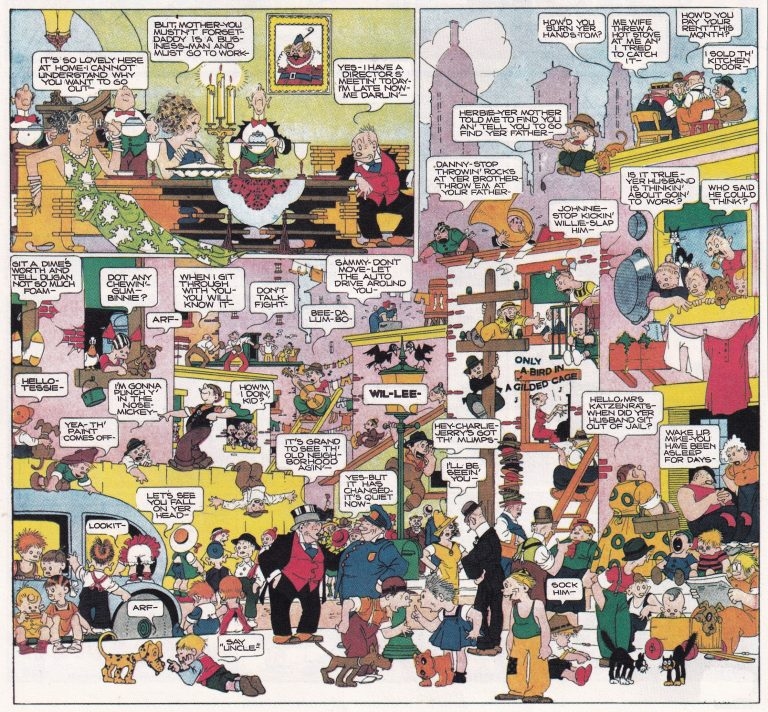
Allan Holtz lists three dozen comic strips by George McManus including Let George Do It, Nibsy the Newsboy in Funny Fairyland, Rosie’s Beau, Panhandle Pete, Spareribs and Gravy, Their Only Child, The Whole Blooming Family and more. His main claim to fame was the very popular Bringing Up Father and when he (and brother Charles and art assistant Zeke Zekley) took Maggie and Jiggs on a tour of America it was an illustrative tour de force.

Posy Simmonds (1945– )
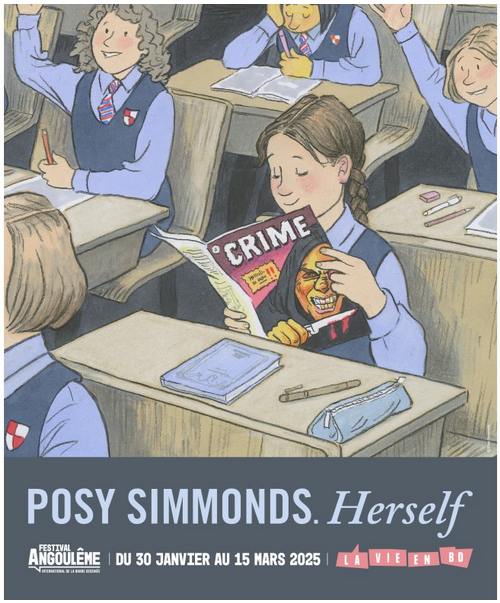
British cartoonist Rosemary Elizabeth “Posy” Simmonds has managed to make her mark in the graphic novel publishing world by reinventing classic literature into illustrated novels for adults. She is best known for her long association with London’s The Guardian, where she serialized Gemma Bovery (2000; made into a film in 2014) and Tamara Drewe (2005–2006; made into a film in 2010) before their publication in book form. In 1987, she began to write and illustrate children’s books, creating such works as Lulu and the Flying Babies (1988) and Fred (1987), the film version of which was nominated for an Oscar. She was made a Member of the British Empire in 2002 for her services to the newspaper industry, and she received the Grand Prix de la ville d’Angoulême in 2024.

Jeff Smith (1960– )
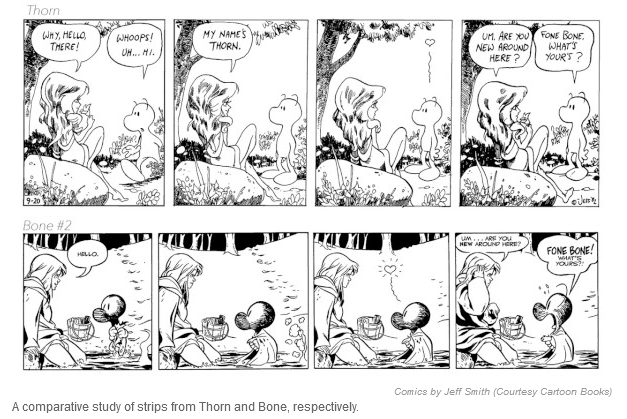
Jeff Smith is the creator of the award-winning comic book series Bone. He and his wife Vijaya Iyer established Cartoon Books in 1991 to self-publish the series. Jeff was a pioneer in comics publishing for kids when Bone launched Scholastic’s graphic novel imprint Graphix Books in 2005. Smith’s other award-winning and acclaimed comics include SHAZAM! The Monster Society of Evil, RASL, Little Mouse Gets Ready!, ROSE, and Bone: Tall Tales. His most recent project, TUKI, ran as a webcomic series from 2013 to 2016, followed by two graphic novels. In 2015 Jeff helped found the annual Cartoon Crossroads Columbus festival.

Leonard Starr (1925–2015)
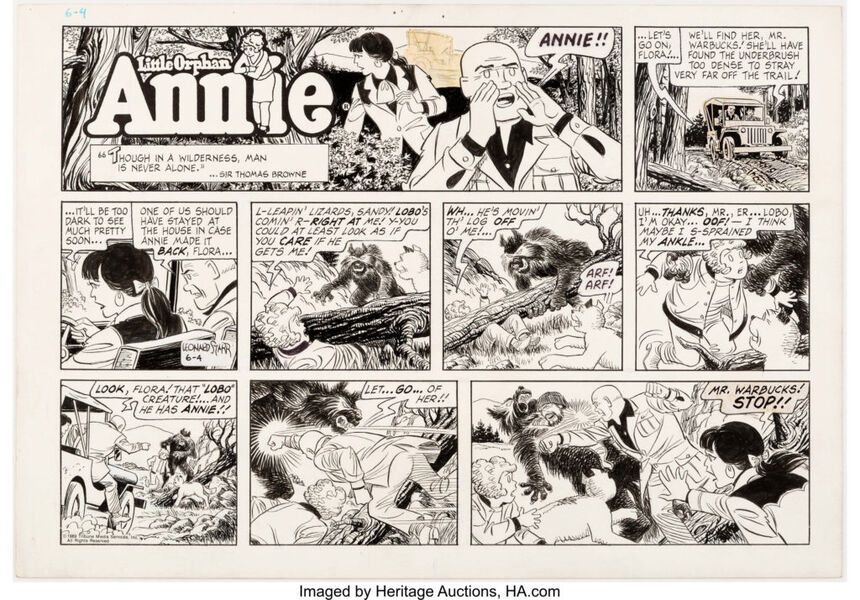
Leonard Starr began his career in the early 1940s Golden Age of comic books, drawing Sub-Mariner and Human Torch stories for Timely and Don Winslow stories for Fawcett. He also worked for a variety of other publishers, including Better Publications, Consolidated Book, Croyden Publications, E. R. Ross Publishing, Hillman Periodicals, and Crestwood. His first work for newspapers was ghosting the Flash Gordon strip for King Features in the mid-1950s. His own strip, Mary Perkins On Stage, began via the Chicago Tribune–New York News Syndicate in 1957; he drew it until 1979. He was then hired by the same syndicate to revive the Little Orphan Annie strip, which he wrote and drew until his retirement in 2000. He also, in tandem with fellow strip artist Stan Drake, created a series of popular graphic novels named for their title character, Kelly Green.
In addition Starr wrote the Winnie Winkle strip during the Frank Bolle years and he wrote for Bolle the last Rip Kirby story. Starr art assisted on occasion the Flash Gordon comic strip during 1955-1956
Chris Ware (1967– )
Known for his New Yorker magazine covers, award-winning cartoonist Chris Ware is hailed as a master of the comics artform. His complex graphic novels tell stories about people in suburban Midwestern neighborhoods, poignantly reflecting on the role memory plays in constructing identity. Stories featuring many of Ware’s protagonists—Quimby the Mouse, Rusty Brown, and Jimmy Corrigan—often first appeared in serialized form, in publications such as The New York Times, the Guardian, or Ware’s own ongoing comic book series Acme Novelty Library, before being organized into their own stand-alone books. His work has appeared in many national and international art exhibits, including solo exhibitions at the Gavle Kunstcentrum in Sweden, the Centre Pompidou in Paris, and as part of the Masters of American Comics traveling exhibit.
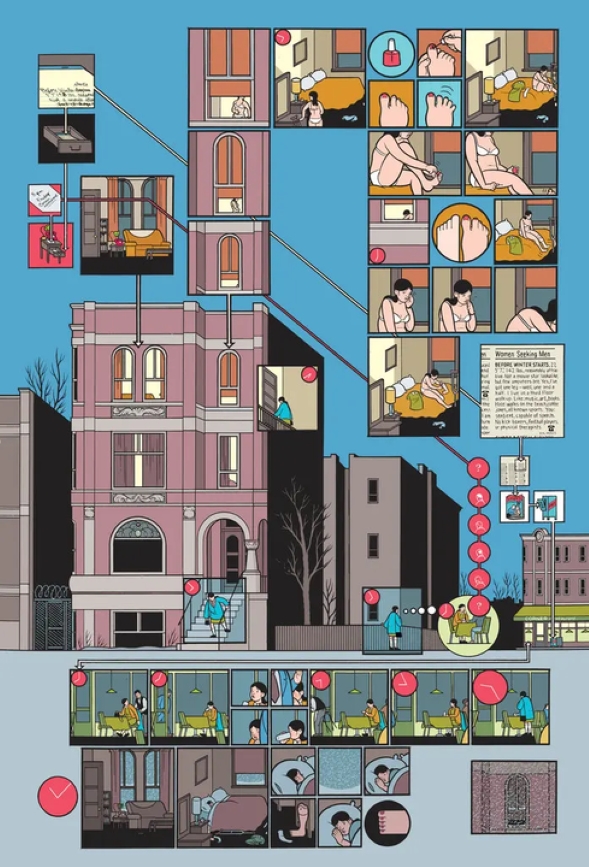
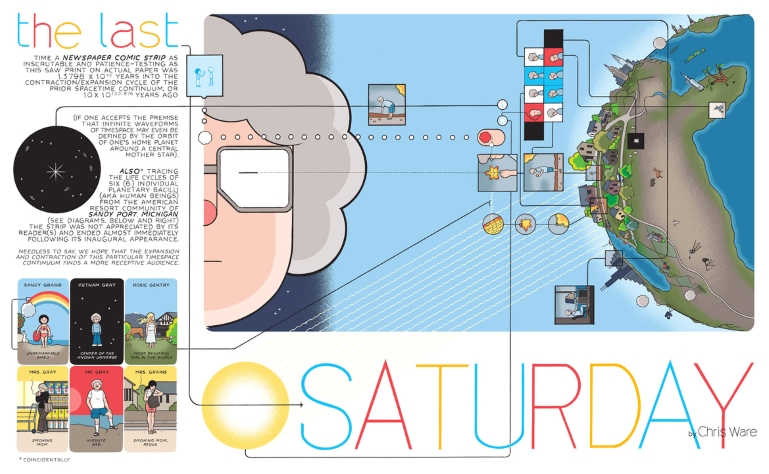
Chris Ware’s Building Stories started as a Sunday newspaper comic strip running from September 18, 2005 to April 16, 2006 in The New York Times Magazine. In the following decade Ware’s The Last Saturday ran as a weekly comic in The Guardian from September 13, 2014 to September 25, 2015.

Comments 2
Comments are closed.