CSotD: Vox Populi and Other Delusions
Skip to comments
Nor should we listen to those who say “The voice of the people is the voice of God,” for the
turbulence of the mob is always close to insanity. — Alcuin to Charlemagne, 798 AD
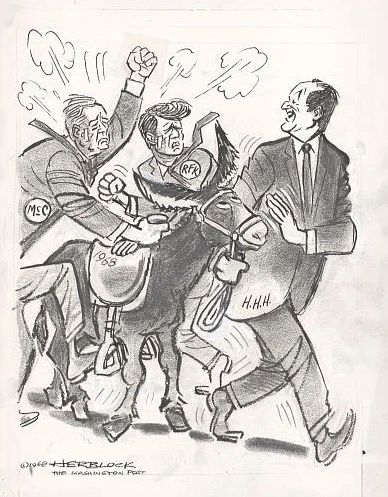
“Friends, I want to remove any cause for contention
between you two fine fellow-Democrats”
Herblock
I missed getting to vote in 1968, because although I was 18, the 26th Amendment wasn’t ratified until 1971, by which time I was 21 anyway.
I suppose I’d have voted for Humphrey because he wasn’t Nixon, but he also wasn’t Gene McCarthy, who had the most primary wins and he sure wasn’t Bobby, murdered just after winning the California Primary and possibly securing the nomination himself.
I’d done a little envelope-stuffing for Gene but my loyalties shifted to Bobby by the time he was killed, and I’ve long suspected that he’d have won the nomination in Chicago, given that Hizzoner had a soft spot for Kennedys.
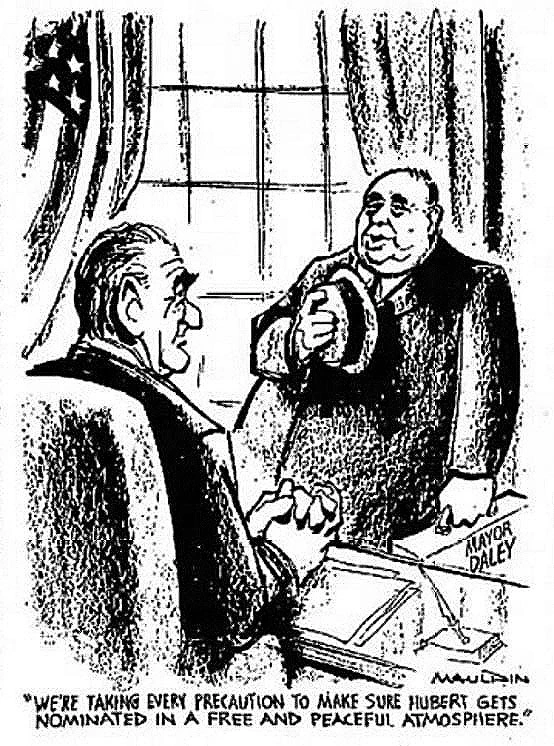
By the convention, it was clear that anyone who had gone Clean For Gene had wasted the effort, because the party was going to pick the candidate and it sure wasn’t going to be Eugene McCarthy.
That was the last time the Democrats chose their nominee in a smoke-filled room. After that, the primary system went from advisory to definitive, which was how George McGovern gained the nomination in 1972.
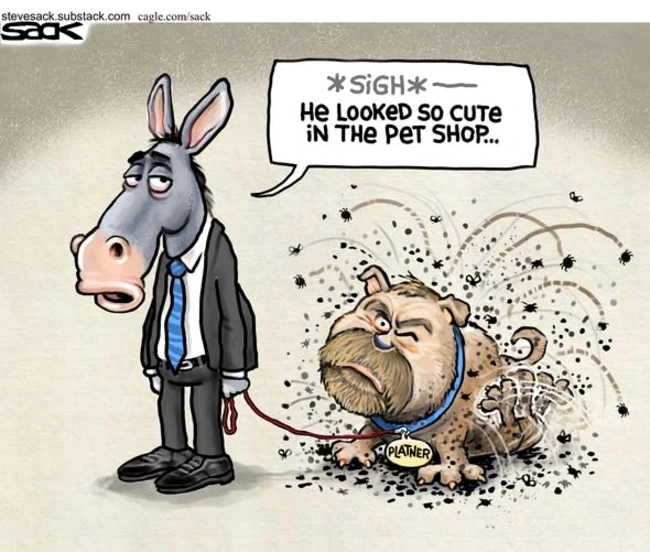
So anyway, Graham Platner dropped out of the Senate race in Maine last night, after leaving the Democrats, as Sack depicts it, disillusioned by what had seemed like a good candidate.
I should offer a disclaimer: When I was an editor in Maine, the first person I met was Janet Mills, who took me to breakfast and filled me in on who was who and what was what in Farmington, then remained a solid contact. And while I greatly admired Olympia Snowe, I only got to spend one afternoon hanging out with her. Susan Collins was the Senator who dropped by regularly and with whom I had a warm relationship.
Journalists don’t have friends, but they do find some sources more cordial than others.
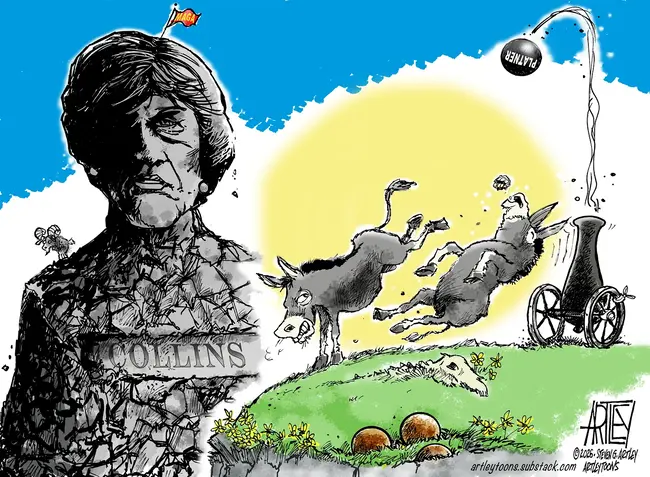
However, Collins took a strong slitch to the right shortly after I left Maine and I was hoping to see her step down, but Artley encapsulates the result of the Platner nomination and fall from grace. His depiction of Collins as a monument is accurate: She and Platner had been locked in polls that were — given the margin of error — tied.
He also does a nice job of showing the self-destructive result of the Democrats having nominated, and then rejected, Platner. It doesn’t seem likely that Mills will be the replacement on the ticket, given that Platner had trounced her in the primary, and assuming the party chooses their nominee — they’ve hardly got time to ask the voters — it’s likely to be former state Senate President Troy Jackson.
Platner is an oyster farmer, Jackson is a logger, so they’d retain the blue-collar aspect as well as potential support from Bernie Sanders. But given how close the race was anyway, this last-minute switch has a strong whiff of the recent presidential race, and whoever gets the nod will have to hit the ground better than Kamala Harris did.
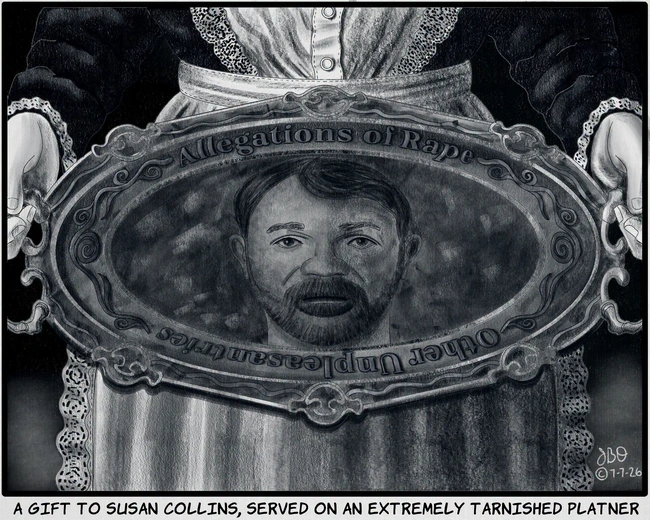
Ostrove sums things up, because Platner had seemed like a solid, popular nominee. There’s some question over whether his past behavior came to the surface by actual process of former girlfriends spontaneously stepping forward or though a concerted effort by the opposition, but there’s no doubt that he had a lot of skeletons in his closet and he wasn’t transparent in dealing with them.
Which brings us back to Alcuin‘s warning to Charlemagne, because Platner was indeed a bright shiny object that quickly tarnished, and while it sounds good to buck the party system, perhaps you need to start doing so at the state level and let people get to really know you before you swing for the fences and try to capture a seat in the US Senate.
Or, to adopt an old-fashioned technique, let the primary be advisory, but leave the final choice to the pros in their smoke-filled room.
Second disclosure: I was a Muskie fan in ’72 and was horrified when the primary system produced McGovern. In the words of Leo Durocher, nice guys finish last, and McGovern was one helluva nice guy. I don’t think little Donald Segretti would have bothered to jam a stick in Muskie’s wheel if the voice of the people wasn’t going to make the choice.
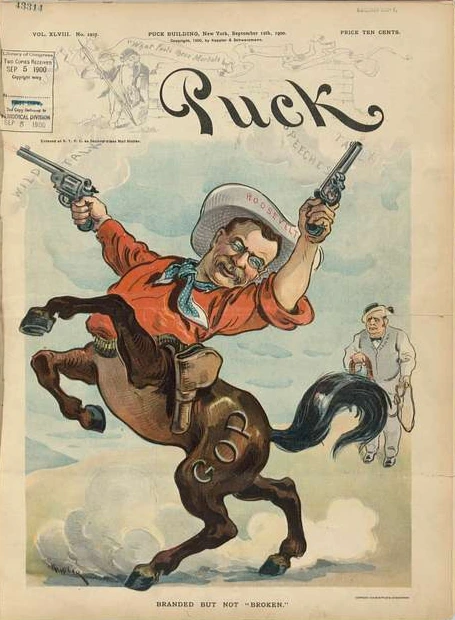
Not that the smoke-filled room is a flawless system, mind you. Remember that the Republicans made Theodore Roosevelt McKinley’s vice-president because, as governor of New York, he kept introducing reforms and they wanted to bury him in a position where he couldn’t do that anymore, yielding, upon the assassination of McKinley, the immortal phrase “Now look! That damn cowboy is president of the United States.”
And thus the Gilded Age gave way to the Progressive Era. Sometimes even a flawed system works out for the better.
Juxtaposition of the Day
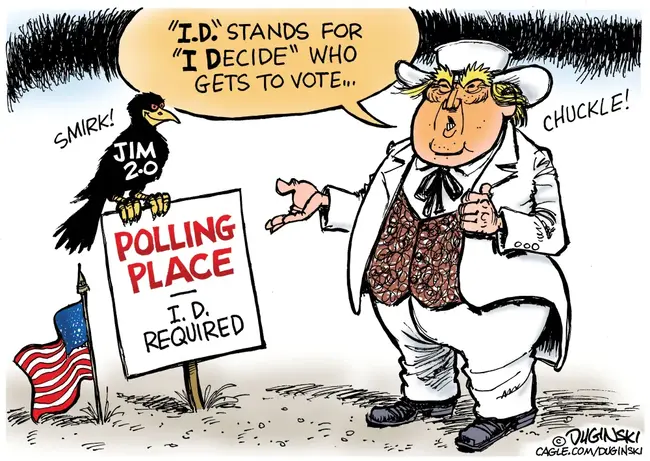

However you feel about the value of binding primaries vs advisory primaries, however, it’s important to keep the actual, final decision in the hands of We, the People, and there is a solid and frightening effort being made to undermine that bedrock American tradition.
Having lost in the attempt to cancel validation of the 2020 election by force and violence, Dear Leader is working to get ahead of things by gaining federal control of voting through the Save Act. He’s already persuaded several state governments to submit their voter rolls for approval and is in the midst of getting the US Postal Service to monkey with mail-in ballots and control whose votes are delivered and whose are quietly rejected.
And if you’re unhappy with what the Graham Platner debacle does to the Democrats’ chance of capturing the Senate, picture how the midterms will turn out if the entire state of Ohio, for instance, is brought under Dear Leader’s thumb.
Here’s a terrifying look at what could happen, from Miles Taylor, who is in a position to know things you don’t want to hear about.
But probably should.
Mike Peterson has posted his "Comic Strip of the Day" column every day since 2010. His opinions are his own, but we welcome comments either agreeing or in opposition.

Comments 17
Comments are closed.