Comic Strips Magazine cartoons

Meet the Kichels

From Abie the Agent and Nize Baby to Edge City and Pajama Diaries Jewish families have been a part of the funny pages. Now meet The Kichels.

The Kichels by Bracha Stein and Chani Judowitz

From Steve Lipman and The Times of Israel.

“The Kichels” is a comic strip that began as a three-month experiment, and will mark its tenth anniversary next year.  Centered around the day-to-day exploits of a purportedly typical haredi (aka “ultra-Orthodox”) family (the Kichel mishpacha) and the members’ extended circle of friends (and rabbis, neighbors, camp counselors, etc.), it appears weekly on the back page of Mishpacha, a popular magazine that caters to rigidly-Orthodox-but-not-chasidic readers.

The Kichels is the creation of writer Bracha Stein (it’s a pen name), who lives in Jerusalem, and artist Chani Judowitz, a resident of Lakewood, NJ; both are members of Orthodox Judaism’s “litvish” yeshiva-oriented community – the real-life “Kichels” are their friends and fellow congregants. Hence, The Kichels combines both an insider’s knowledge and an outsider’s irreverent perspective on Orthodox actions.

In less than a decade, The Kichels has become a must-read institution, a barometer, for a large part of the Orthodox community, of how its men and women and children operate.

Mishpacha magazine managing editor Shoshana Friedman thought of the idea and partnered strangers writer Bracha Stein and cartoonist Chani Judowitz to create the weekly comic strip.
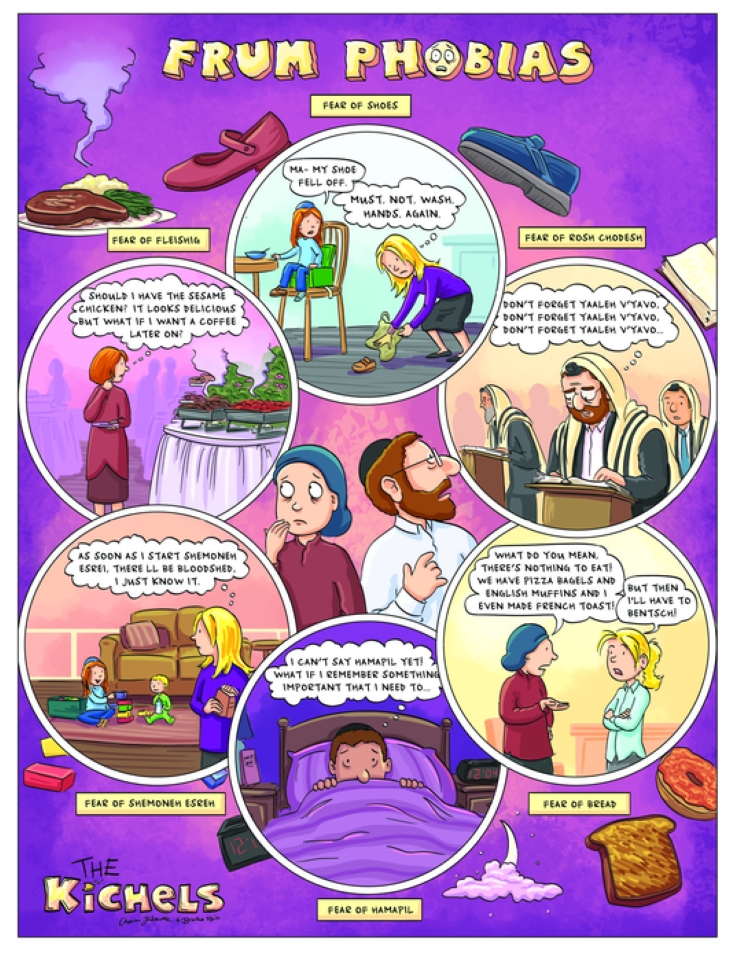
The Kichels by Bracha Stein and Chani Judowitz

Steve Lipman continues:

The Kichels (based in an unnamed, generic heavily Jewish U.S. neighborhood, presumed to be Flatbush, Brooklyn) clearly serves a niche community – the English-speaking “yeshivishe – Litvish” (largely non-chasidic) crowd that reads magazines like Mishpacha and Ami. These readers understand the lifestyle and nuances and “Yinglish” language of the strip’s characters, and share their concern about such topics as shidduch procedures, frum one-upmanship and one-upwomanship, and prestigious yichus.

The Kichels have their own website with selected comic strip pages and more background.

Mr Lipman’s look at The Kichels includes a review of Jewish satire in comics and prose.

Previous Post
CSotD: Mother of Exiles Sees Her Door Slammed Shut
Next Post
CSotD: Sunday Will Often Be The Same

Comments 10

    1. Are you familiar with “ethnic media”? That’s how it works; any group that’s big enough to have its own interests is big enough to have its own media.

      1. I think this reads as ruder than I meant it. Sorry. And sorry for spamming the comments.

    2. Sorry, hit wrong button

  1. It’s impressive that a comic with such a narrow target audience has managed to sustain itself for so long. Although it’s not necessary to have “insider” knowledge to get all of the jokes, most of them do require a certain amount of familiarity with Jewish customs and precepts.

    1. It’s called ethnic media.

  2. Translations of Yiddish and Hebrew words. No idea if they will help. Just want to help any Gentiles reading the Times of Israel article or the Kichels archives.
    Kichel (the name of the family) is a type of cracker. The “ch” makes the same sound as in Loch or Bach. All the “ch”s in Hebrew or Yiddish make that sound. There is no ch-as-in-cheese in Hebrew. There is in Yiddish, but then you use the German spelling of “tsch” or “tch.”
    Mishpacha (the name of the magazine) is Hebrew for family (also spelled “mishpaḥa” in English).
    The major Jewish denominations in the US are Orthodox, Reform, and Conservative. The Orthodox adhere strictly to halacha (Jewish ritual law as developed in the Bible, and Talmud and mediæval and modern authorities). The Reform reject most laws outside of those considered “religious” in a modern, Western sense. The Conservative follow Jewish law but are more lenient in application than the Orthodox.
    Orthodox Jews in the United States can be divided based on level of acculturation into Modern (most), Yeshivish (less), and Ḥasidish/chasidic (least). It’s more complicated, but I guess that’ll do. The Yeshivish and Chassidish are often lumped together as “Ḥaredi” though that’s really a term used in Israel for the members of those communities, who reject the legitimacy of the modern State on religious grounds.

    Frum Phobias explained, clockwise from the top: Again, no idea if they will help. Frum is Yiddish for religious.
    Jewish law requires handwashing after touching shoes and other things. Lots of handwashing.
    Rosh Chodesh/Ḥodesh is the first day of the Jewish month and a minor festival. An extra paragraph beginning “yaaleh v’yavo” is added to prayers; if forgotten, you must repeat it.
    Bentsch is Yiddish for “bless” (think benediction) and is used colloquially to mean saying the four-blessing Grace After Meals, which is reserved for bread and can take five minutes or more. After other foods, a single, shorter blessing is said.
    HaMapil is the blessing said before going to sleep. If you don’t go right to sleep, you’ve said a blessing with the Lord’s name in vain.
    Shemoneh Esreh is the 19-blessing prayer said thrice daily: morning, afternoon, and evening. Men go to the synagogue to pray with a quorum; women have no obligation to pray in a quorum.
    Fleishigs is Yiddish for “meaty” (think flesh) and is used to refer to a food that contains meat (or poultry), as well as a person who has eaten such recently. In addition to eating milk and meat together, Jewish law prohibits consuming anything dairy for up to six hours after eating meat.
    No idea if any of that helps. You can always try Wikipedia, Chabad.org, or (I guess) asking me.

    1. Ḥaredi, usually translated at Ultra-Orthodox, is Hebrew for “quake,” as in, those “who quake at the Lord’s word” (cf. Isaiah 66:2,5). Yes, the name “Quaker” comes from the same verse, but they are otherwise unrelated.

    2. Litvishe is Yiddish for Lithuanian, but is also used as a synonym for Yeshivish, as the Yeshiva movement started there.
      Yeshiva is Hebrew for academy, in this context referring to a post-secondary institution where men study Talmud and the Jewish law codes for 10-16 hours a day. The communities centered around these yeshivos are called “yeshivishe.”

  3. Frum Phobias – Have the sesame chicken. There’ll be non-dairy creamer for the coffee.

Comments are closed.

Search

Subscribe to our newsletter

Get a daily recap of the news posted each day.