Wayback Whensday – Origins of “Comic Strip”
Skip to comments
Cartoonist Don Simpson steps on a third rail of comics research – he criticizes esteemed comics historian David Kunzle‘s use of the phrase “comic strip” in Kunzle’s various pre-histories of the 20th century comics.
In “Kunzle’s Pre-History of Comics: But Is It Really? (A Snobbish 2014 Essay Reposted From Another Platform)” Simpson marks Kunzle’s bona fides:
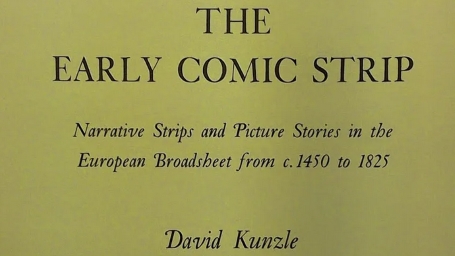
The scholar David Kunzle declared in 1973 that he was writing “a history or pre-history” of the modern newspaper comic strip. This enterprise has come to encompass a significant portion of his professional scholarship, including four major books with the term “comic strip” in the title: History of the Comic Strip, Volume I: The Early Comic Strip—Narrative Strips and Picture Stories in the European Broadsheet from c.1450 to 1825 (1973)[1]; The History of the Comic Strip, Volume II: The Nineteenth Century (1990)[2]; Rodolphe Töpffer: The Complete Comic Strips (2007)[3]; and Father of the Comic Strip: Rodolphe Töpffer (2007)[4].
Such a sizeable corpus of research and writing,[6] to say nothing of the publication of these sometimes cumbersome and profusely illustrated works, would be a worthy if not magisterial achievement for any scholar, particularly one working in such a pioneering area of graphic art as pre-twentieth-century printed picture stories.
Don Simpson’s objection comes from the use of the phrase “comic strip.”
However, the twentieth-century term “comic strip” figures prominently in each of the titles mentioned, and Kunzle in his own right has become considered a father of sorts to scholars of comics, and has had a surprising and unexpectedly substantial impact on the way comics are being perceived today.
So it may seem impertinent to ask: is Kunzle’s undeniable accomplishment really a history or pre-history of the comic strip? Does it do justice to the pre-twentieth-century material Kunzle studies to be considered primarily as comic strips or precursors to comic strips? What are Kunzle’s motivations for claiming the term “comic strip” as his rubric, and would his material have been better served by another term, such as “picture story”? What effect has Kunzle’s work, and his assimilation of his material to the modern comic strip, had on comics (both on its scholarship and the art form)? Would it be more productive, in fact, for comics scholars and artists to think, not of earlier graphic (printed) picture stories as latent comic strips (or comic books or graphic novels), but of comics as a particular formulation or solution to the problems presented by the graphic picture story?
A compelling discussion of when the “comic strip” term should be applied to the art form.
Don Simpson notes that:
An informal search Google N-Gram search and search of databases at my disposal suggests that the term comic strip did not emerge as a term of description for the American newspaper feature we now know by that name until probably the mid-1910s.
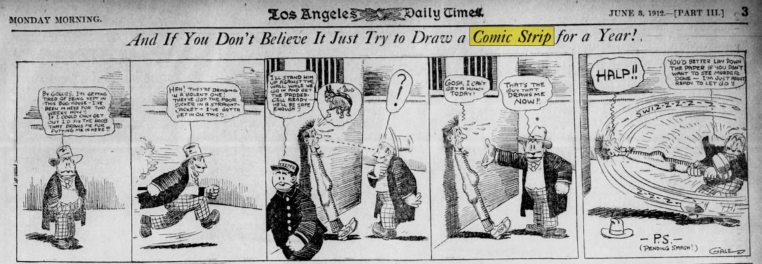
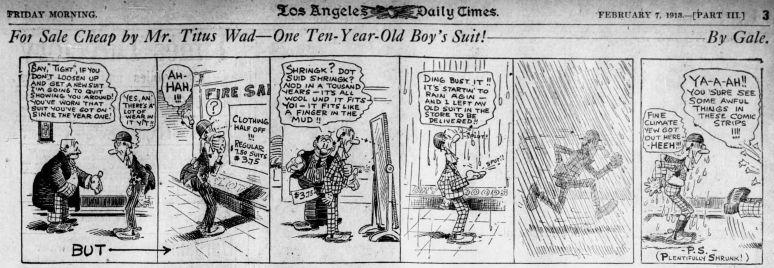
My newspaper.com search for the term in its modern usage confirms Simpson’s position. There was one use of the term in 1911 when The Los Angeles Times heralds the arrival of The Los Angeles Evening Herald noting “It has several comic strips.” 1912 finds a half dozen mentions including the Mr. Wad comic strip at the top of this page. 1913 has “comic strip” in a couple score of items, and after that its use explodes.
So why did David Kunzle use the “comic strip” term? Simpson speculates it was a marketing tool.
Kunzle seems to have made the pragmatic calculation that labeling his research on broadsheets and picture stories a “history or pre-history of the comic strip” would be of benefit to his scholarship both academically and in terms of landing a publisher for what was no doubt a prohibitively expensive undertaking.
Observing that:
[I]n the first half of the 1970s, the first of a new wave of comic-strip histories were beginning to appear, or were being readied for publication. These included Dick Lupoff and Don Thompson’s anecdotal anthology All in Color for a Dime (1970)[18]; Les Daniels’ Comix: A History of Comic Books in America (1971)[19]; Marvel artist Jim Steranko’s two-volume The Steranko History of Comics (1970, 1972)[20]; Arthur Asa Berger’s sociological study The Comic-Stripped American: What Dick Tracy, Blondie, Daddy Warbucks and Charlie Brown Tell Us About Ourselves (1973)[21]; and Jerry Robinson’s The Comics: An Illustrated History of Comic Strip Art (1974)[22]. Kunzle may even had been aware of Maurice Horn’s The World Encyclopedia of Comics (1976), then in preparation.[23]


Comments 1
Comments are closed.