A Saturday Sojourn Among the Comic Strips
Skip to comments
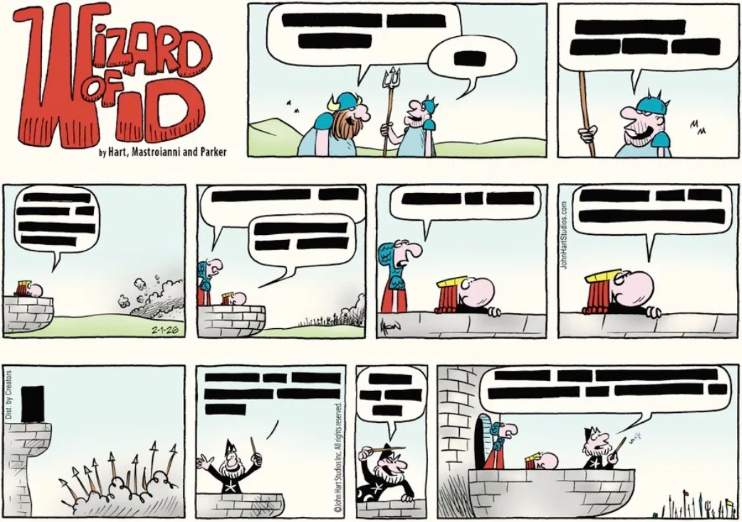
Last Sunday’s Wizard of Id became the topic of an Arkansas Democrat Gazette editorial (or here):
This past weekend, The Wizard of Id got political. Or not.
You might have seen the strip Sunday–a whole strip dedicated to . . .
We’re not sure.
What was it trying to say?
Epstein!
… was some folks’ guess, in places on the Internet where we were directed. It was, surely, the creator’s mocking of the United States Department of Justice and its redactions when it released the last chapter of the Epstein files!
Phooey, say others. This was obviously a shot at comic censors who are forever messing with the art of comics and their creators. You know, the censor guy from “Pearls Before Swine” must have invaded Id…
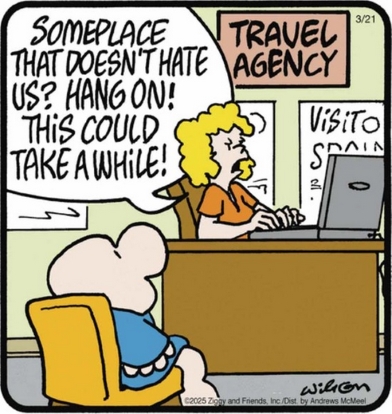
On a related note ATvolunteer at Daily Kos discusses the growing politicization of the funny pages.
What intrigues me now is how that several strips with almost no history of political content have recently begun to pay attention to the outrageously bizarre behavior of what passes as our government. Stepping outside of their lane, strips such as Ziggy and Frank and Earnest have published strips with content that is unmistakably political. What pleasantly surprised me last weekend was that Wizard of Id has joined the ranks of nonpolitical cartoonists who have come together to say “Enough!”
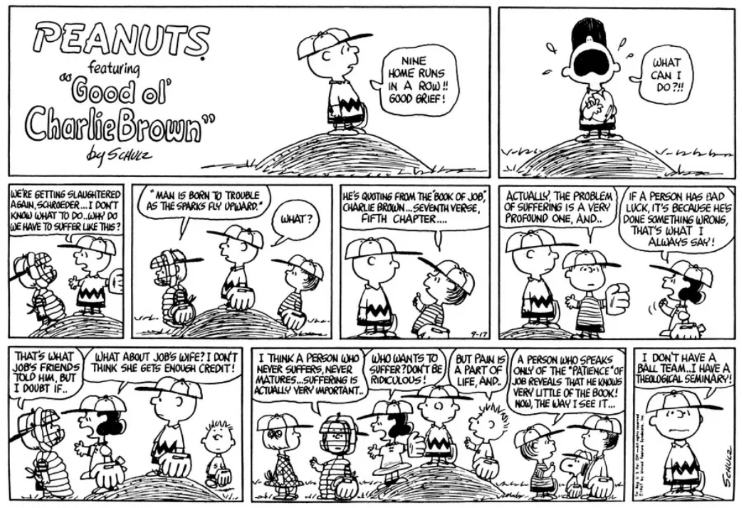
At Philosophy Now Tim Madigan ponders the philosophy of Peanuts.
Perhaps it’s not purely coincidental that Schulz – a man who was very learned in intellectual issues – began to be published at almost the same time as the philosophy known as Existentialism came into the American public’s consciousness. Michaelis quotes Schulz as saying: “I’m not a philosopher … I’m not that well-educated” (Michaelis, Schulz and Peanuts: A Biography, p.394). But, as Shakespeare might say, Schulz doth protest too much. While ‘Peanuts’ was primarily a humorous ‘comic’, it was itself labeled as ‘existential’ from an early stage, as it dealt with such themes as loneliness, dread, contingency, and despair, all of which could be found in the works of such Existential thinkers as Søren Kierkegaard, Friedrich Nietzsche, Martin Heidegger, Simone de Beauvoir, and Albert Camus. In particular…
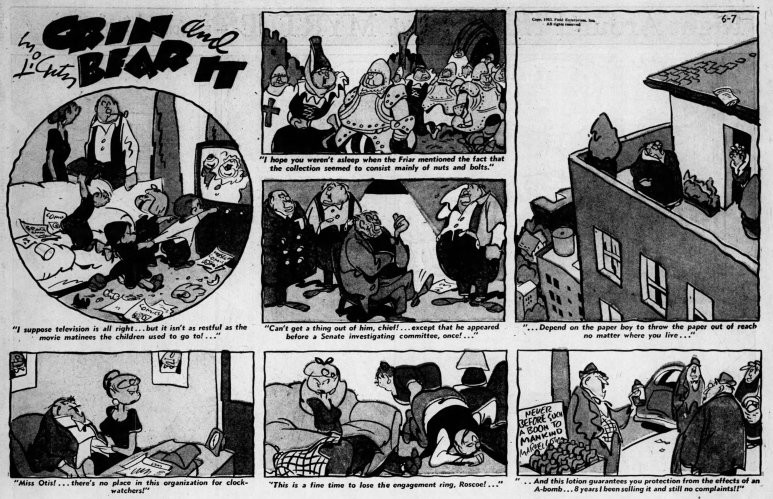
The Joplin Globe publishes Bill Caldwell’s appreciation of George Lichty and Grin and Bear It (or here).
Growing up, I always anticipated the upcoming Sunday funnies in the Globe. Some comics were stand-alone, and others had ongoing stories. The daily paper had its own set of comic strips, such as “Alley Oop,” “Li’l Abner” and “Andy Capp.” But what always surprised me were the one frame, stand-alone cartoons that appeared scattered in the paper, taking up space anywhere at the top, bottom or middle of the page. The one I remember most was “Grin and Bear It,” created by George Lichty. When I first became aware of it, I was curious about the humor. Then as I grew older, I could understand the satire his portly characters spouted. For 83 years, Lichty’s cartoon brought smiles to millions of readers.
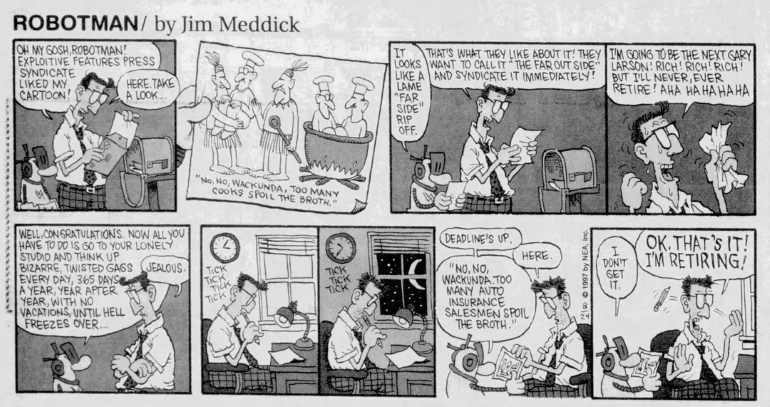
Over at the Comic Strip History Reddit site Auir2blaze runs a Robotman comic strip from 1997 in which Jim Meddick illustrates the travails of the daily syndicated cartoonist.
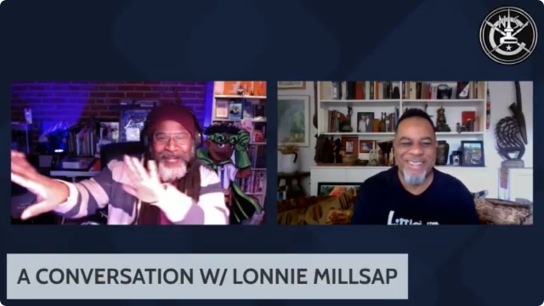

The National Cartoonists Society has dropped a few more NCS Studio Visits videos of Jamar Nicholas interviewing various cartoonists: Lonnie Millsap, Dee Fish, Nick Seluk, Mark Parisi, and John Kovaleski.
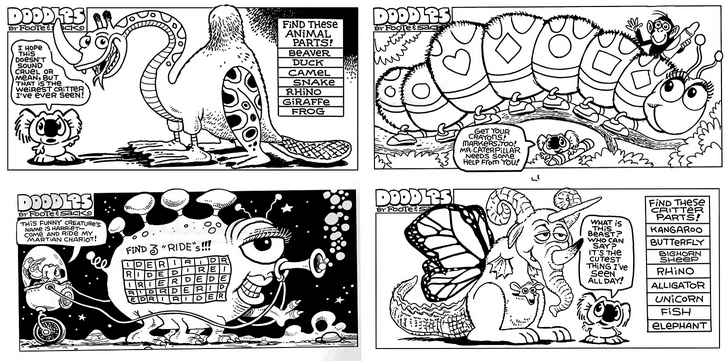
Forty years ago Steve Sack expanded his cartooning career with a non-political comic. On his The Art of Sack Substack he tells of the genesis of “Doodles, Monsters, and the World’s Worst Costume.”
Back in 1986, I started a children’s puzzle-and-activity feature for the Sunday funny pages with my friend—and genuinely great cartoonist—Craig MacIntosh.
It didn’t have much of a theme. Or really any theme.
The basic formula was this: I’d draw an animal, a monster, or an alien—whatever weird critter struck my fancy—then slap a word search, maze, or some other puzzle right in the middle of it. That was the whole deal. It gave us an excuse to draw funky creatures and, ta-da!, get paid for the pleasure.
The strip eventually became known as Doodles…


Comments 7
Comments are closed.