CSotD: Thursday Short Takes
Skip to comments
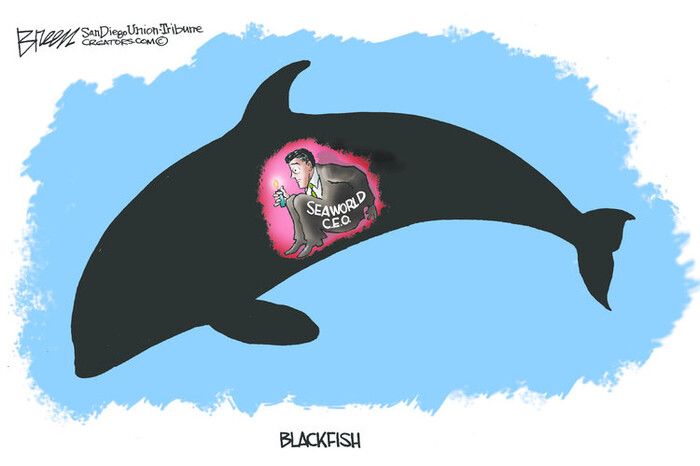
No theme today, just various things that struck me, and so let's start with the most various of them, which is Steve Breen's commentary on the resignation of SeaWorld's CEO.
Apparently, he'd been ruining his Armani suits by despondently scraping against the walls of his office.
I like the way SeaWorld explained this to stockholders:
With improving operating and financial performance trends along with substantial progress in enhancing the strategic positioning of the Company's mission-driven brand, the Company's Board of Directors and current President and Chief Executive Officer, Joel Manby, agreed that this is the right time to identify a new CEO as the Company enters its next phase of intensified focus on execution and growth.
Which is delightfully appropriate because they managed to cram all those insipid management buzz words into a single paragraph like sardines in a can.
Or marine mammals in a tank.
I have no pity for Manby, who came on board after the documentary Blackfish revealed the behind-the-scenes horror show.
Having public rejection of SeaWorld swallow him up is fine with me and I'd feel the same if he had taken the reins at a tobacco company promising to restore their profits.
Unlike a lot of SeaWorld critics, however, I'm not entirely against captive animals.
I am, however, against deliberate, unnecessary cruelty.
SeaWorld came along in 1964, when technology allowed them to do something they should not have done, which was to house orcas in close captivity.
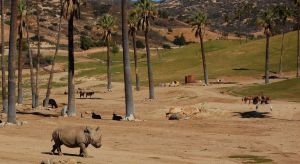 They were just on the wrong side of the cusp, since, in 1972, San Diego saw the opening of the San Diego Zoo Safari Park, an 1,800 acre facility that allows its animals to have more space and semi-natural habitat, a breakthrough in captive wild animals.
No, not perfection.
In the early 80s, I toured the Cheyenne Mountain Zoo with the director, who explained how they were trying to upgrade and transition from the old concrete-and-bars format to something more natural in appearance.
However, they didn't have 1,800 acres to play with and, he admitted, the creation of grass and tree display areas was for the comfort of visitors, not animals.
If the animals ever really got to live in a "natural setting," he said, you'd never see them.
The term for old-style zoological gardens is "postage stamp," for two reasons: One is the size of the cages, but the main one is the urge to collect one of everything, to take pride in variety rather than excellence, and, in the days before motion pictures, that was an appropriate goal: Let people see nature.
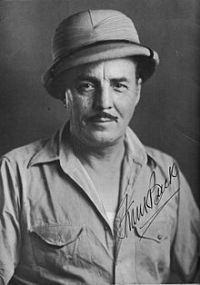 But the animals were not expected to enjoy long lives and, when one died, you wired Frank Buck or some similar "bring'em back alive" sahib to go out and get you another.
Those days are gone, not only because we're kinder and smarter but because there aren't that many specimens out in the wild to bring back and, in fact, the zoos have become genetic repositories, with animals like the Przewalski’s horse living only in zoos and reserves, and that, in large part, thanks to the zoos.
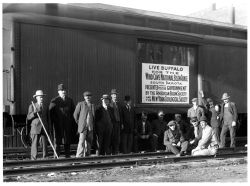 Which is one more jewel in Theodore Roosevelt's legacy: He was involved both in the founding of the Bronx Zoo, and in the transfer of bison from the zoo back to the Dakotas, where they helped rebuild the nearly extinct wild herd.
TR had some old-fashioned ideas about conservation, but also had the advantage of an active mind and a willingness to learn, so that, for instance, when he traveled to Yellowstone in 1903, he realized that eliminating predators not only failed to improve the deer and elk herds but actively and seriously damaged them.
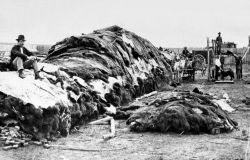 Which makes me less than sympathetic to the people who — more than half a century later — thought that sticking orcas in tanks and making them perform for crowds was a plan that could be justified in any way that slaughtering bison for their hides had not once been.
(Okay, that wasn't exactly a "short take." Rant mode off.)
Juxtaposition of the Day
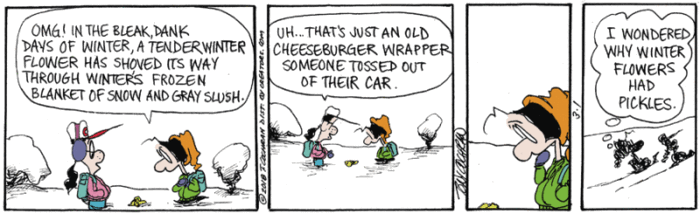 (Agnes)
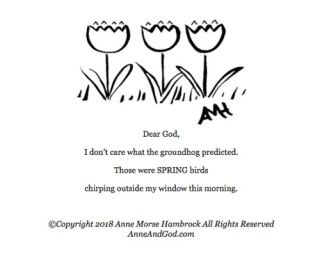 (
(The weather here as we start March has been very lamb-like, with temps reaching the 50s and 60s and a fair amount of mud, if not grass, exposed.
However, I am not fooled. It'll be back.
When I was a kid growing up in the Adirondacks, at the beginning of March we'd get these coloring pages in school that featured kids running across a field joyfully flying kites amid the flowers. And I'd look out the window and see two feet of snow.
They might as well have given us pictures of kids riding on dragons' backs.
We often went to my grandparents' house in Bethlehem, Pa., and the drive down was like a slowed-down version of Dorothy opening the cottage door into Oz: As we went, the snow receded, the grass came out, buds formed on the trees and, when we got to Grandma and Grandpa's house, there would be daffodils and tulips blooming, and crab apple blossoms just starting to pop.
The drive back was a bit less inspiring.
But it wasn't a dream. It was a place. And you and you and you…and you were there. But you couldn't have been could you? No, Aunt Em, this was a real truly live place and I remember it was in color, and about 30 degrees warmer …
And, finally …

Andy Marlette explains the Florida legislature's ultimate solution, blending all their gundamentalist fantasies into one.
The legislature ignored the pleas of the Parkland kids and passed a law that funds training for gun totin' teachers and even provides a $500 bonus for any teacher who takes the training and agrees to pack heat in the classroom.
Local schools can choose to pay for those $560 Glock 9 mm handguns, which I'm sure will be approved in the budget as readily as construction paper, tissues and pencils are.
An old sod's fancies lightly turn to thoughts of mating …
Mike Peterson has posted his "Comic Strip of the Day" column every day since 2010. His opinions are his own, but we welcome comments either agreeing or in opposition.
Comments 8
Comments are closed.