CSotD: Reading for meaning
Skip to comments
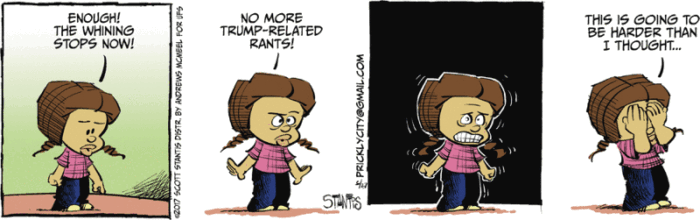
Poor Carmen, the conservative half of the Prickly City duo, has been undergoing a dark night of the soul since even before the elections, in the course of which Scott Stantis brought in a sympathetic Bernie Sanders character and Carmen wound up working for Gary Johnson.
Last week, she and Winslow, the liberal coyote, compared the current tribalism of our political scene to "Lord of the Flies," and today she begins an attempt to lower the heat without lowering her standards.
Tough mission.
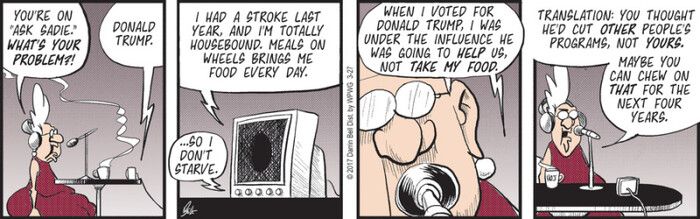
Over in Rudy Park, the talk-show hosting curmudgeon Sadie is less sympathetic to the idea of reconciliation, and her sharp response uses the "Meals on Wheels" controversey as much to rag on people who voted against their own interests as to address the actual topic of the budget.
I'm more aligned with Carmen and Winslow in that it's time to put away the pointy sticks and sit down to figure our way, if not off this desert island, at least to a way of co-existing until rescue arrives.
I have a friend who, as an avowed anti-socialist, insists that "Lord of the Flies" is a treatise on the evils of socialism.
I, having spent several summers at an eight-week boys' camp, insist that it is a reflection on human nature.
If Golding was writing a political parable, he sure clothed it in realism, to the extent that my willingness to compromise is this: He may have been speaking in metaphors, but it's just as valid to read the book as a more literal critique of why we ought not to let adolescent boys — or those who behave like them — run things.
And that is a compromise: I refuse to read "Animal Farm" as both a commentary on Stalinism and a description of how farm animals behave without supervision.
To which I would add this: For all the talk about how much our current situation reminds people of "1984," there are reasons to prefer "Lord of the Flies," starting with the fact that Orwell was not a great stylist and, whether or not you feel Golding deserved his Nobel, he certainly cobbled words together better and his book is a better read.
But, on perhaps a less snobbish level, "1984" shows only the end result, which, thank God, we have not reached and may never.
"Lord of the Flies" depicts the slide into barbarism, and, if we haven't killed poor Piggy yet, you can readily find our current spot on the continuum somewhere in the text and project things forward from there.
Basically, Orwell makes for better slogans, but Golding tells a more complete and chilling story.
A large part of the horror of "Lord of the Flies" is that Ralph has a solid moral sense but is eventually overwhelmed by the macho posturings of the bully, Jack, and — ironically — his gang of choirboys.
But had Jack's crewe, instead, been the school's rough-and-tumble rugby team, Golding would have tipped his hand too early and ruined the novel. If it were only the obvious bullies who so readily descend to such depths, they wouldn't be nearly as much a threat.
One thing that "Lord of the Flies," "Animal Farm" and "1984" have in common, along with "To Kill a Mockingbird" and other books often assigned as class reading for young people or for town-wide reading projects, is that you cannot possibly misinterpret them.
No reasonable reader could think that Jack is the hero of "Lord of the Flies" or that Winston Smith, indeed, is a reprobate who needs to be reined in for the good of society or that Tom Robinson should have been hanged without a fair trial.
Their value as art, however, is not in posing some abstract-but-universal moral truth but in the ability of the author to craft a story such that the intent is unmistakeable.
That's not necessarily a talent we would always praise.
The same could be said of "The Turner Diaries," and I promise you there are people who feel that that book, and the film "Birth of a Nation" are absolutely correct in their messages, thanks to the craft of their creators.
 And, as David Fitzsimmons points out, we are currently led by a man who cannot distinguish truth from fact, fact from nonsense, reporting from propaganda, or journalism from clickbait, and bases his judgment of information on whether it flatters and confirms his worldview.
A worldview gained, one might note, at an all-boys' residential school. And now he's the one holding the conch.
It's not a worldview you can simply reason away.
You cannot simply hand a fan of "The Turner Diaries" a copy of "To Kill A Mockingbird" and expect them to have some grand epiphany, anymore than Ralph could lure the choirboys away from Jack by offering his own plans for self-governance.
Nor, I would add, could a fan of "To Kill A Mockingbird" sit through a screening of "Birth of a Nation" without revulsion.
Which does argue in favor of Carmen's plan to withdraw from the divisiveness, except that it's pretty plain she won't be able to.
As Stantis himself wrote on his blog:
I get many emails and comments telling me that I need to back off from criticizing President Trump and give him a chance. What exactly does that mean? That I should just not comment at all if I disagree with what the president is doing? If so, for how long? A few months? A year? His entire term? That is ridiculous. You can’t sit back and ignore what is wrong in the name of ‘giving him a chance’.
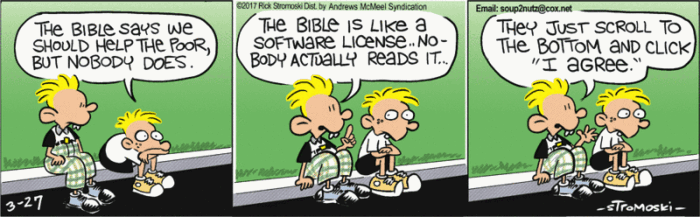
While others parse politics, Rick Stromoski goes instead for morality in today's Soup to Nutz, and hits the bull's eye.
It seems naive to banter over how people praise or reject contemporary literature when they are so willing to praise, ignore and misinterpret the classic book they nearly all claim to be the centerpiece of their morality.

Mike Peterson has posted his "Comic Strip of the Day" column every day since 2010. His opinions are his own, but we welcome comments either agreeing or in opposition.
Comments 5
Comments are closed.