CSotD: Cause and Effect
Skip to comments
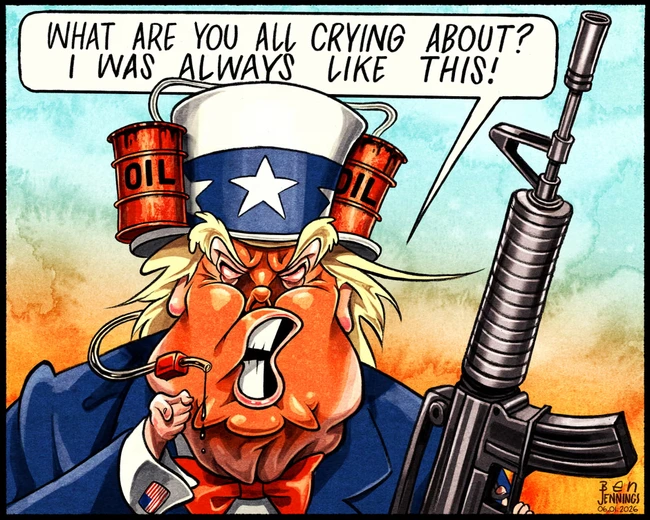
Jennings introduces today’s theme with what should be an obvious point, though perhaps it takes someone from outside the US (He’s British) to ask the question: Why all the surprise?
To be fair, this is how history works. There have been all sorts of dubious figures who have come to power, but nobody who suddenly, like Athena, burst fully grown and armored from the head of Zeus. Even Attila, who swept through Europe like a flame, did so slowly enough that the Pope had time to go forward and bargain with him on the outskirts of Rome.
Which is to say that, whatever you think of Donald Trump, his position at the head of the United States didn’t “just happen” and if you didn’t see it coming, well, that’s on you. We elected him. You can’t believe in democracy unless you accept that everybody owns the decisions made by the majority.
And however you feel about the Electoral College, Trump won the popular vote. The Pottery Barn doesn’t really have a rule of “You broke it, you pay for it,” but democracy does. Still, we should try to pick up the shards.
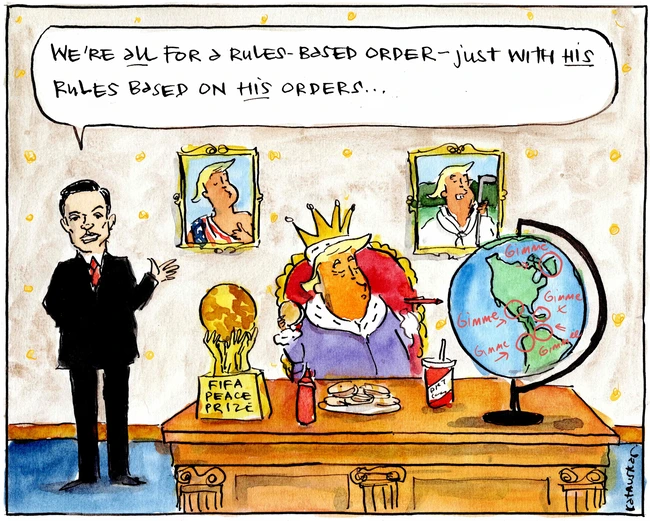
In another clear-eyed view from abroad, Katauskas lays out the situation Americans face: We are in the hands of a narcissist consumed with his own self-glorification and self-aggrandization. It’s easy to laugh at his FIFA Peace Prize as a ridiculous bribe, but they awarded it because that’s how obvious and empty his gullible vanity is.
It’s also easy to laugh at his fast-food diet, but you should ask yourself whether you consider it vulgar or proletarian or both, and how that speaks to your attitude towards commoners in a nation that is not supposed to have nobility.
A nation that eats at McDonald’s elected a TV star. Big Macs have been successfully marketed as part of a healthy diet and Donald Trump was successfully marketed as a business genius.
The fault is not in our stars, but in ourselves, and the marketing effort continues: Katauskas has Marco Rubio deliver the message, and it’s true that Trump, however unqualified and overmatched he is as a world leader, is surrounded by those who prop him up whatever their previous misgivings.
He is a con artist. He runs on this idea he is fighting for the little guy, but he has spent his entire career sticking it to the little guy — his entire career. … He’s going to Americans that are struggling, that are hurting, and he’s implying, ‘I’m fighting for you because I’m a tough guy.’ A tough guy? This guy inherited $200 million. He’s never faced any struggle.– Marco Rubio, February 2016
Juxtaposition of the Day
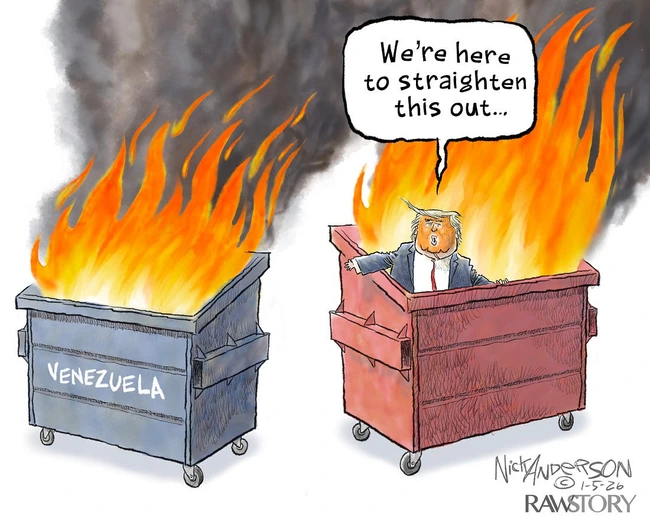
Anderson suggests that Trump has enough trouble dealing with the problems in his own country and has little business attempting to solve the problems in Venezuela. And nobody is doubting that Venezuela has plenty of problems, starting with a dictator who blatantly stole the last election.
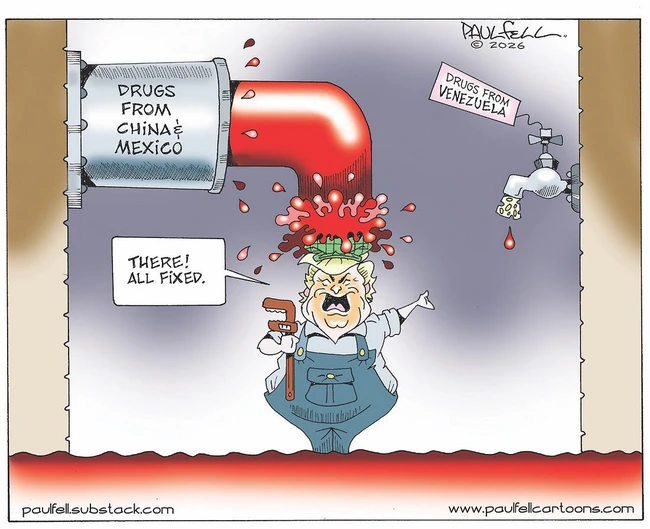
But production of fentanyl and smuggling of cocaine are not major issues with Venezuela, and yet, as Fell points out, Trump has managed to convince his loyal followers that he has moved to stem the flow of drugs into the United States despite it being a minor factor coming from that country.
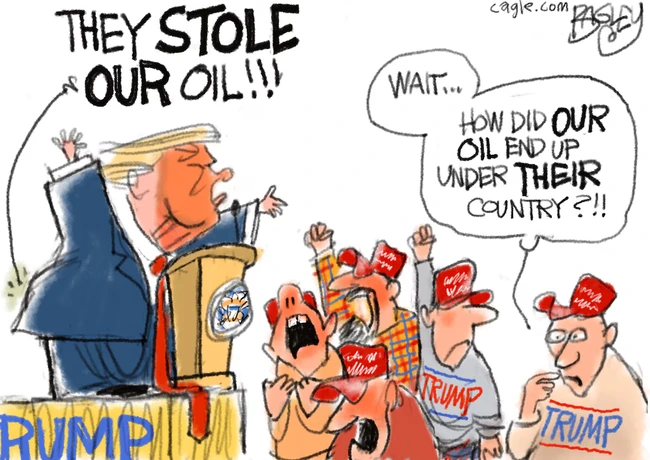
And if that story begins to fail, he can shift to misrepresenting the nationalization of Venezuela’s oil reserves under Hugo Chavez, a move in which American companies may have lost money and certainly lost access to future profits but were awarded billions in compensation. Was it a fair settlement? Not the point. The point is that we’re talking contracts and access; it was never “our” oil.
Bagley shows one of the MAGA faithful starting to question the point. This may be an overly optimistic depiction. As has been stated here before, the MAGA movement is based on loyalty, not logic.
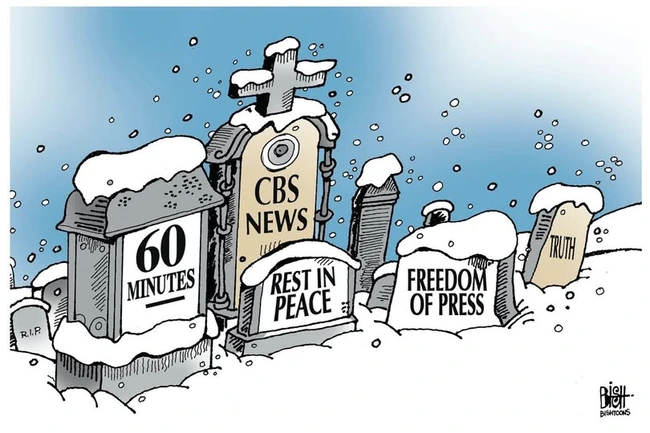
The rest of the conservative movement might well be reachable, but providing them with information is at risk. Trump was elected in a world that includes Fox News, Newsmax and other sources of purposefully skewed coverage, but now we’re seeing sources that were once mainstream being purchased and co-opted by partisan oligarchs.
Thankfully, the free press is not going down without a struggle, and this critique of the new CBS Evening News under Bari Weiss will at least raise a snicker among those hoping for better coverage.
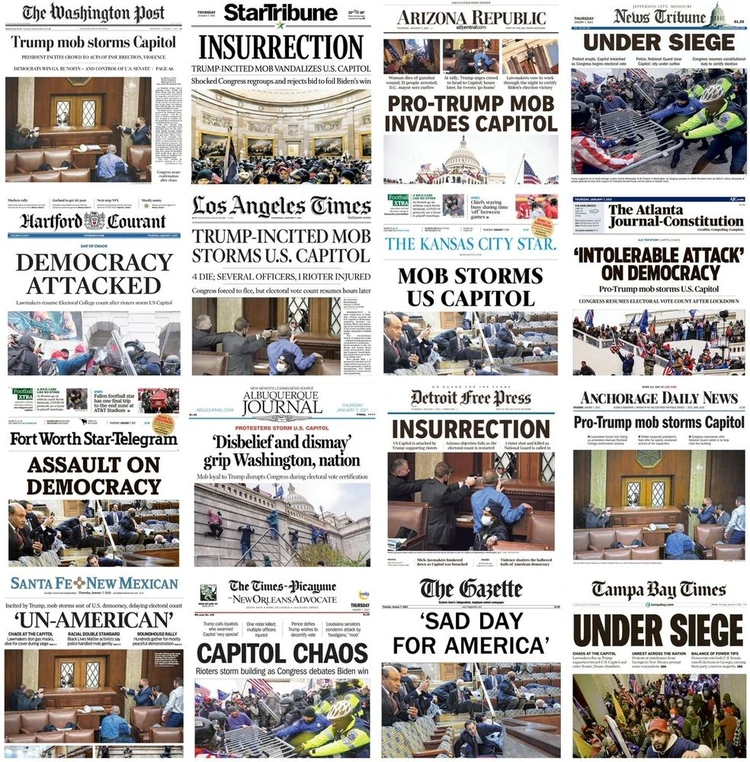
Today, however, we should mourn not just current assaults on democracy, but the cleansing of the record. Government files are being erased, but NPR is preserving its own evidence from Trump’s attempted coup.
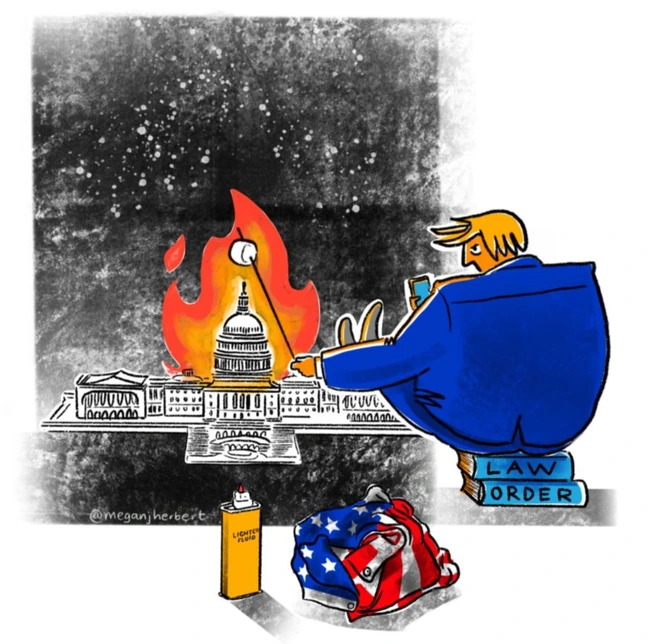
And Herbert re-ran this with the remark “Happy 5th anniversary to this cartoon I guess.”
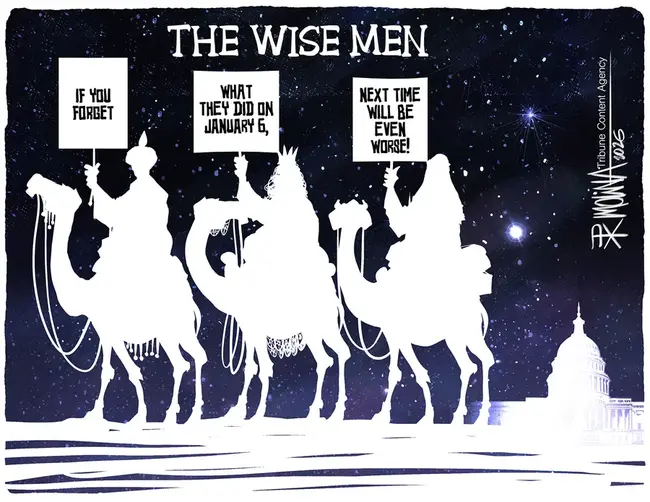
While Molina was more direct in his warning about those who forget the past.
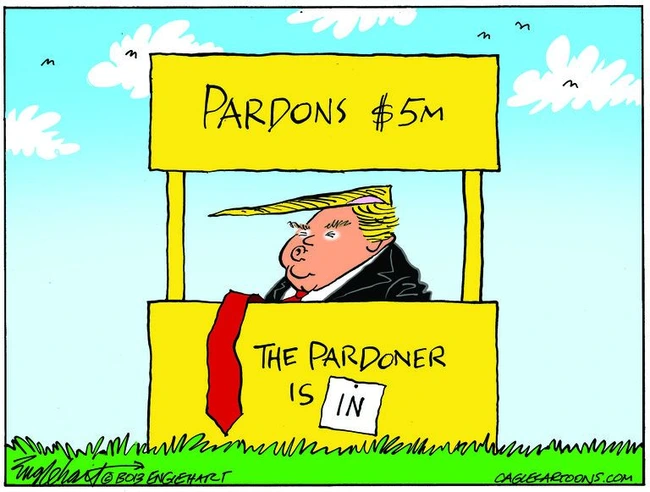
Those with memories will remember that more than 1,000 felons convicted for their actions in the attempted coup were pardoned by the man who Jack Smith testified had inspired them, nor is it the only time he has chosen to undo the work of our courts.
And while Trump invaded Venezuela to capture a head of state he links to drugs, he pardoned the head of Honduras who was legally convicted of smuggling hundreds of tons of cocaine into the US.
Not that he couldn’t explain it:
Trump: He was the president of the country, and they basically said he was a drug dealer because he was the president of the country. And they said it was a Biden administration set up. And I looked at the facts and I agreed with them.
Question: What evidence can you share that he was set up and that he wasn’t?
Trump: Well, you take a look. I mean, they could say that, uh, you take any country you want. If somebody sells drugs in that country, that doesn’t mean you arrest the president and put him in jail for the rest of his life.
I suppose it comes down to whether you believe Ralph Waldo Emmerson that “A foolish consistency is the hobgoblin of little minds” or Barbara Tuchman that “The only really detestable character in Chaucer’s company of Canterbury pilgrims is the Pardoner.”
Keep the faith. And your mojo.
Mike Peterson has posted his "Comic Strip of the Day" column every day since 2010. His opinions are his own, but we welcome comments either agreeing or in opposition.


Comments 16
Comments are closed.