All Santa Histories Eventually Hit on Thomas Nast
Skip to comments
The top tier of Jeff Mallett‘s treatise on Christmas traditions in today’s Frazz hits on the American Santa Claus as a long-standing part of Yuletide season, ending with Thomas Nast‘s personification of the elflord.


The Birth of a Holiday and the American Santa Claus
Yesterday Talmadge Boston for The Dallas Morning News told us the story of Christmas and Santa in America (or here).
When Lincoln was sworn in to his first term as president, only 18 states recognized the holiday. Lincoln biographer David Reynolds found that many Americans in the Northern part of the country in that era, especially New England’s Puritans, regarded Christmas as “a vestige of paganism that was not mentioned in the Bible,” which made them seek to suppress it as a holiday.
It was the Southerners who liked to enjoy Christmas with great festivity, Reynolds wrote.
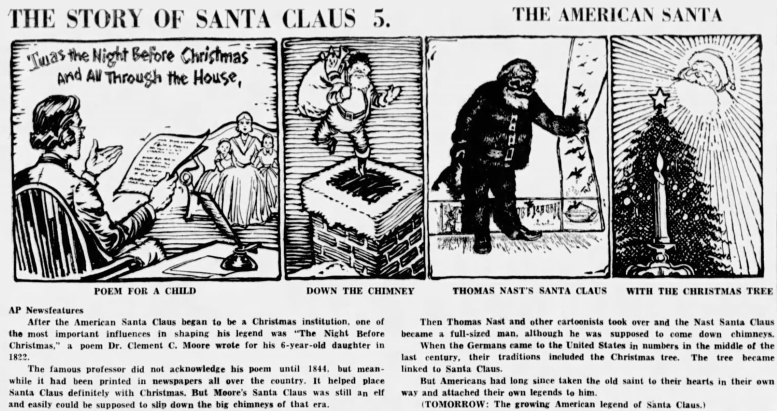
Though Clement Moore penned his famous poem “A Visit from St. Nicholas” (opening line: “’Twas the night before Christmas”) in 1823, and Charles Dickens released A Christmas Carol in 1843, they weren’t enough to create a national holiday.
And Santa Claus was not yet the icon he was to become.
Santa Claus was hardly the ubiquitous messenger of Christmas he is today. Before the Civil War, mentions of him were scarce and varied. Washington Irving’s 1809 satire, Knickerbocker’s History of New York, included a character named Nicholas flying in a wagon, delivering gifts to children. In 1821, a children’s book by William B. Gilley included a poem about “Santeclaus.” But the mythology hadn’t yet crystallized and images of the jolly fellow had not been widely used in print.
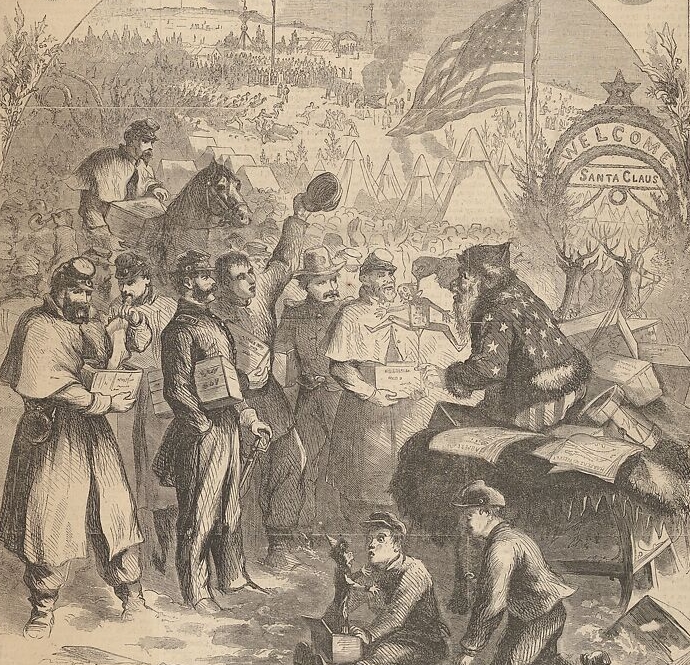
…Nast came through for the president in the Jan. 3, 1863, issue of Harper’s Weekly, with two powerhouse illustrations. For the journal’s cover, he titled his drawing “Santa Claus in Camp.” Santa sat on a sleigh, his face matching Moore’s description of St. Nick, but instead of being dressed in fur, he wore the Union flag’s stars and stripes. And the gift being delivered to Union soldiers was a puppet of Confederate President Jefferson Davis with a rope around its neck.
Nast would refine his Santa through the years coming up with “Merry Old Santa Claus” for the 1880 Christmas issue of Harper’s Weekly dated January 3, 1881, the definitive version shown in Frazz’s third panel.
But the American Santa has its origins in the Old Countries.
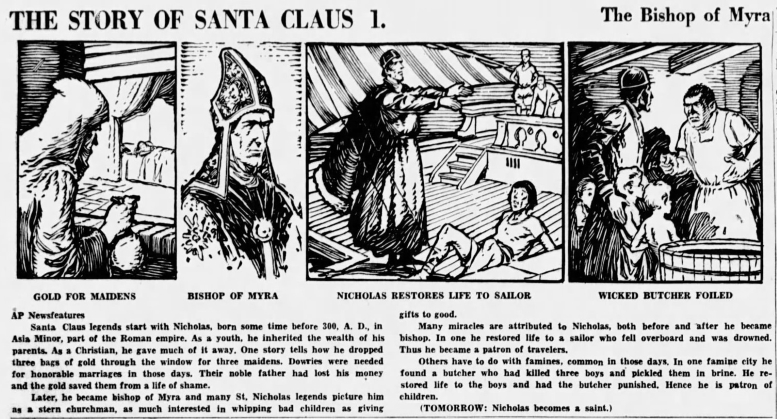
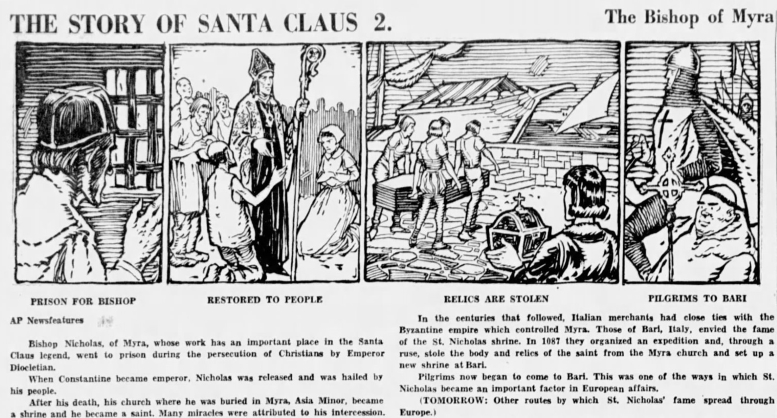
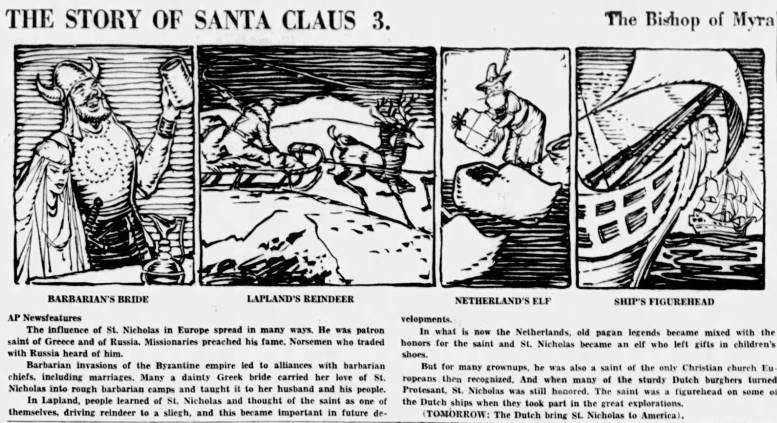
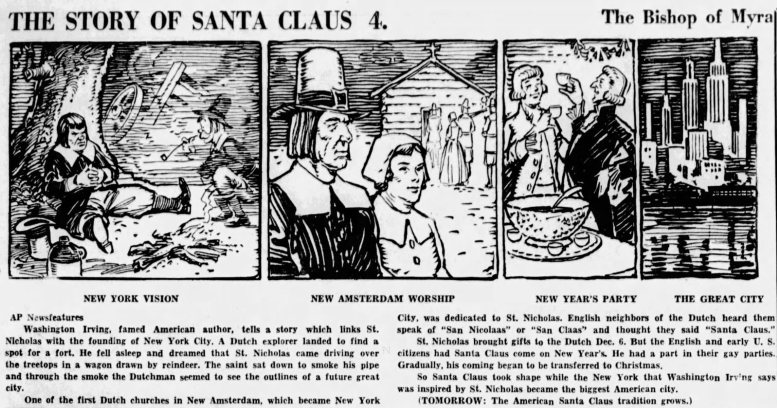
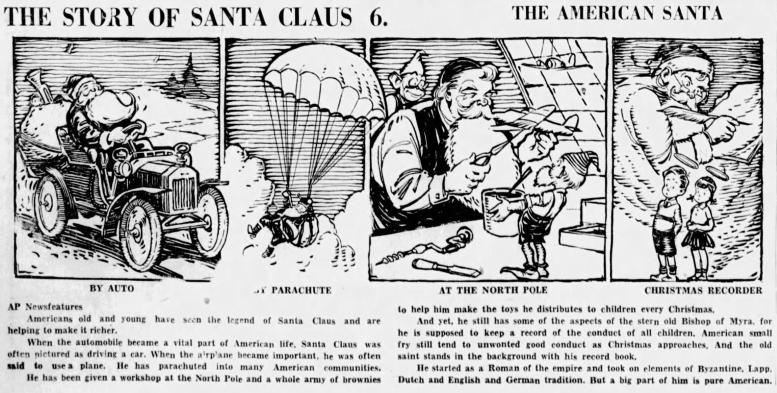
In December 1951 Associated Press Newsfeatures writer Sherry Bowen and art director Ed H. Gunder presented The Story of Santa Claus in six daily installments for newspapers.
The mini-series naturally mentions Thomas Nast.


Comments 3
Comments are closed.