CSotD: Conversions and Comfortings
Skip to comments

I had intended to run a collection of Reiner/Trump cartoons to show the depth of rejection Trump’s insane post had sparked, but Campbell sums it up. There’s not much more to be said, and the people who are shocked are shocked and the people who cannot be shocked are not.

I liked Bramhall’s take, but its simplicity is its problem: A decent person is rightfully outraged at the notion of dancing on a grave, but a person who favors Trump’s approach would, instead, see it as a declaration of triumph.
Sometimes a political cartoon is intended to convert, and other times, it’s intended to comfort. There were a lot of cartoons about turning it up to 11, and several that showed Reiner, with or without his wife, up in the clouds with angels, though they were Jewish and all that Pearly Gates stuff would not be in their expectations.
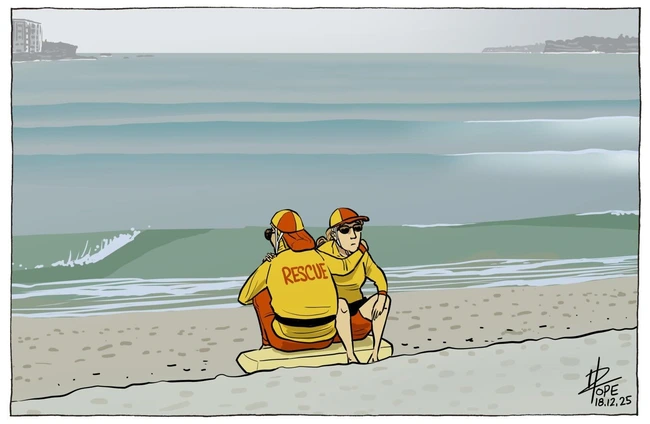
That’s not to say that cartoons of comfort have no value. Sometimes there’s nothing to say, and, in cartooning as well as in person, the best you can do is “I’m so sorry.”
Dave Pope offers this commentary on the Bondi Beach killings and, while it seems aimed at the lifeguards (who did great work in the crisis), it touches everyone who feels helpless, there and around the world.
Special credit, too, for the lack of emotion. Sometimes emptiness is more eloquent than tears.
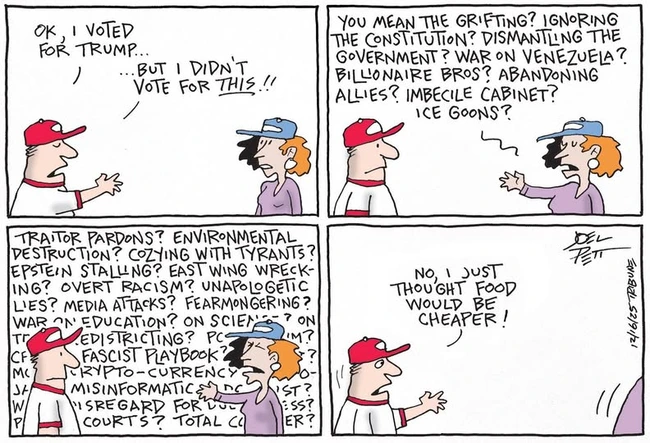
Pett’s cartoon falls into the category of comfort despite how it appears to be an attempt to convert.
It would be lovely if such conversations took place, but they don’t, particularly not in a siloed world in which people can shut themselves up into the comfort of broadcasters and podcasters who will never challenge their assumptions.
The list she offers is a case of reassuring people that they aren’t crazy, that what they’ve seen is really happening. But it won’t convert the True Believers, who will shut down rather than processing it.
Juxtaposition of the Day
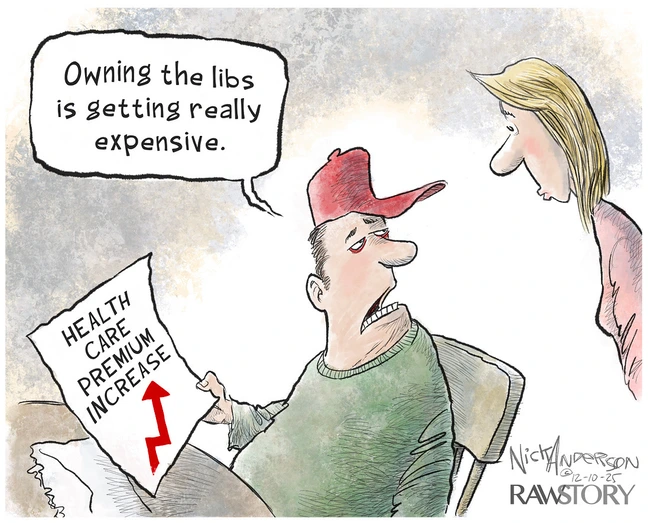
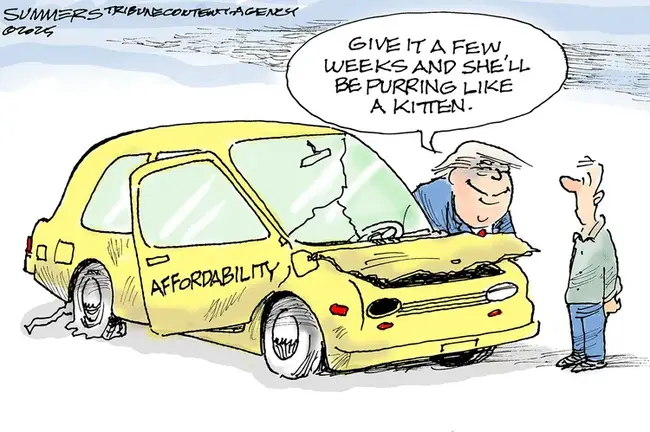
Two different topics, two different audiences. Anderson is correct that a lot of people are about to get some very bad news about their health insurance, but, then again, not everyone. I’ve sat in the meetings where new premiums were discussed, and at least in those cases, they wouldn’t go into effect until current contracts ended.
The people who get insurance at work probably won’t see huge boosts until later, and others will find ways to blame Joe Biden or Obama or somebody else.
This is a comfort cartoon.
By contrast, Summers uses a familiar symbol of dishonest dealing, the used car dealer who unloads lemons on unsuspecting customers. He puts the “affordability” label on that banged-up car and thus cites what everyone knows, which is that the cost of living is not coming down.
The most obvious difference is that health care costs are out there somewhere, still somewhat theoretical, while cost of living is immediate and unavoidable.
There’s also a secondary, pragmatic factor, in that editors who regularly use Anderson’s work have gathered a different audience than those who regularly use Summers’ work. Summers may reach more people who need conversion, though that’s no guarantee it will happen.
But approaching them makes it at least possible, while, going back to Pett’s piece, inundating them with a flood of reasons to convert is not as effective as saying to them, “He’s been lying to you, and you know it.”
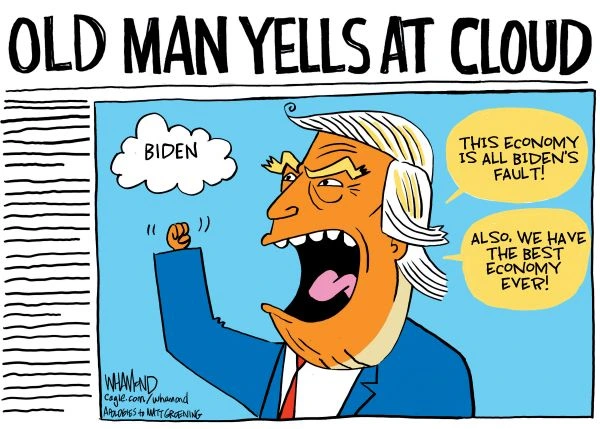
There’s a lot to be said for sheer mockery, too. It is a commonplace that bullies can’t tolerate being laughed at, and flying that Baby Trump balloon at demonstrations is more effective than any speeches.
One of the lessons of the No Kings rallies has been that a dog in a silly costume gets more attention than a long, rational sign nobody has time to read as they pass by.
Specifically, Whamond trades on an established concept, of batty old Abe Simpson shaking his fist and yelling at clouds, and transfers it to last night’s speech, though not so closely that the reader has to have seen the speech to get the point.
The point being, as it is in Summers’ piece, that Trump’s explanations and excuses make no sense and should not be trusted, not based on a reading of John Locke or Adam Smith or on an understanding of how tariffs failed in the 19th Century, but based on the simple fact that we can’t go grocery shopping the last week of the month because we’re broke until payday.
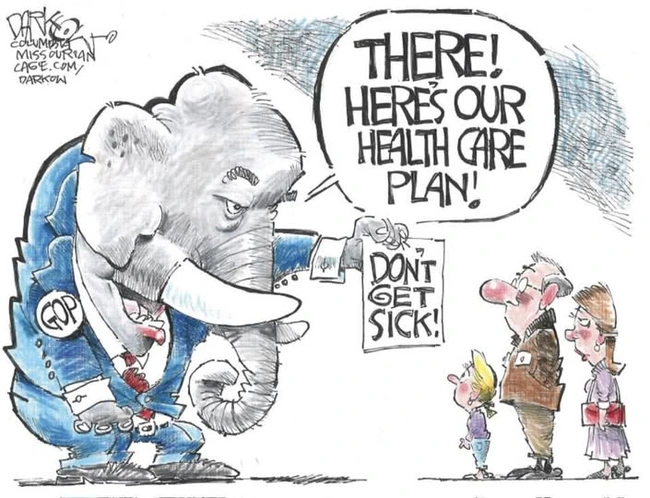
Darkow cuts to the chase on health care, and I say that as someone who went without coverage for several years.
I was young and healthy and when I looked into “catastrophic coverage” policies, even those were well beyond what I could afford. Fortunately, I could assume that, if anything happened to me, my ex would take care of the kids, but that was awfully thin gruel for me and won’t work for people without a second parent to rely upon.
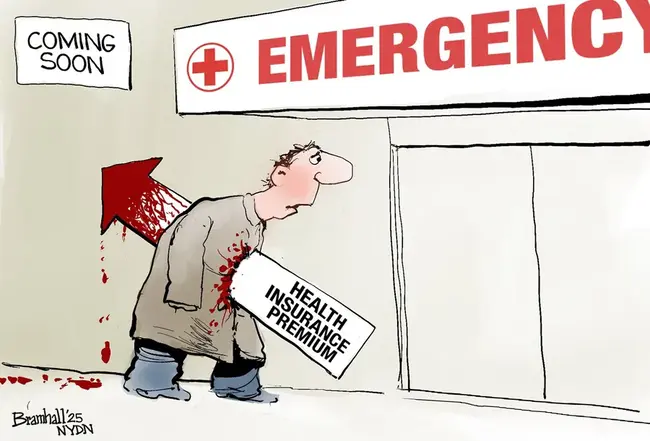
The problem is that people don’t know how health insurance works and the Republicans seem determined to keep it that way, not in a vague partisan manner, but specifically by spreading deliberate, bare-faced lies about undocumented people getting the same coverage as citizens.
It’s as ridiculous at the racist accusation that “illegal immigrants” have caused the housing shortage, when houses are near half a million dollars and you can’t get a mortgage without a valid Social Security number. It’s beyond ridiculous — it’s absolutely gob-smackingly stupid — to believe that motel maids and lawn care workers are cashing out houses, but if you hate enough, you’ll believe anything.
People should have learned how insurance works in high school social studies. They didn’t. That ship has sailed. And they won’t listen now because they’re convinced the people explaining it are the enemy.
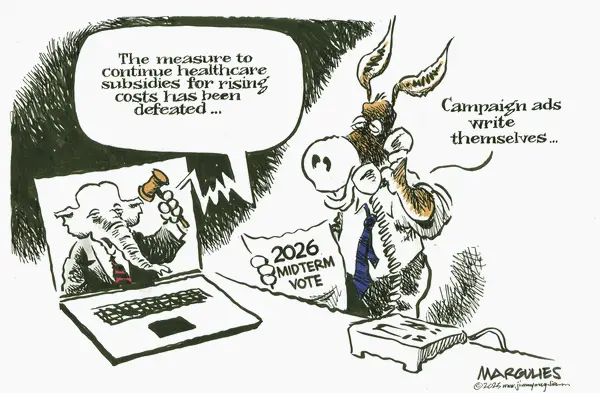
Ads never write themselves. But ending the shutdown let the GOP hang themselves, and considering the results of recent special elections, it’s possible to look towards the midterms hopefully and come up with campaigning that will work.
There has never been a more important time to comfort the afflicted and to afflict the comfortable.
Mike Peterson has posted his "Comic Strip of the Day" column every day since 2010. His opinions are his own, but we welcome comments either agreeing or in opposition.

Comments 19
Comments are closed.