CSotD: Reporter’s Notebook
Skip to comments
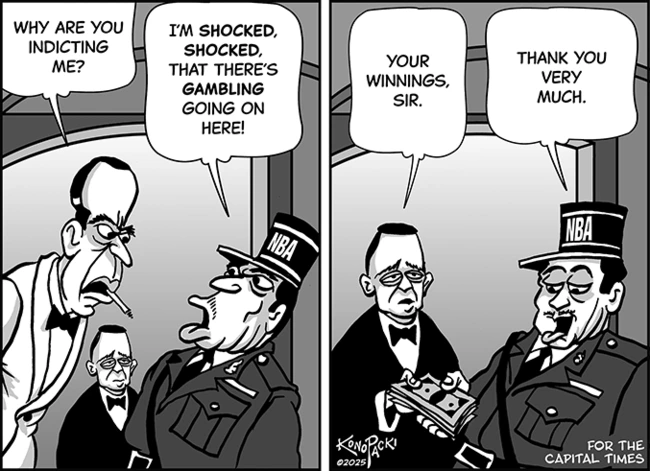
Bravo to Konopacki for making intelligent use of a moment in Casablanca that has become an insipid cliché in other hands. Saying “I’m shocked! Shocked!” merely makes the point that someone is pretending not to have known something they certainly did, which, most times, is obvious. (Yawn)
But Konopacki uses it in perfect context: In the film, Louis Renault is told by the nazi major to find an excuse to close the cabaret, and declares that he’s shocked to find gambling going on. Then he’s given his winnings. Obviously, it’s hypocritical, but Louis is a hypocrite, a major factor in the movie.
Konopacki accuses the NBA of taking a similar stance against gambling, expressing shock at the scandal unfolding, but pocketing the profits from its extensive partnerships with online gambling sites. It couldn’t be a more appropriate use of the moment.
It’s not enough to be clever. Konopacki applies a familiar cinema moment to a current crisis in a way that is apt, demonstrating the difference between just being clever and really being smart.
Juxtaposition of the Day
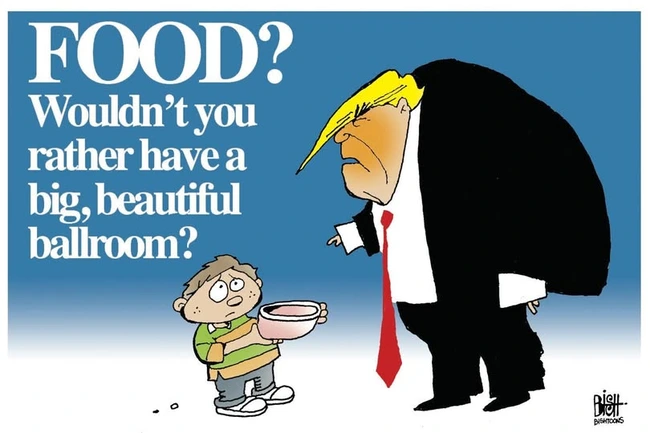

I’m pairing these in part to avoid picking on a particular cartoonist for a widespread error in reportage.
The ballroom is not being paid for with tax funds. There’s a strong argument that, if it has to be built, it should be publicly financed, but that’s a different argument. There’s also validity in suggesting that the “contributions” being used amount to bribes or protection money.
And I’ll allow that de Adder’s take makes the point that it is tasteless to flaunt wealth in a time when others are in crisis, a point also made in regard to the wretched excess of Trump’s Great Gatsby party.
But political cartoonists are journalists, and it isn’t logical to imply a financial connection between the budget privations and the ballroom. It’s not an either/or proposition. Nobody would write an editorial suggesting that, if the ballroom weren’t being built, Congress could use that money to feed the poor.
Nobody should draw one, either.
Juxtaposition of His Own Work
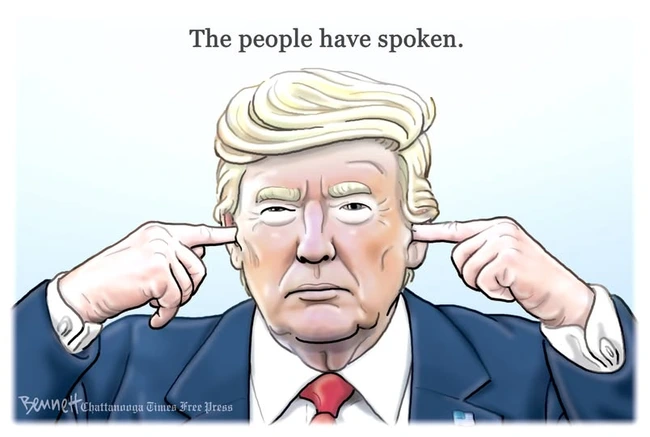
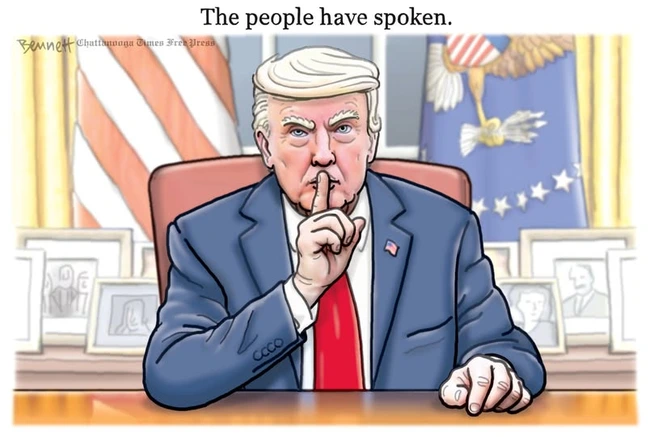
Bennett apparently rethought this piece. The “hush” version is the one currently on-line while the fingers-in-ears one had apparently escaped earlier. Generally, I feel that once something is out there, it’s gone; I’ll fix misspellings and occasionally change a word to clarify the point, but I don’t rewrite something because I wish I’d said something else.
However, these strike me as two different takes, though the uniform message is that he doesn’t want to hear it. IMHO, they make such a nice pairing that they both deserve to be permanent. No harm, no foul.
Juxtaposition of the Day #3
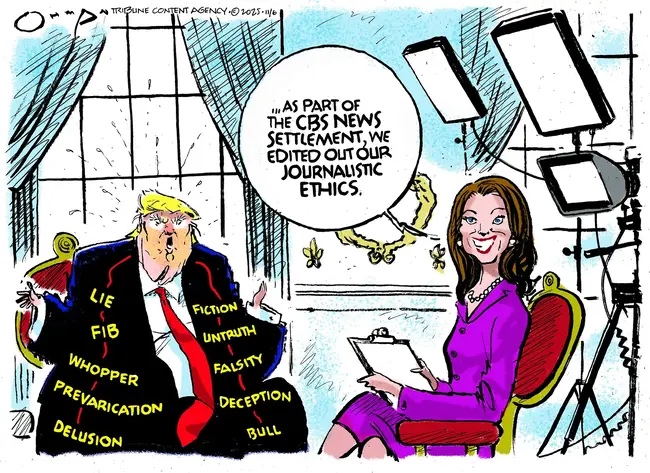
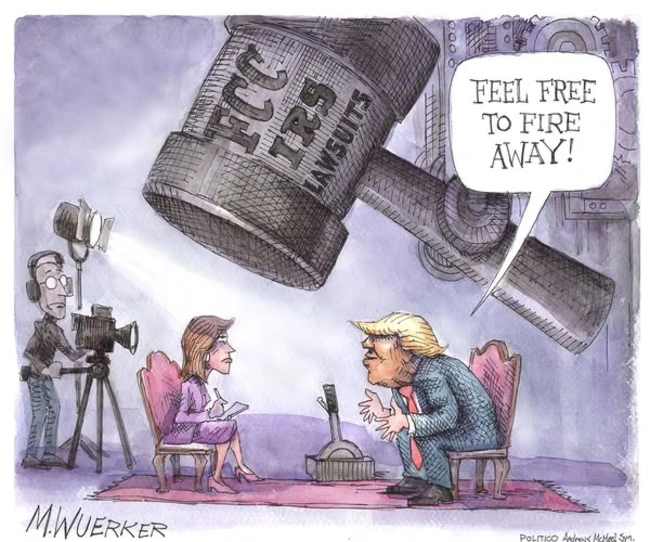
CBS and Nora O’Donnell have taken flak for not pushing back on Trump’s obvious lies in that 60 Minutes interview.
However, there is no journalistic ethical requirement to turn an interview into an interrogation, and, in fact, one perfectly valid technique is to let the subject prattle on and hang himself. In print journalism, if you really hate the subject of the interview, you can leave in all the “ums” and the “you knows” that normally get edited out, but in either medium, you can allow their nonsensical bullsh*t to speak for itself.
And Wuerker has a point: A confrontation would simply spark another bogus lawsuit and O’Donnell’s brand-new trumpy boss would most certainly fold. Let the fact-checkers sort it out.
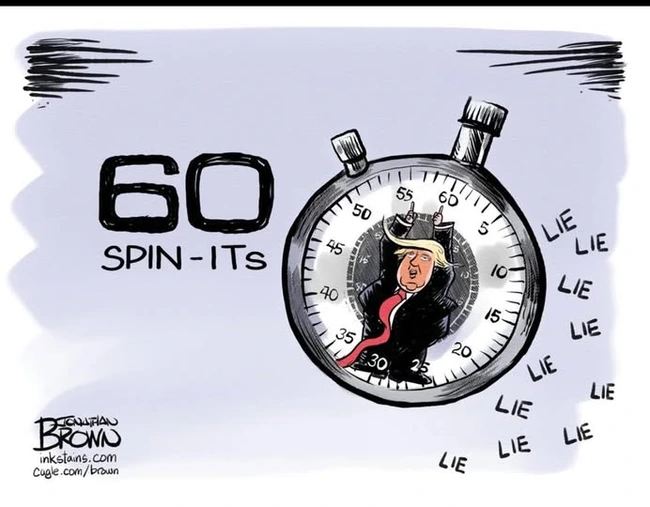
Brown nailed it and, you’ll note, with a pun that was both clever and apt.
Le monde entier regarde
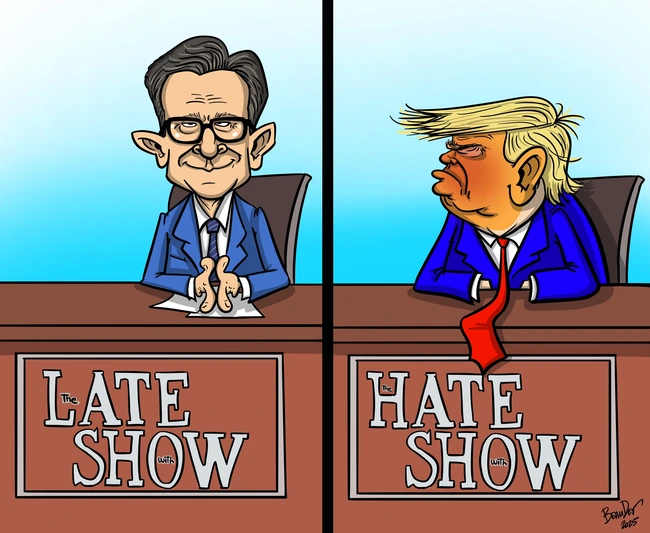
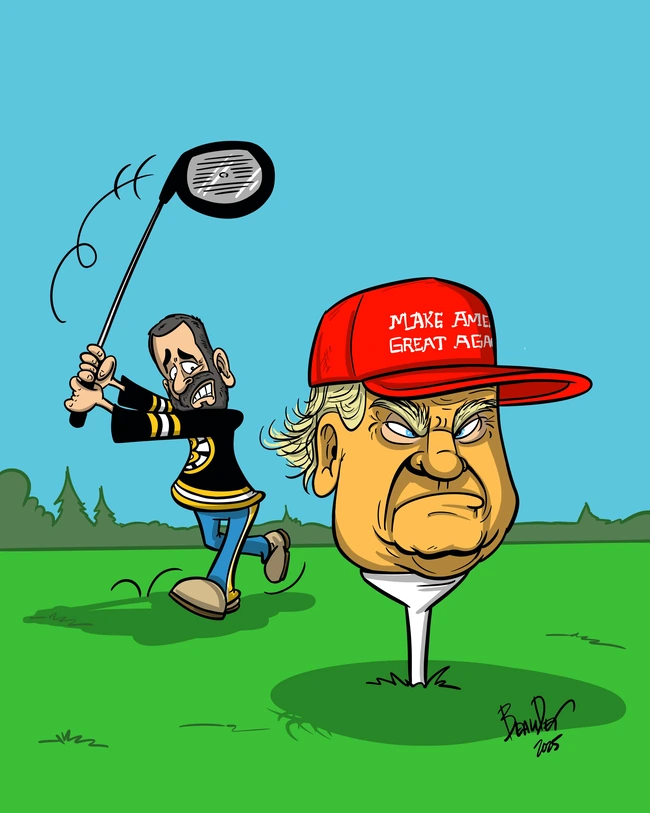
When we reported on the Canadian Townsie Awards, we didn’t have access to Beaudet’s winners for best francophone cartooning, so I emailed him and he sent them. I was surprised to find Dear Leader in both, but that’s a sign that the whole world really is watching, however they may be reacting.
I had met Beaudet at last year’s AAEC convention in Montreal, but, while everyone in Montreal is bilingual, you don’t have to go far from town to need French. He’s un bon gar, but he’s from downriver and his English is as good as my French, so our conversation was pretty limited.
However, my ability to read the language is still fairly strong, so I was able to enjoy this:
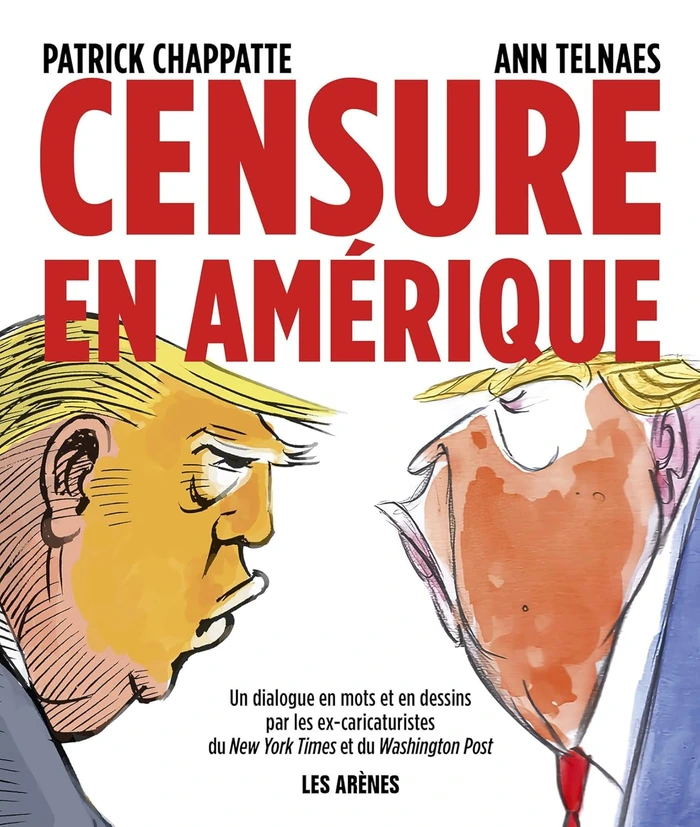
“Censorship in America: A dialogue in words and pictures by the ex-cartoonists of the New York Times and Washington Post” is a conversation between Patrick Chappatte and Ann Telnaes published by a French publishing house in a large (9″x11″, 224 pages), gorgeous book that shows how much more seriously cartooning is regarded there than it is here.
It’s also tout en francais, but (A) I used to pop over the border for a copy of La Presse once a week, so I can (slowly) read French and (B) it is at least three-quarters made up of full-page and double-truck color cartoons, and while Chappatte’s have French dialogue, it’s sparse and easily understood.
Their conversation is decidedly worthwhile. Both cartoonists — who are on this new list of most-influential — have global standing in the fight for free expression. And well after they were established in that effort, Telnaes quit over being censored, and Chappatte lost his NYTimes gig over someone else’s cartoon.
They’ve each got a lot to say about censorship.
Which makes the French easier to parse. When Chappatte quoted Steven Colbert as calling the CBS payment to Trump “un gros pot-du-vin bien gras,” it wasn’t an idiom I recognized, but I knew the quote, which was “a big fat bribe.” Similarly, I didn’t need to know the last word when political cartoonists were referred to as “canari dans la mine de charbon.”
Nor was it hard to figure out their references to self-censorship and obediance in advance, which are common and toxic results of governmental and management pressure.
They’re both so articulate — the conversations happened in English, which Chappatte then translated — that I’d be reading along with familiar ideas when something new would pop up and knock me over, such as when Telnaes observed that, in his first administration, the thin-skinned Trump was so much a creature of television that he didn’t really notice political cartoons. .
And then there were all those beautiful cartoons.
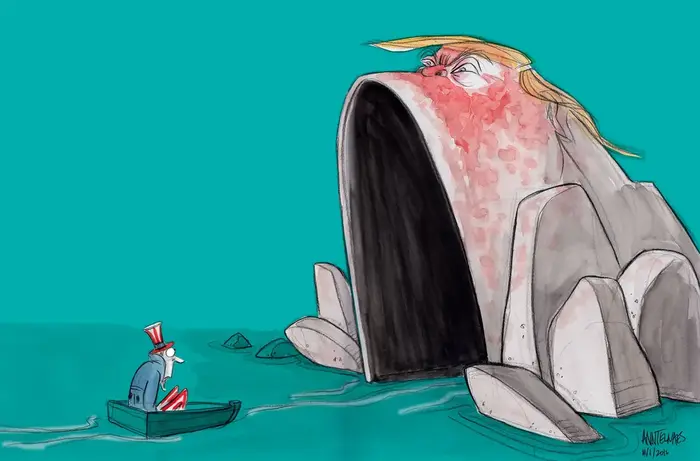
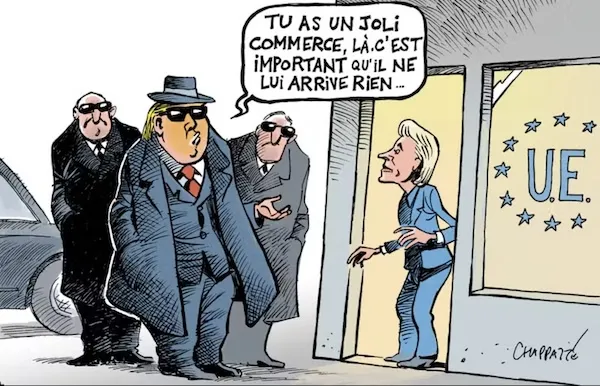
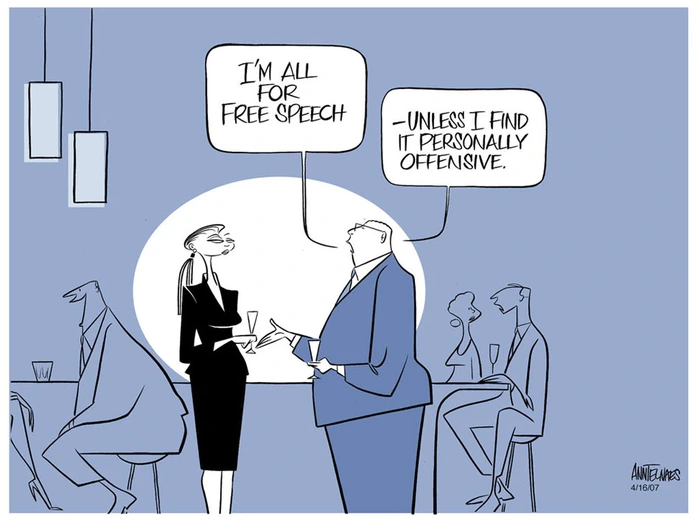
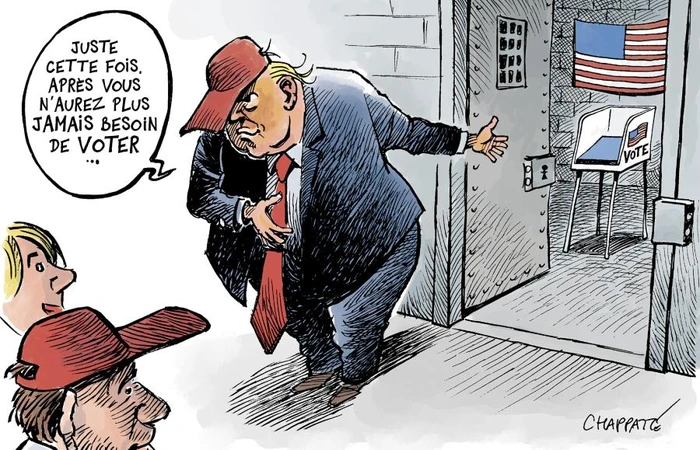
The trick is finding a copy. I emailed the publisher but heard nothing back, so that, though it seems quelque peu bizarre to pay Jeff Bezos for a book about what an ass he is, that seems to be the source for now.
The American site offers a Kindle version for $18.99, which would be an abomination given the splendor of the graphics-heavy print edition, but if you go to Amazon’s site in France, you can get a print copy sent here for about $51. C’est une bonne affaire!
I’ll close with a French song I used to play, which my brother brought home from his sophomore year abroad. Actually, he brought back two, one of which began
Y avait un homme qui s’appelait Davy
Il était né dans le Tennessee
But this one was a hit back then and is still worth the time I spent learning it phonetically:
Mike Peterson has posted his "Comic Strip of the Day" column every day since 2010. His opinions are his own, but we welcome comments either agreeing or in opposition.


Comments 32
Comments are closed.